
Unit 5 Test (Lessons 37–44): Exponents and Logarithms Solutions
| # | Answer | Lesson Origin |
| 1A) | 37 | |
| 1B) |
The function will shift left two spaces and up one space. The new equation would be |
37 |
| 1C) | 39 | |
| 1D) | 40, 41 | |
| 2) | C | 43 |
| 3) | A | 37 |
| 4) | D | 41 |
| 5) | A | 42 |
| 6) | C | 43 |
| 7) | B | 37 |
| 8) | B | 37, 44 |
| 9) | A | 42 |
| 10) | C | 38 |
| 11) | C | 41 |
| 12) | D | 43 |
| 13) | D | 44 |
| 14) | C | 40 |
| 15) | C | 44 |
| 16) | B | 40 |
| 17) | D | 37 |
| 18) | C | 39 |
| 19) | A | 38 |
| 20) | D | 39 |
| 21) | D | 39, 40 |
| 22) | D | 43 |
| 23) | B | 44 |
| 24) | A | 39 |
| 25) | D | 43 |
Answer all parts of the open response problem.
- Complete the problems about exponents and logarithms.
- Determine the exponential function that contains the points shown in the table.
| x | y |
| –1 | 36 |
| 0 | 12 |
| 1 | 4 |
| 2 | |
| 3 |
- Using your function from part A, describe what would happen to the function if and . Then write the new function, g(x).
The function will shift left two spaces and up one space. The new equation would be .
- Rewrite the equation using the properties of logarithms.
- If and , what is the expression for ? Show your work.
Multiple Choice
C
- What is the inverse of the equation ?
Note
- This option adds the numbers in the given equation together.
- The sign of the number in the exponent is incorrect.
- The sign of the constant is incorrect.
A
- Graph:
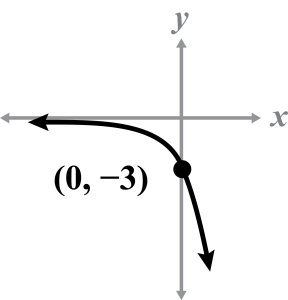
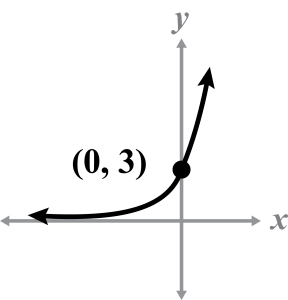
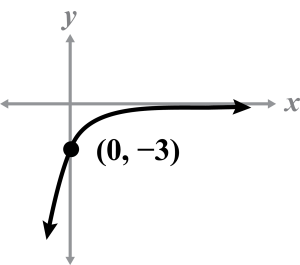
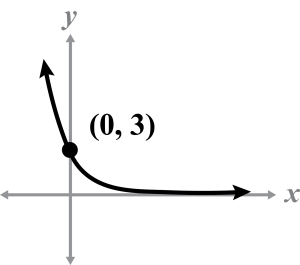
Note
B, D) When , the graph is below the x-axis, and these represent .
C, D) The direction of these graphs occurs when the exponent equals –x.
D
- Using common logarithms, determine the approximate value for:
-
0.6091
-
1.6416
-
2.0305
-
6.7685
Note
- This option multiples both sides by 0.3.
- This option has the log values switched in the numerator and denominator.
- This option does not use the coefficient of x when solving.
A
- If then ln V is equivalent to:
Note
- This option simplifies out the 3s, though one is a power, and the other is an argument.
C, D) These options do not use the product and quotient rule correctly to rewrite .
C
- Determine the domain for the equation:
-
Asymptote:
Note
- This option is the range of the logarithmic equation.
- This graph cannot include one in the domain.
- This option is the domain if the equation is reflected over the y-axis.
B
- Which graph transforms down two units and right one unit?
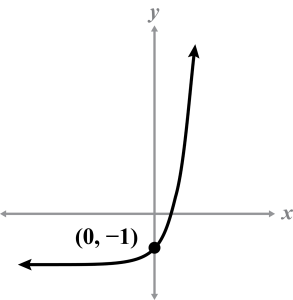
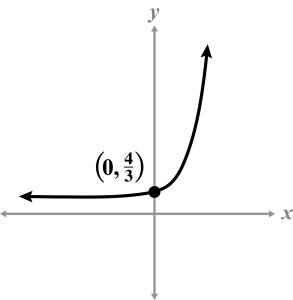
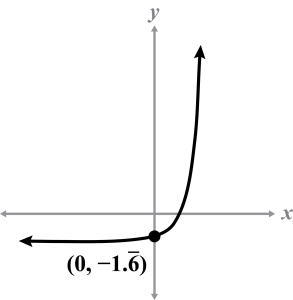
Note
- This graph represents the given equation.
- This graph represents .
- This graph represents .
B
- To determine how quickly algae grows in a pond, scientists approximate the square footage covered with algae. On day zero, algae covers 0.25 square feet of the pond. By the third day, 31.25 square feet of the pond is covered in algae. Write an exponential equation that models the spread of algae.
Note
- This option is the linear equation between the given points.
- This equation uses the point rather than
- This equation switches the values of a and b.
A
- Solve:
Note
- The solution –6 is extraneous because it makes the arguments negative.
- This option is the value in the factored answer before solving.
- These options are the values in the factored terms before solving.
C
- Solve:
-
0
-
2
-
7.5
-
no solution
Note
- This option is the answer if the constants are combined incorrectly.
- This option is the answer if terms are not distributed correctly.
- This option is the solution if the problem is not rewritten with a common base.
C
- If and , approximate the value of .
-
0.3528
-
0.4852
-
1.681
-
2.209
Note
- This option is
- This option is
- This option is
D
- Which pair of functions matches the transformation from f(x) to g(x) on the coordinate plane?
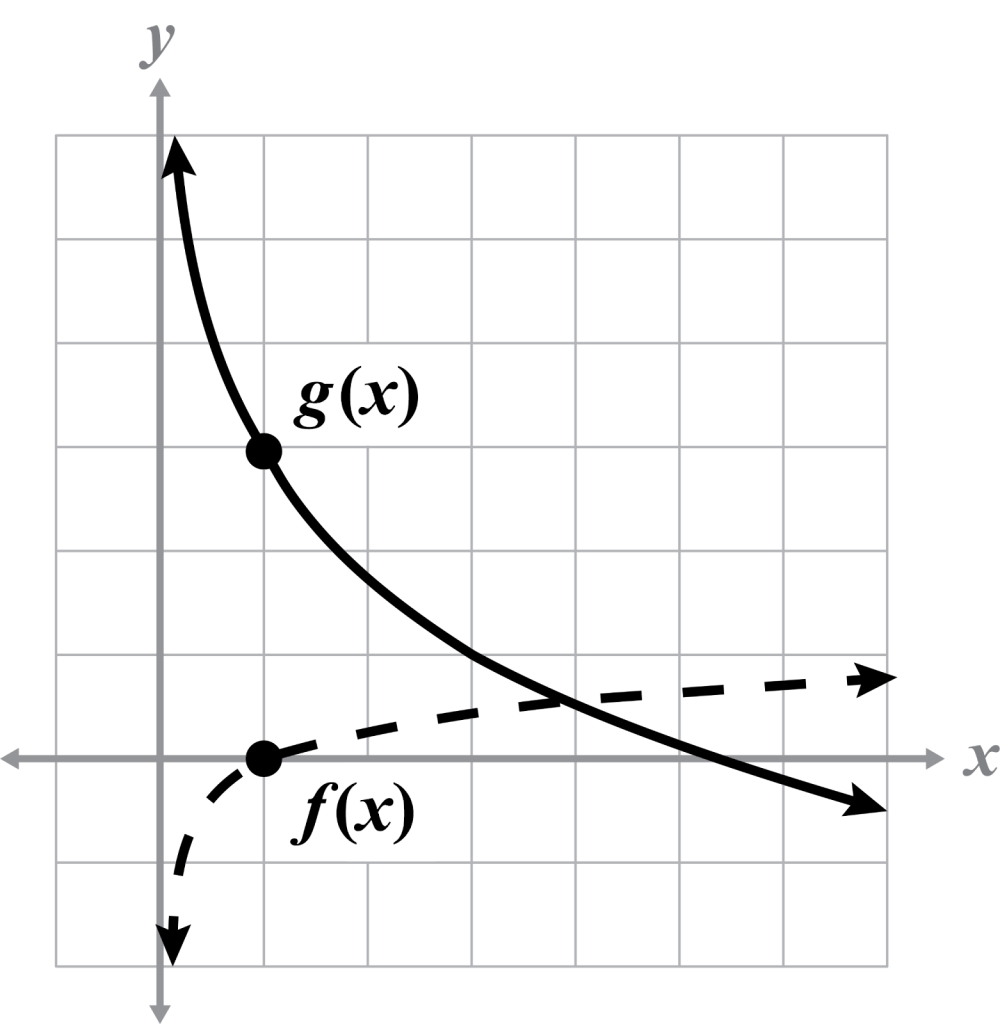
Note
- This pair of equations has f(x) and g(x) reversed.
- The value of a is incorrect for g(x) because this is a compression.
- The value of a is incorrect because this does not reflect g(x).
D
- A family invested $4500 in a high-yield savings account at a rate of 4.45% compounded quarterly. If the money will be used to help pay for college in fifteen years, how much money will be in the account? Round to the nearest whole dollar.
-
$2300
-
$8646
-
$8708
-
$8740
Note
- This option is the total if the money depreciated by the given rate.
- This option is the total compounded yearly,
- This option is the total compounded semi-annually,
C
- Write the expression as a single logarithm.
Note
- This option does not apply the power rule correctly.
- This option treats one-half as an argument instead of a power.
- This option has the incorrect power in the denominator.
C
- A new car depreciates at a rate of 12% per year. If you purchased your car for $15000, when will it be worth approximately $5000?
-
less than one year
-
about 3 years
-
about 8.5 years
-
about 9.5 years
Note
- This option is the answer if the argument of numerator and denominator are switched.
- This option is the answer if the principal is divided by the final value.
- This option is the answer if three is used instead of one-third for the argument in the numerator.
B
- Solve for the value of x.
-
1
-
no solution
Note
- This option is the solution if 2 and 3 are multiplied instead of raising 2 to the 3rd power.
- This option is the solution if one is added to both sides instead of subtracted.
- This option is the solution if both sides are not divided by –4 to start.
D
- Describe the transformation from f(x) to g(x).
-
From f(x), g(x) is stretched, then translated left three units, and up one unit.
-
From f(x), g(x) is stretched, then translated right three units, and up one unit.
-
From f(x), g(x) shifts from growth to decay, is stretched, then translated left eight units, and up one unit.
-
From f(x), g(x) shifts from growth to decay, is stretched, then translated right eight units, and up one unit.
Note
A, B) These options do not include the change in the value of b.
A, C) The value of h is positive, which moves the graph right.
C
- Evaluate:
Note
- This option is 9 divided by 27.
- This option is the reciprocal of the solution.
- This option is 27 divided by 9.
A
- Solve:




Note
B, D) These options represent solutions less than the value of x.
C, D) These options show a positive endpoint.
D
- Rewrite as a logarithmic equation.
Note
A, B, C) These options do not place the base and argument in the correct location for a logarithmic equation.
D
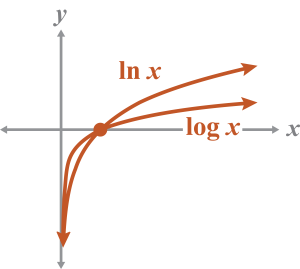
- Compare and Select the true statement.
-
The graphs cannot be compared because they do not have the same base.
-
The natural log and the common log are the same graph.
-
The common log is steeper than the natural log and both have an intercept at the point
-
The natural log is steeper than the common log and both have an intercept at the point
Use technology to compare:
D
- If , x is equal to:
-
2.5
-
10
-
25
-
32
Note
- This option is five divided by two.
- This option is two times five.
- This option is five-squared.
B
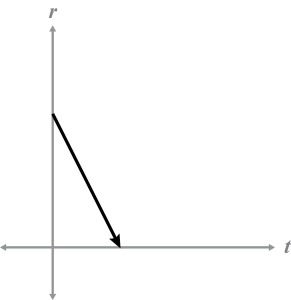
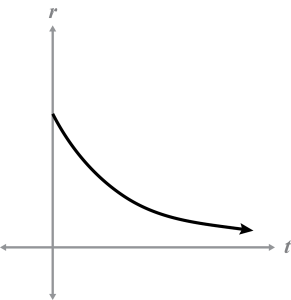
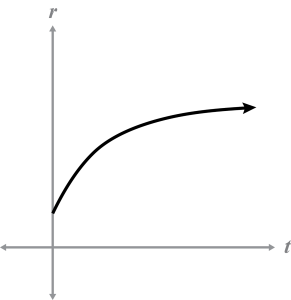
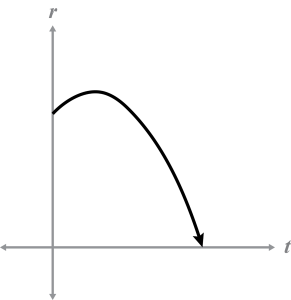
- Select the graph that best represents radioactive decay of an element, r, over time, t.
Note
- This option is a linear graph.
- This option is an exponential increase.
- This option is a quadratic graph.
A
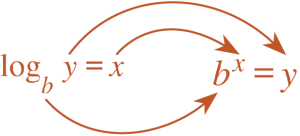
- If which of the following is true?
Note
B, C, D) These options do not correctly rewrite a logarithm as an exponential equation.
D
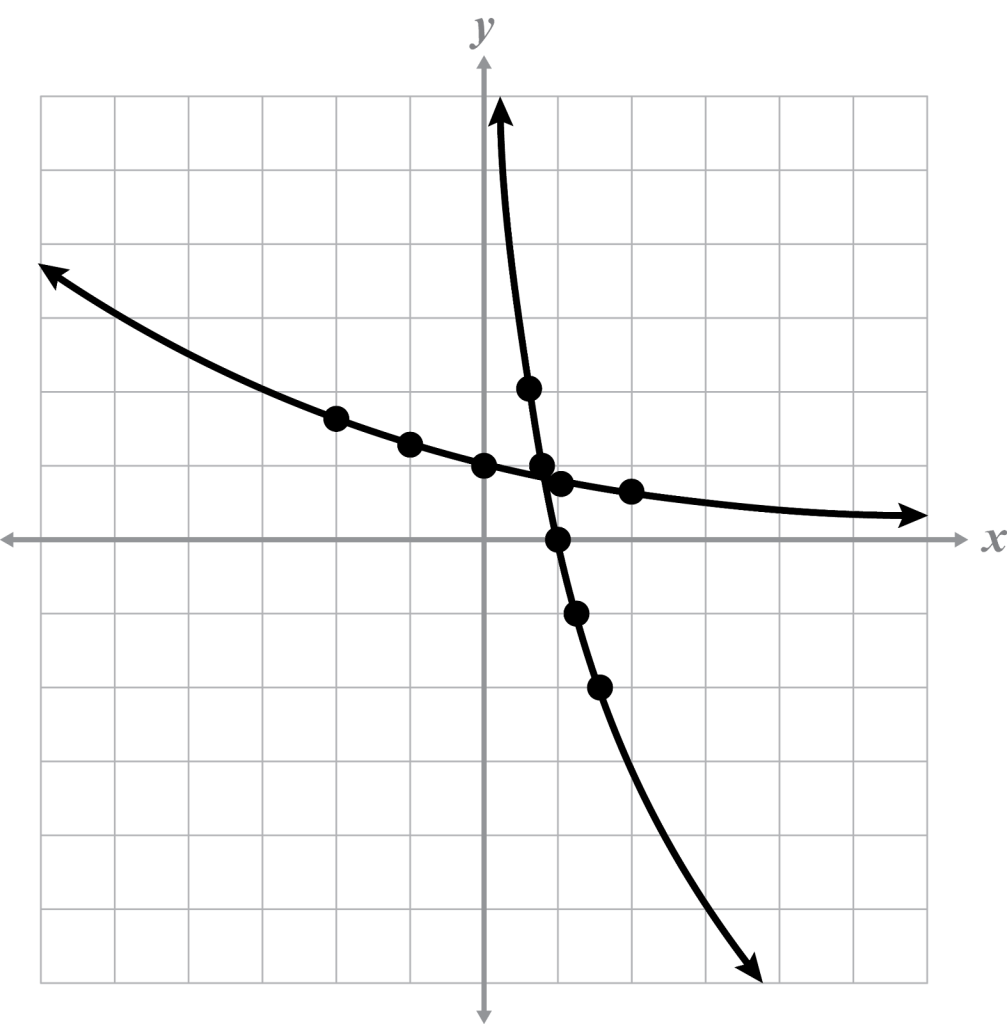
- Name the end behavior of the logarithmic function that has an intercept of
-
The function with an x‐intercept at has an asymptote at
Note
- This option is the end behavior if the function has an endpoint at .
- This option is the end behavior for the function with an intercept at .
- The x-values are not negative for the function with an intercept at .