
Unit 2 Test (Lessons 11-22): Radicals, Complex Numbers, and Families of Functions Solutions
| # | Answer | Lesson Origin |
| 1A) | |
18 |
| 1B) | 19 | |
| 1C) | 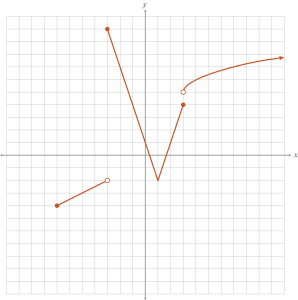 |
21, 17, 18 |
| 1D) | 17, 18 | |
| 2) | B | 11 |
| 3) | A | 15 |
| 4) | D | 22, 18, 17 |
| 5) | C | 13 |
| 6) | C | 16, 15, 13 |
| 7) | B | 20, 18 |
| 8) | D | 11 |
| 9) | C | 15 |
| 10) | A | 17, 18 |
| 11) | A | 12, 11 |
| 12) | B | 11, 12 |
| 13) | B | 14 |
| 14) | D | 15, 16 |
| 15) | D | 17 |
| 16) | A | 16, 12 |
| 17) | C | 19, 18 |
| 18) | A | 21 |
| 19) | B | 22, 18, 17 |
| 20) | D | 21 |
| 21) | C | 13, 11 |
| 22) | 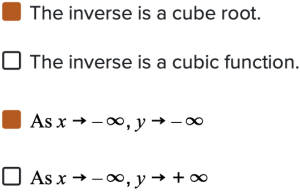 |
19, 18 |
| 23) | 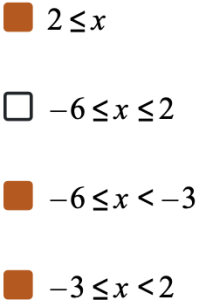 |
23 |
| 24) | 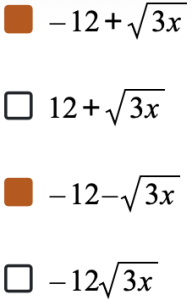 |
12 |
| 25) | 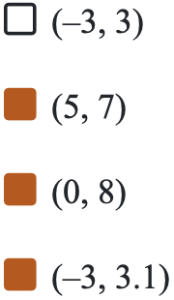 |
22 |
Answer all parts of the open response problem.
- Complete the piecewise function.
- Write the equation that transforms the absolute value parent function over the given interval.
Vertically stretch the function by a factor of three, shift the function right one and down two from the origin.
dilate: a = 3
shift right: h = 1
shift down: k = 2
- Determine the inverse of the function algebraically.
- Graph the piecewise function.
- Name the domain and range.
B
- Simplify:
Note
- The coefficient and the radicand have been switched.
- The radicand remainder is missing.
- This option divides 16 by 3 rather than taking the cube root.
A
- Simplify:
-
–1
-
–i
-
1
-
i
Note
B–D) Any of these choices could occur if your student does not know how to simplify i.
D
- Write the system of inequalities for the given graph.
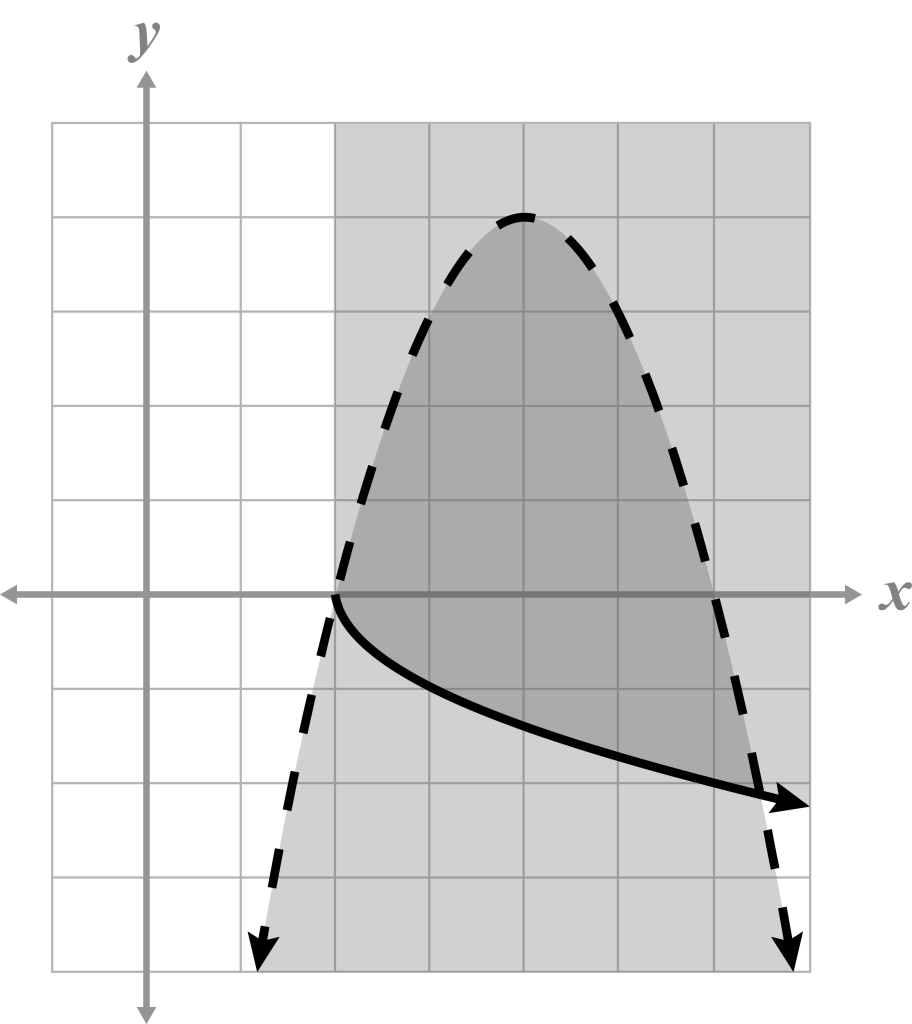
Note
A–B) The h and k values are written with the opposite inequality.
A, C) The inequality symbols are assigned to the incorrect inequality.
C
- Solve under the set of real numbers.
-
–1
-
–4
-
4
-
1
Note
A) This option is extraneous because it results in an imaginary number.
B, D) These options are the values if the quadratic trinomial is factored incorrectly.
C
- Solve under the set of complex numbers.
Note
- This solution ignores that the expression is –12 on the right side of the equation.
- This solution switches the placement of the coefficient and the radicand.
- This solution forgets to include the imaginary number as part of the solution.
B
- Select the domain and range that represents the inverse of the graph.
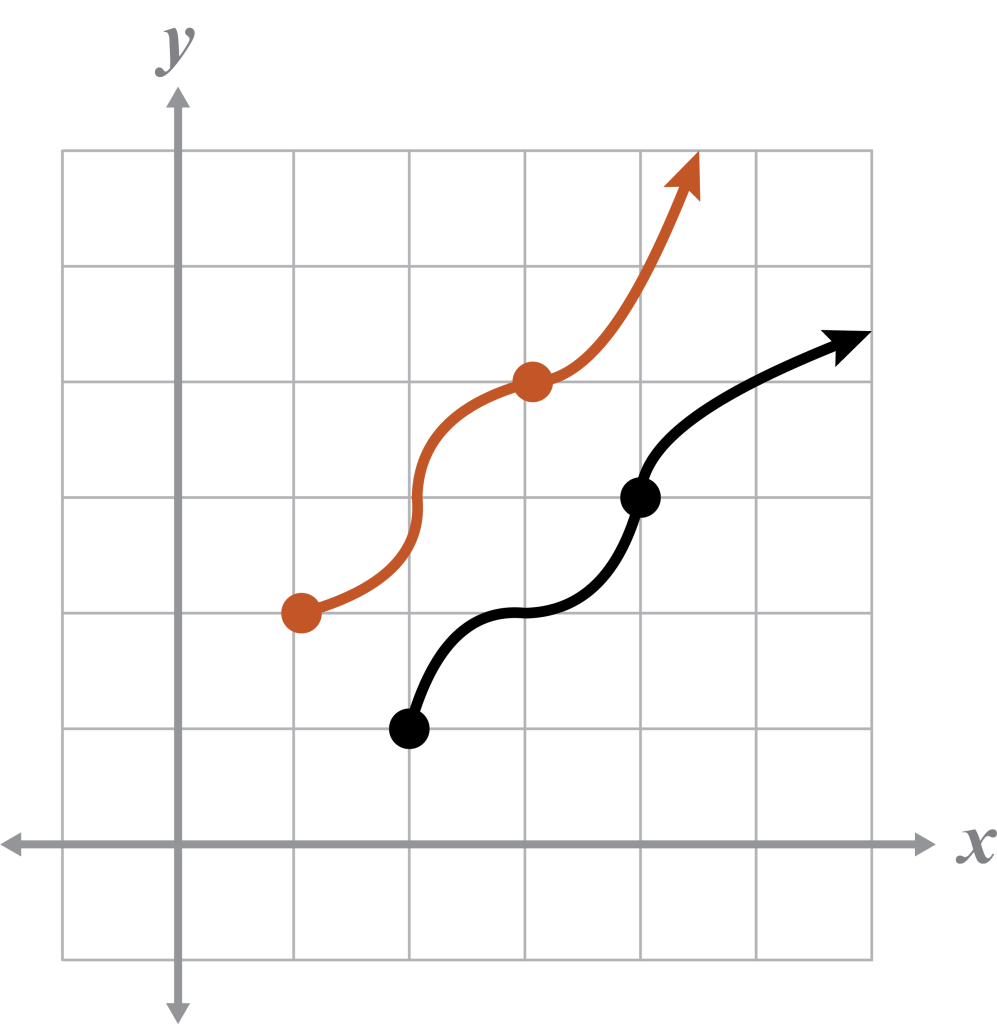
Note
- This option is the domain and range of the given graph.
- Because there is an initial point, the domain and range cannot be all real numbers
- The inverse is increasing, so the inequality symbols also need to increase.
D
- Simplify in radical form.
Note
- The coefficient and the radicand are switched.
- This answer occurs if you take the square root rather than the cube root.
- This option multiplies six by two rather than squaring it.
C
- Classify the expression:
-
complex
-
real imaginary
-
real complex
-
imaginary
This is an integer, therefore it is real. All real numbers are complex
Note
- An integer is also real.
- A number cannot be real and imaginary at the same time.
- The simplified answer does not contain the imaginary number i.
A
- Name the end behavior of the graph.
-
-
No work needed, both ends of the graph are pointing down. This means that the function is even.
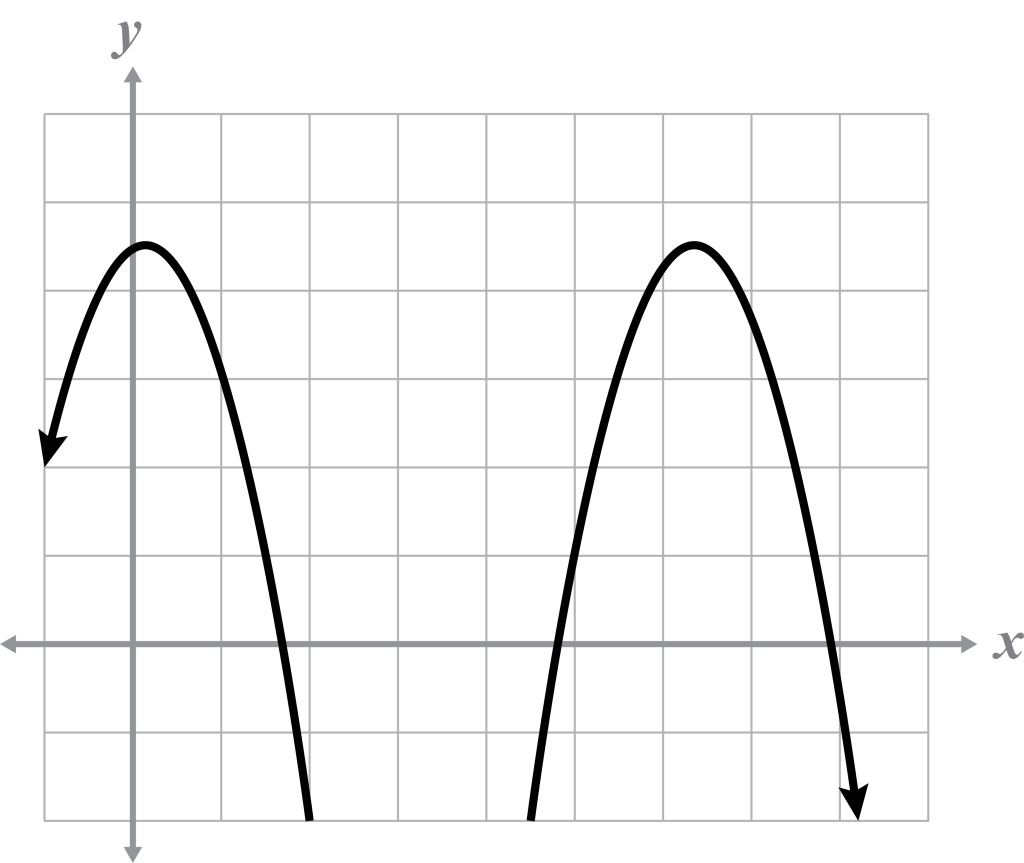
Note
B–D) The y–values are decreasing on the graph but increasing with this notation.
Use the image to complete problems 11–12.
A
- Determine the area of the rectangle.
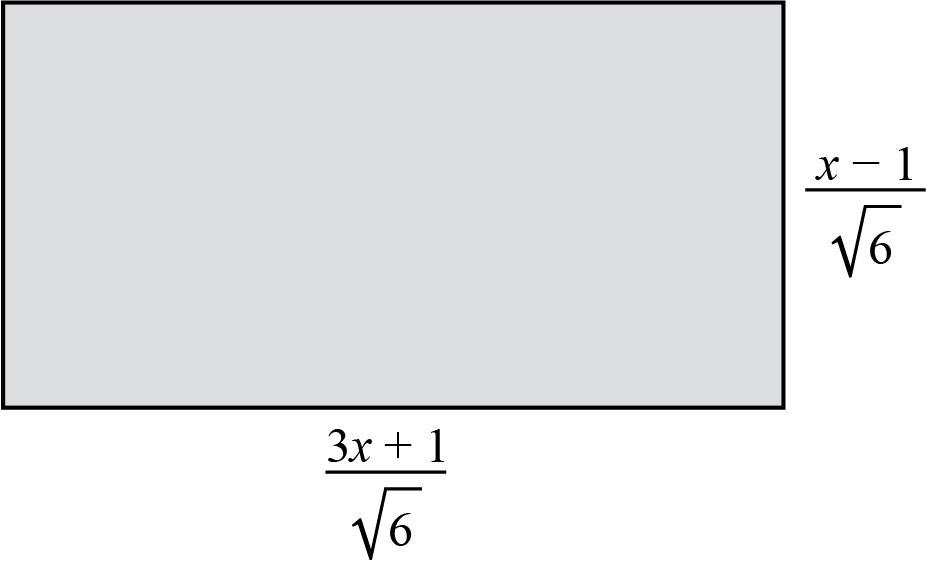
Note
- The square root of 36 was not taken in the denominator.
- The distributive property was not used in the numerator.
- This option incorrectly simplified the coefficient 3 with the denominator 6. A trinomial and a monomial cannot be simplified.
B
- Determine the perimeter of the rectangle.
-
units
-
-
-
Note
- The denominator was not included in the answer.
- 36 was in the denominator rather than 6.
- This option incorrectly simplifies 2 and the square root of 6.
B
- Solve under the set of real numbers.




Note
- This option is the restriction on the radical, but the solution is more restrictive.
- This option is the solution if the value 2 is not squared.
- The direction of the inequality shading is incorrect.
D
- Determine the expression that is equivalent to:
Note
- This option is equivalent to
- This option is equivalent to
- This option is equivalent to
D
- Determine the graph that contains the rational and absolute value parent graph on the same coordinate plane.
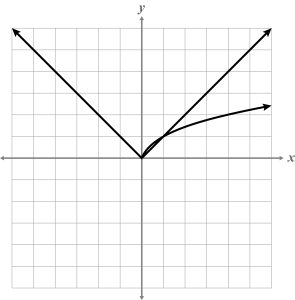
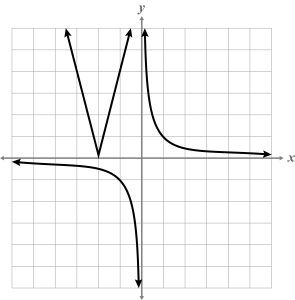
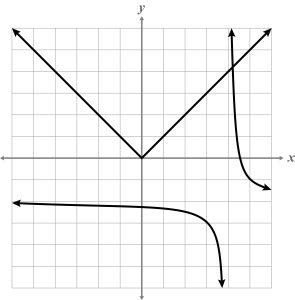
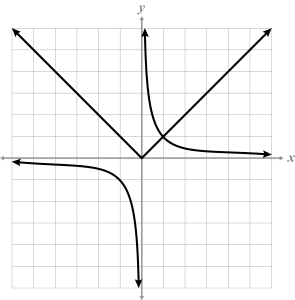
Note
- This option is a square root, or radical, parent graph with an absolute value parent graph.
- The absolute value graph is not a parent graph.
- The rational graph is not a parent graph.
The absolute value parent graph has a vertex at (0, 0).
The rational parent graph has a horizontal and vertical asymptote at the x- and y- axes.
A
- Simplify by rationalizing the denominator:
Note
- This option eliminates the term incorrectly.
- The denominator is not rationalized.
- This option incorrectly simplified the value of 12 in the denominator by multiplying under the radical, but the negative must be simplified out first.
C
- Determine the inverse of the given graph.
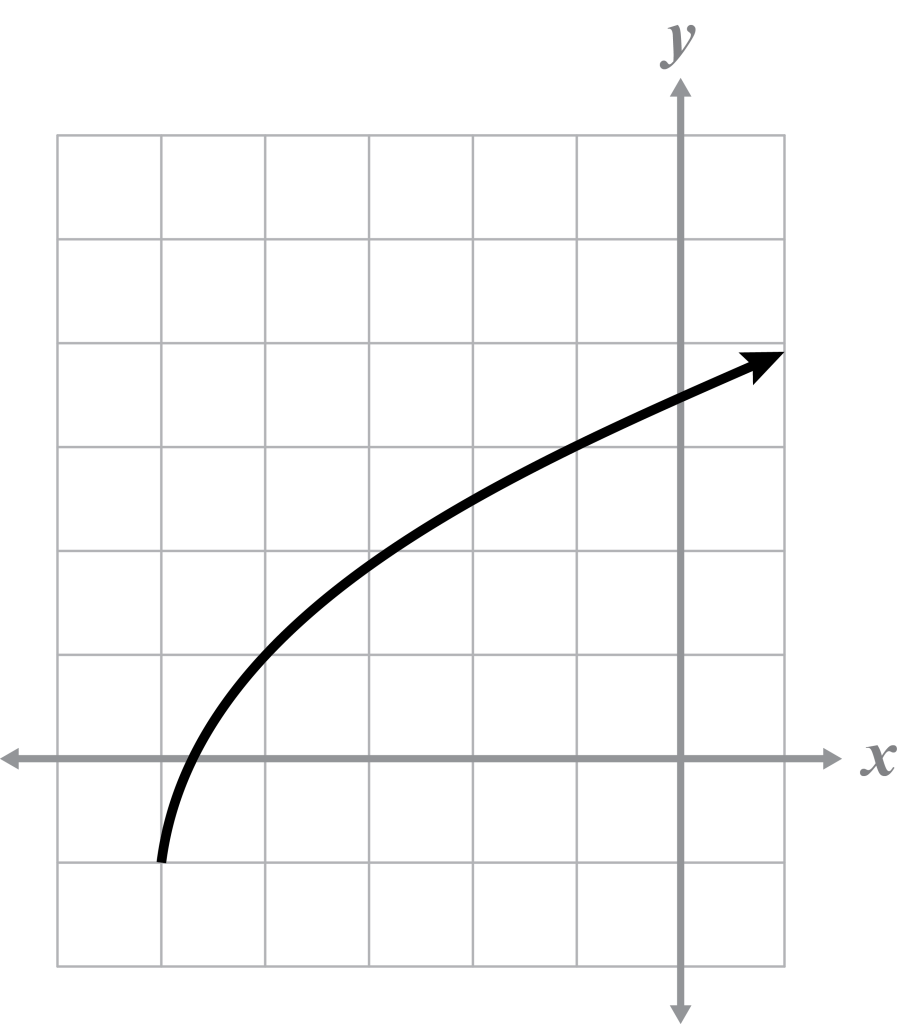
square root graph
Note
- This option is the given equation.
- This option switches the h and k values and takes the reciprocal of a.
- This option uses the k value for the restriction rather than the h value.
A
- A marble is released at the top of a track and stops when it gets to the collection area. The graph compares the time in seconds to the height above the ground for one marble’s run. Determine the rate of change for the sloped portion of the track.
-
Decreasing one foot per second
-
Increasing one foot per second
-
Decreasing 0.32 feet per second
-
Decreasing 3.09 feet per second
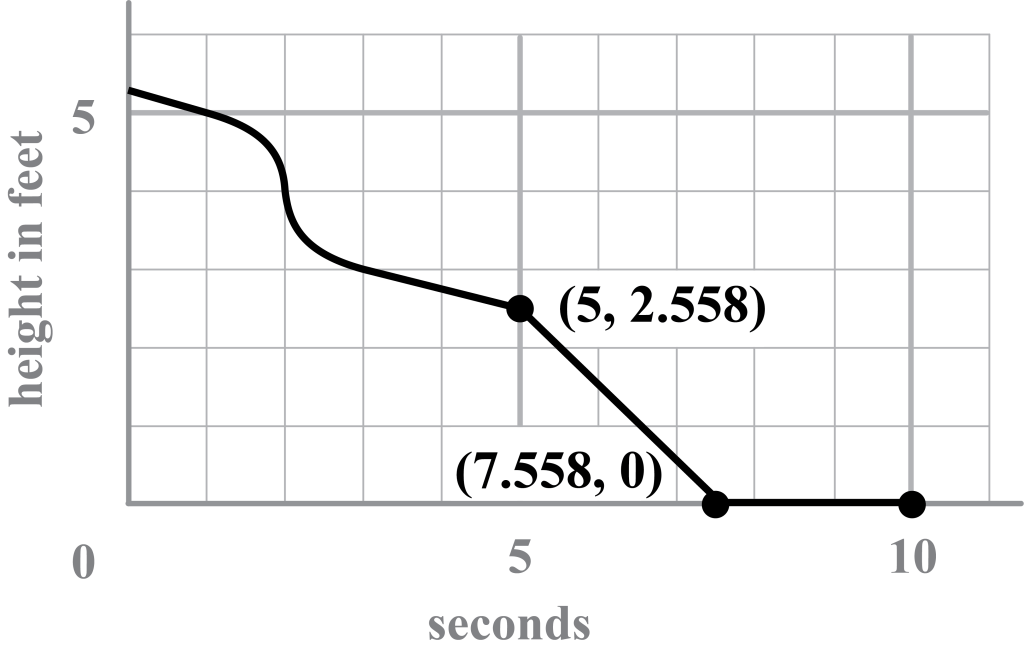
Note
- The rate of change cannot be positive if the slope is negative.
- This answer subtracts the x- and y-values and divides point 1 by point 2.
- This answer subtracts the x- and y-values and divides point 2 by point 1.
B
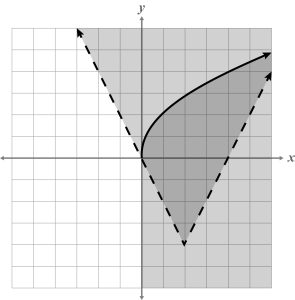
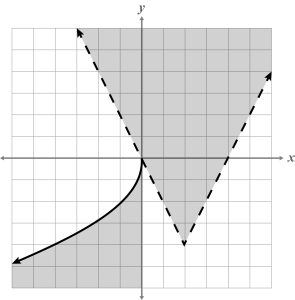
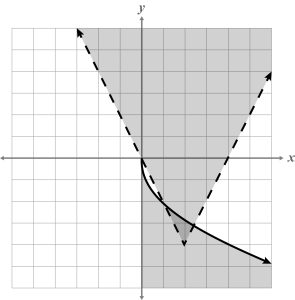
- Determine the graph for the system of inequalities:
-
-
-
-
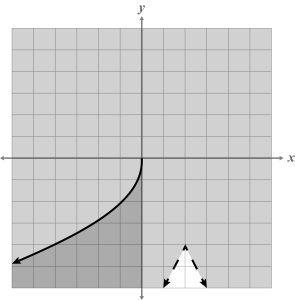
square root, shading below
reflect over the x- and y-axis
absolute value, shading above
Note
- This option does not reflect the square root inequality over either axis.
- This option reflects the square root inequality over the x-axis, but not the y-axis.
- This option reflects the absolute value inequality over the x-axis.
D
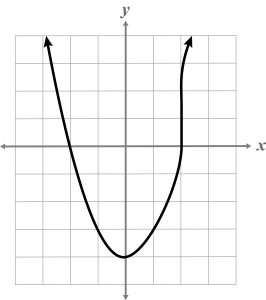
- Determine the graph that represents a one-to-one function.
-
-
-
-
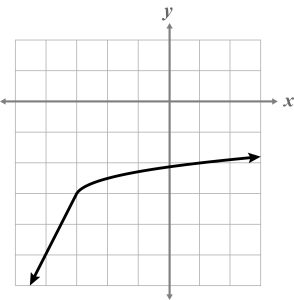
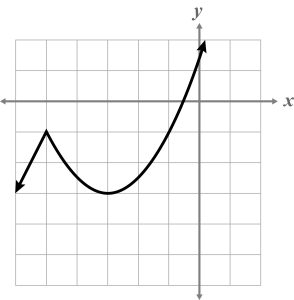
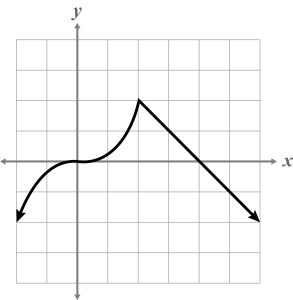
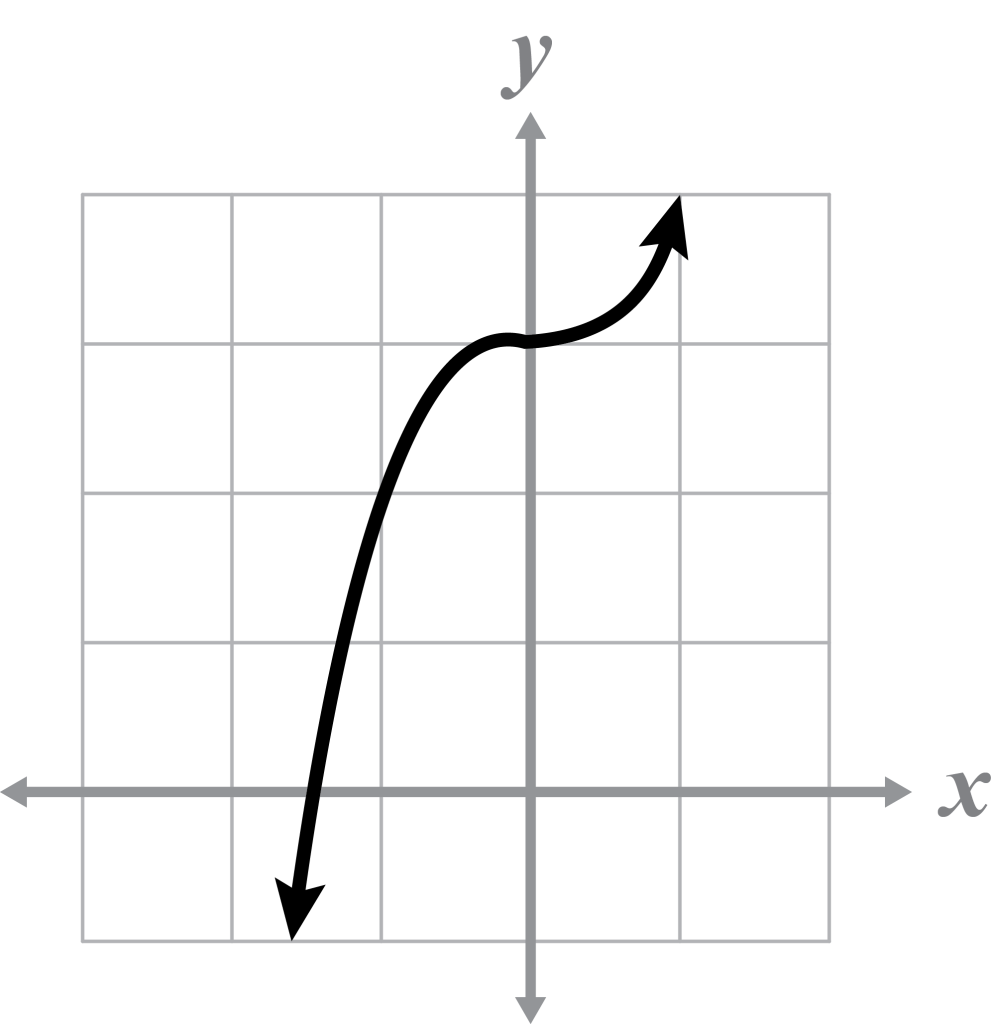
The horizontal line test can be used to determine one-to-one functions. If a graph passes the HLT, the function and its inverse are one-to-one.
Note
A–C) Do not pass the horizontal line test
C
- Solve:
Note
- This option occurs if you subtract 2 from rather than adding.
- This option ignores the –2 on the left side of the equation.
- This option is the value if the reciprocal of the fractional exponent is not taken and is raised to the power.
- A student graphed a function through (0, 3) and knows that as Select all true statements about the inverse of this function.
-
The inverse is a cube root.
-
The inverse is a cubic function.
Note
(2nd) The given is a cubic function, the inverse is a cube root.
(4th) The y-values decrease as the x-values decrease for cubic and cube root functions.
- Select all intervals to complete the piecewise function.
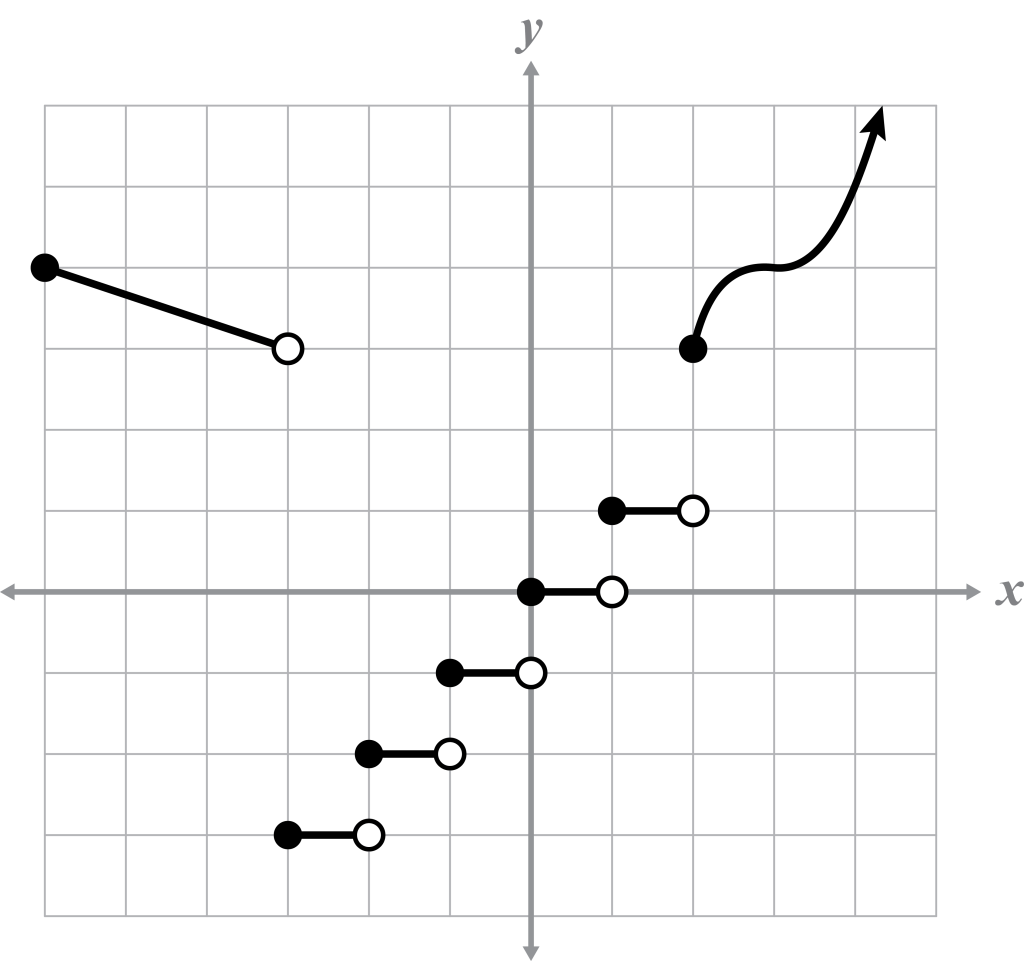
Note
(2nd) This option does not represent any one function across the graphed intervals.
- Select the conjugate pair.
Note
(2nd) The symbol of the first term does not change in a conjugate pair.
(4th) The terms of a conjugate pair are not multiplied together.
Conjugate pairs are written in the form
- Select any ordered pair that is a solution to the system of inequalities.
-
(–3, 3)
-
(5, 7)
-
(0, 8)
-
(–3, 3.1)
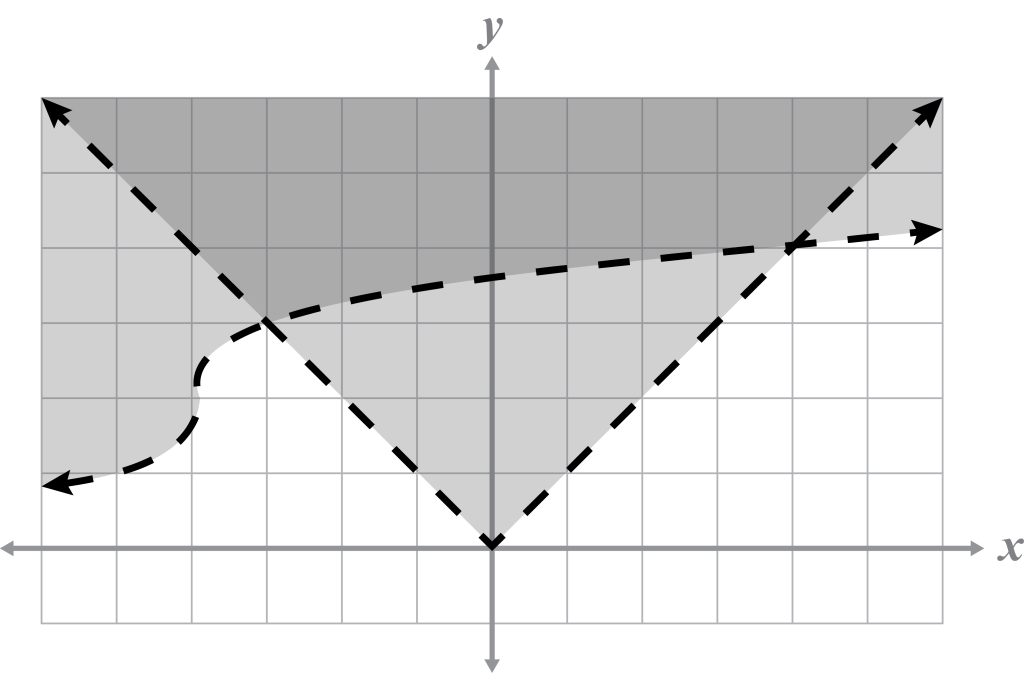
Any ordered pair in the shaded region is a solution to the system of inequalities.
Note
(–3, 3) is an intersection point but not a solution.