
Explore

Unit Rates Solutions

  • A    unit rate    is a ratio between two units where the second unit, the denominator, is one.
  • Unit rates show the relationship between two variables, an    independent variable   , and a    dependent variable   .
  • The independent variable    does not    depend on the other variable and is represented by the variable    x   .
  • The dependent variable is    dependent    upon the independent variable and is represented by the variable    y   .
    • (x, y) (   independent   ,    dependent   )
  • For example,    time    is an independent variable.
  • On the coordinate plane, the values for the    independent variable    are represented on the horizontal    x-axis   , and the values for the    dependent variable    are represented on the vertical    y-axis   .
  • To determine the unit rate from a graph using one coordinate, the graph must go through the    origin   .
  • Choose    integer    values for the x- and y-value x, y, if possible.
Note

(You will learn how to compute the unit rate from a graph that does not go through the origin in Algebra 1)

  • To compute the unit rate,    divide    the dependent variable (y) by the independent variable (x),    dependentindependent   , then simplify so the denominator is one.
  • To predict values,    multiply or divide    the unit rate by the given value. Common units will simplify out of the expression.
  • Unit rates are often written with a slash:    dependentindependent   
Note

Unit conversions will be covered in Algebra 1


Significant digits will not apply to this lesson.

Example 1

Compute the unit rate.

  1. Rayne walked 0.75 miles in 0.25 hours. What is Rayne’s walking speed in miles per hour?
    hours, miles

0.75 miles0.25 hour=3 mileshour

  1. Vincent bought 3 pounds of grapes for $5.83. What is the cost per pound of the grapes?
    pound, price

$5.833 lbs=$1.94lb

  1. Six tickets to a local concert cost $159. What is the cost for one ticket?
    tickets, cost

$1596 tickets=$26.50ticket

Example 2

Determine the unit rate from a graph on the coordinate plane.  

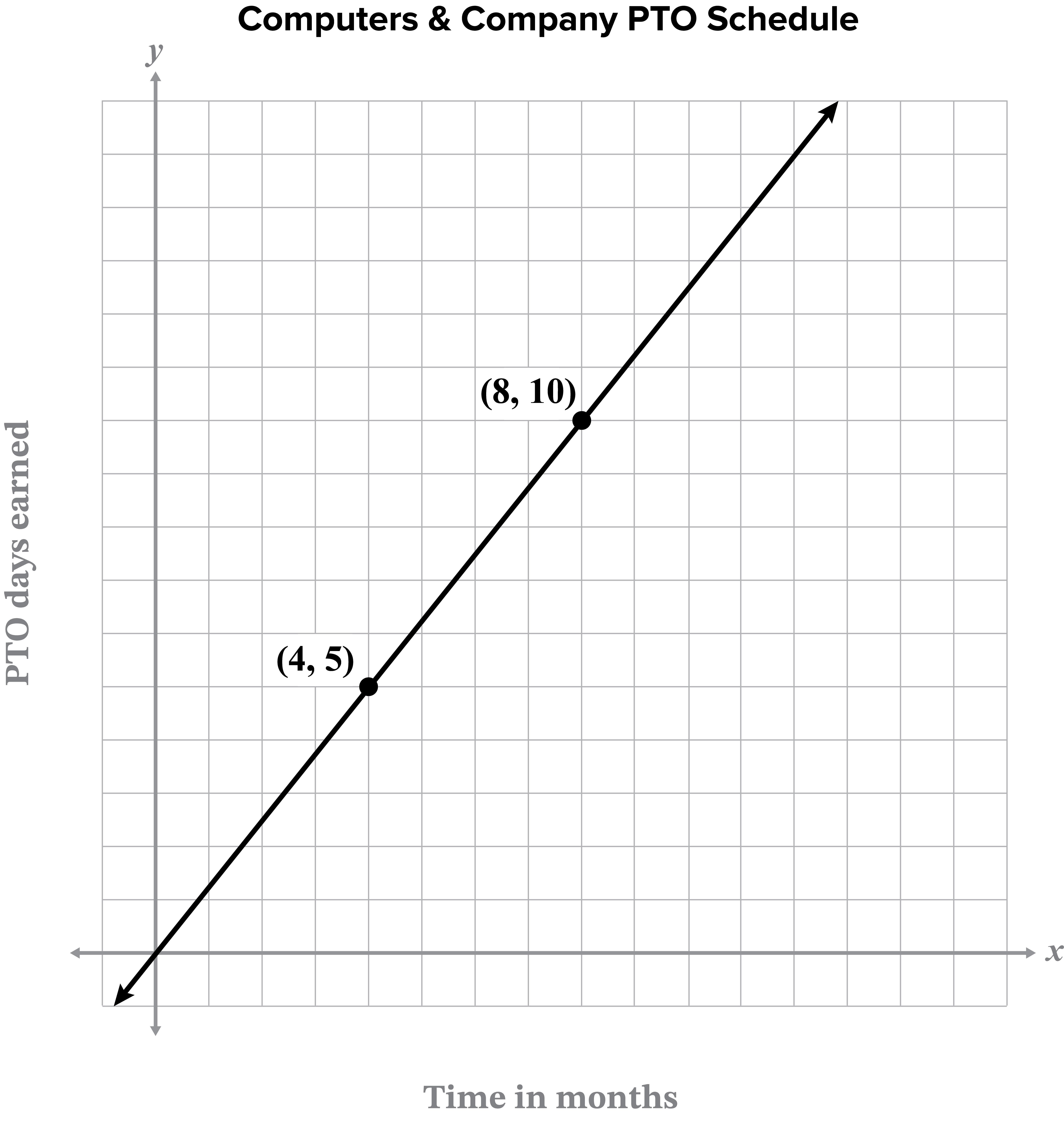
Jacob wanted to determine his paid time off (PTO) at his new job at Computers & Company. The company included the PTO graph as a part of his welcome packet. Using the graph, determine how much PTO Jacob earns per month.

Plan:

Determine if the graph goes through the origin.


Choose a coordinate with integer values x, y

Divide the dependent variable (yby the independent variable (x).


Write the unit rate with appropriate units.

The graph goes through the origin.

Coordinate: 4, 5yx=54=1.251.25 PTO days accruedmonth

Jacob earns 1.25 days of paid time off per month.
Note

Q: Would the unit rate be the same if the point (8, 10) was used?

A: Yes, the unit rate is, for this example, constant. 108=1.25

Example 3

Apply the unit rate to predict values.  

  1. Jacob determined that he earns 1.25 days of PTO per month. How many days of PTO will Jacob earn after 12 months?

unit rate =1.25 daysmonth12 months ·1.25 days1 month=15 days

Jacob earns 15 PTO days in 12 months.

Plan:

Multiply 12 months by the unit rate.

Months simplifies out of the expression.

Simplify.

  1. Rayne walked at a speed of 3 miles per hour. How many hours did it take to walk 5 miles?

unit rate = 3 mileshour5 miles3 mileshour=5 miles·1 hour3 miles=1.67 hours

It took Rayne 1.67 hours to walk 5 miles.

Plan:

Divide 5 miles by the unit rate.


Miles simplifies out of the expression.


Simplify.

Customer Service

Monday–Thursday 8:30am–6pm ET