Practice 1 Solutions
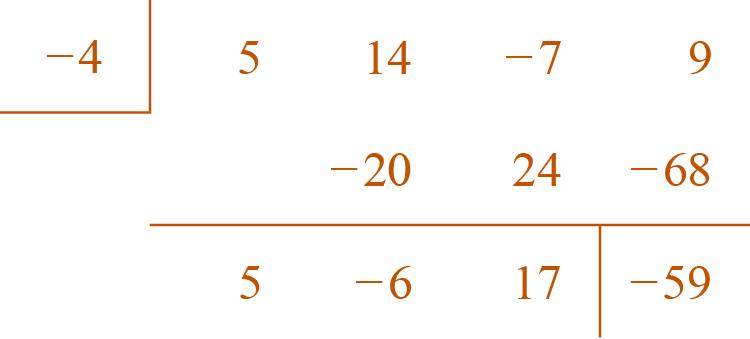
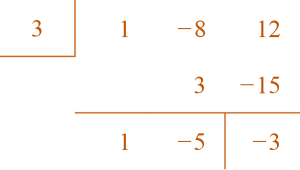
Find the quotient using synthetic division.
Note
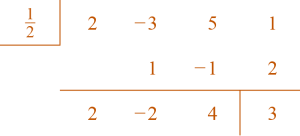
Remember to divide every term by the coefficient of the divisor before using synthetic division. To write the final answer, multiply the remainder by this coefficient.
Factoring the expression after synthetic division is not required, but may be helpful in future lessons.
Note
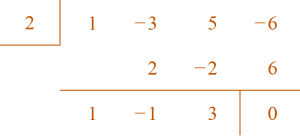
Q: How do you know that the divisor is a factor of the polynomial?
A: The remainder is zero.
Note
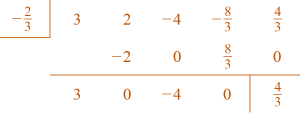
Q: What is the coefficient of the divisor?
A: 3
Q: When there is a 0 in a column, what does this mean for the quotient?
A: That term has a coefficient of zero and is not needed to be written as part of the final answer.
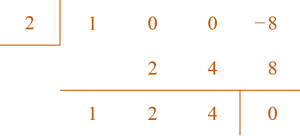
Note
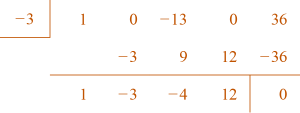
Notice that this is the difference of cubes. You can use synthetic division or the polynomial identity for factoring a difference of cubes.
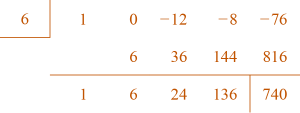
Note
Q: What is the coefficient of the cubic term used in synthetic division? Explain.
A: It is zero because this is not listed in the given polynomial. Zero multiplied by anything is zero.
Use the Remainder Theorem to determine P(k).
Note
Problems 9–12
When the directions say to find the remainder, the quotient does not need to be written.
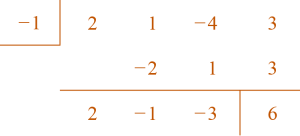
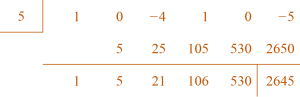
P(5) = 2645
Note
You can use a calculator to work with the large terms more quickly.
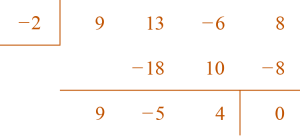
Note
Q: How do you know that –2 is a root of the polynomial?
A: Because the remainder is zero.
Q: How do you write this as a factor?
A: x + 2
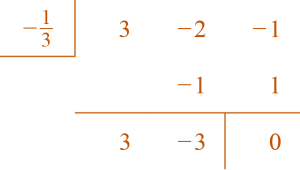
Note
Q: Name the root and factor of this problem.
A: is a root of the polynomial. is a factor
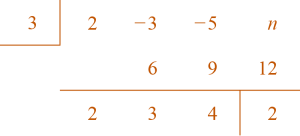
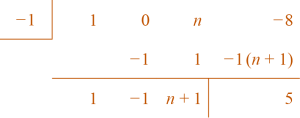
Find the missing value.
Note
Problems 13–14
Remember to check your work by substituting the value of n back into the polynomial.