Remainder Theorem for Polynomials Solutions
- The Remainder Theorem: If the polynomial P(x) is divided by (x – k), then the remainder is equal to the value, P(k).
- Rather than using substitution for all values of x, use synthetic division to find the value of the remainder.
- Synthetic division is more efficient than substitution because you do not need to raise any term to a power.
Example 6
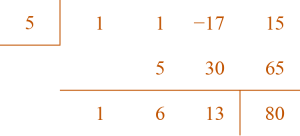
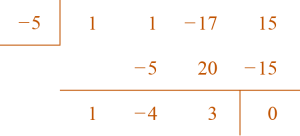
Determine if P(5) and P(–5) are factors of .
P (5) = 80
OR
P(5) is not a factor because the remainder is not zero.
The value –5 is a root of the polynomial because the remainder is 0 ; therefore, (x + 5) is a factor of P(x) .
Example 7
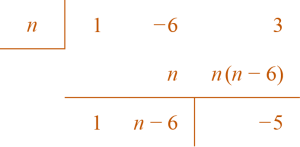
Find the missing value when P(n) = –5 for .
Plan
Substitute the values into the synthetic division frame
Complete synthetic division
Solve for n