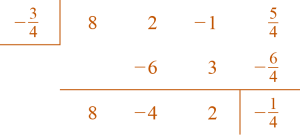
Synthetic Division with Non-Integers Solutions
- When the divisor has a coefficient other than one , you need to complete an additional step to use synthetic division.
- First, divide every term of the dividend and the divisor by the coefficient of the divisor.
- Then follow the steps of synthetic division.
Example 4
Simplify using synthetic division.
Note
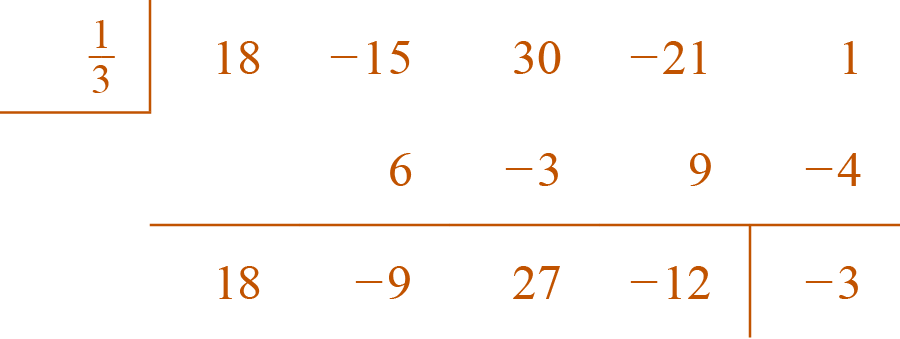
It is CRITICAL to divide EVERY term by the coefficient of the divisor. If you skip this step, the answer will be off by a multiple of the coefficient.
Implement
Explain
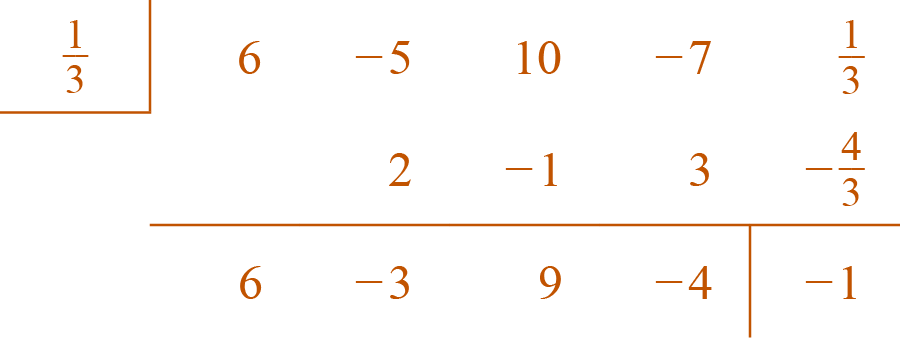
- Divide every term by the coefficient of the linear divisor (In this example, the coefficient of 3x is 3.)
- Simplify each term
- Find the zero of the divisor
- Write the remainder using the given divisor (Multiply all terms of the remainder by the number you divided out.)
- Write the quotient with the remainder
Note
In Example 4, if you do not divide each term by the coefficient of the divisor, the error would look like this.
Example 5
Find the quotient using synthetic division.