Explore
Synthetic Division with Integers Solutions
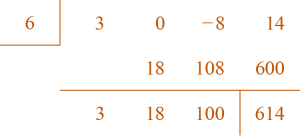
- Here are the steps for solving with synthetic division:
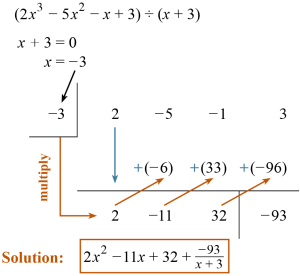
-
-
- Write the solution as:

- Write the solution as:
-
Example 1
Simplify using synthetic division.
Implement
Explain
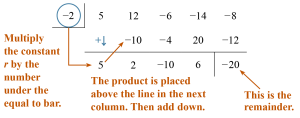
- Set the linear divisor equal to zero and solve
Note
This is the root or zero of the divisor.
- Place the zero of the linear divisor in the top left corner
- List the coefficients and constant of the polynomial dividend
- Write the first coefficient under the line
- Multiply the constant r by the first coefficient and place it under the second coefficient
- Add the column vertically
- Repeat until no values are left
- Determine if there is a remainder or if the divisor is a factor
- Write the quotient with the remainder
Note
When writing the quotient, start with one less degree than the polynomial dividend. From there, the degree of each term decreases by one.
Example 2
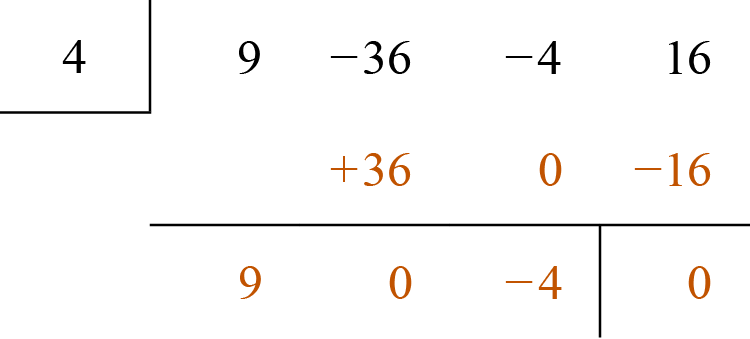
Simplify using synthetic division.
or
Note
For solutions that have no remainder, check if the quotient can be factored. The rationale behind factoring the quotient completely will be covered in a later lesson. For example, the quotient of this example is also a difference of two squares and would be written as the factored expression (3x – 2)(3x + 2).
Remember to write the final expression in standard form, factoring completely when possible.
Example 3
Find the quotient using synthetic division.