Explore

Reciprocal Functions Solutions

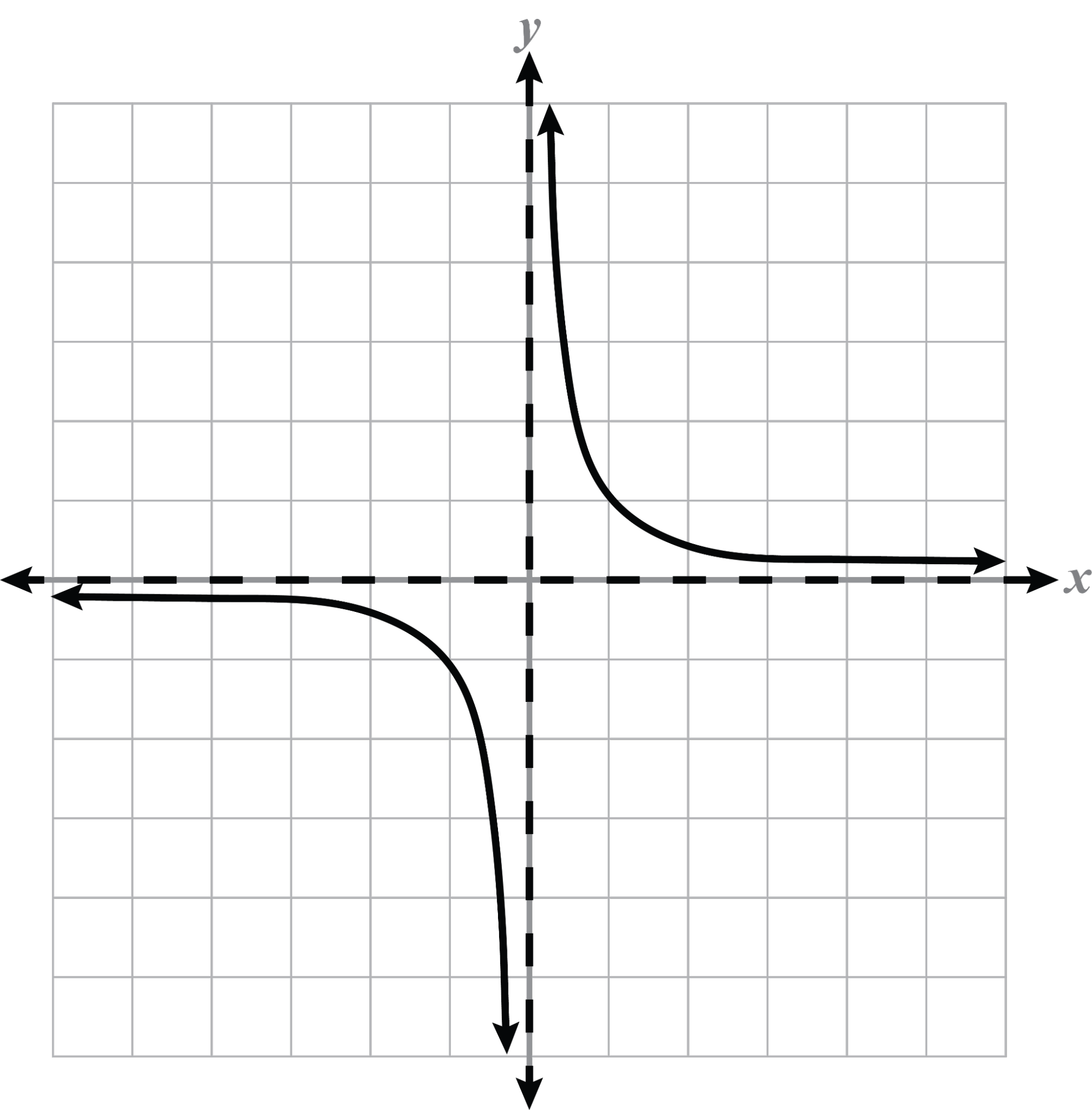
  • A reciprocal function is a simple rational function in the form: fx=axh+k, xh

  • The simplest form of a reciprocal function is its     parent    function: f(x)=1x, x0
  • A reciprocal function forms a    hyperbola    on the coordinate plane.
Note

The graph of y=1x may also be called an inverse function.

  • Hyperbolas can have asymptotes that are    vertical or horizontal    .
Note

Horizontal asymptotes also determine end behavior. You will learn about oblique (slant) asymptotes, how they occur, and end behavior in later lessons and levels.

    • An    asymptote    is a line that a graph (or curve) approaches (but does not touch) as it moves towards infinity or negative infinity.
    • The asymptote is drawn on a graph using a    dashed    line. It is used to help create    boundaries    for a function, but is not part of the graph itself.
  • In a reciprocal function:

    • there is a    vertical    asymptote that is the restriction for the denominator, or domain.

    • there is one    horizontal   , asymptote, k.

    • a    never equals zero   . If a=0, it cannot be a reciprocal function.

  •  If intercepts exist on the graph of a reciprocal function, then:


    • the x-intercepts, or zeros, of the graph are the values that make     f (x) = 0   .

    • the y-intercept is the value for     f(0)   .

Customer Service

Monday–Thursday 8:30am–6pm ET