Turning Points with Technology Solutions
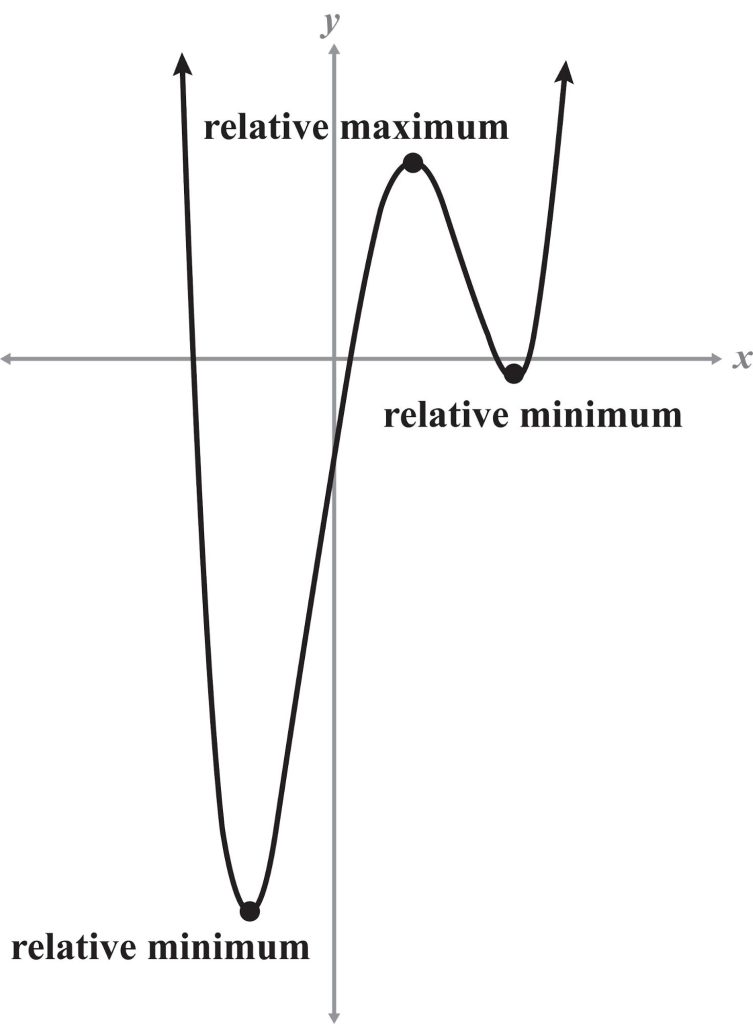
  • A    turning point    occurs when a graph changes directions (up to down or down to up).

  • A graph’s maximum number of turning points must be less than the degree of the polynomial, or    n1, when xn   .
  • If a graph has fewer than n1 turning points,    multiplicities    may occur (but not always).
  • Turning points are also called    relative minimum    or    relative maximum    points based on their positions on the graph.
  • Graphs can have more than one turning point, and likewise    more than one    relative minimum and relative maximum.
  • In this level, you will determine the largest or smallest turning point across an    interval    of a continuous function.

  • A turning point may also be a    root   .
Image49

Steps for Identifying Turning Points

  1. Use    technology    to locate and estimate turning points on a graph.
  2. Use the    zoom-in and zoom-out    features to accurately determine and name all turning points.
  3. Sketch graphs that include    end behaviors   ,    roots   , and    turning points   .
  4.    Label    the numbers on your sketch to provide more information about the graph.

Remember, a sketch does not reflect the exact scale of a graph. It gives a general idea of what is happening at key points on the graph.

Note

In this Unit, the focus is on continuous polynomial functions. This means that the functions do not have endpoints. Therefore, the relative minimum and maximum will only refer to turning points (for this course). As you complete higher levels of mathematics, the relative minimum and maximum definitions will be updated to reflect the objectives for that level. 

Example 3

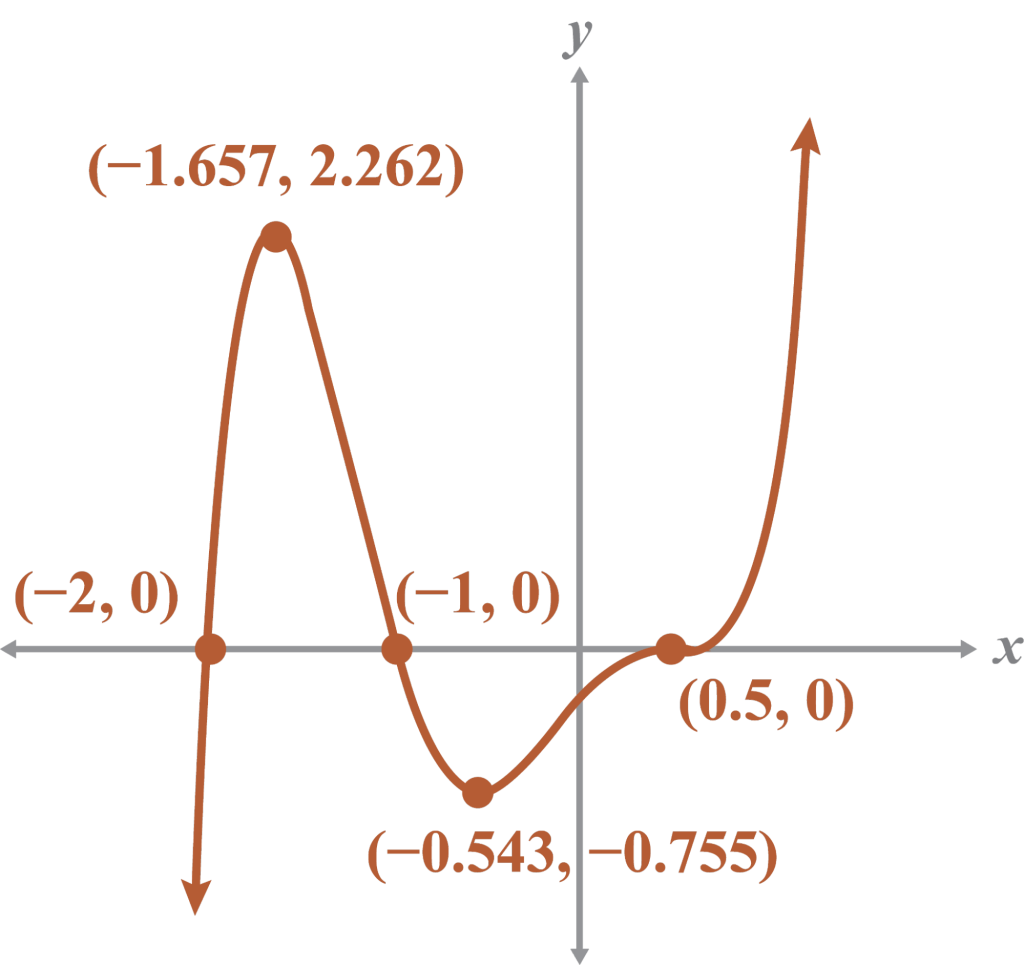
  1. Sketch the equation. Include roots and turning points.
  2. What is the maximum number of turning points that can occur in the graph? Explain why the graph does or does not have the maximum number of turning points.
  3. Name the relative maximum point on the interval [2, 2].

 px=x0.53x+2x+1

n=3+1+1=5

  1. Sample:
    Image52
  2.  n1=4
    This graph does not have four turning points because when x=0.5, there is a multiplicity of three.
  3. (1.657, 2.262)

Example 4

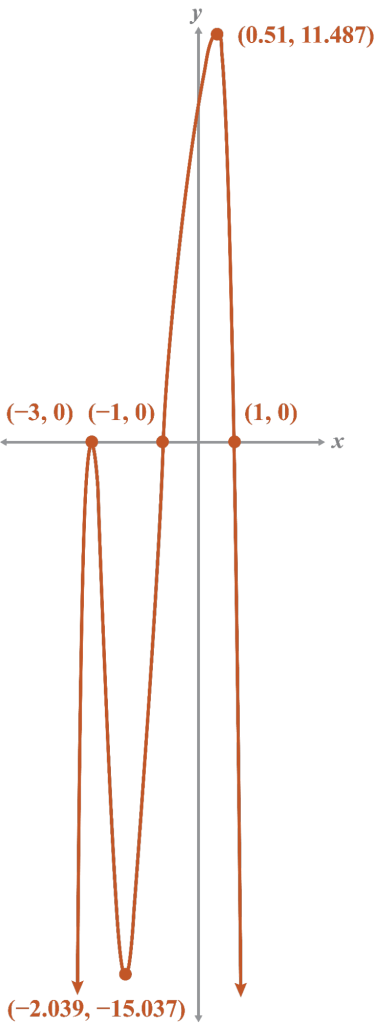
  1. Sketch the equation. Include roots and turning points.
  2. Name all real and non-real, complex roots.
  3. Name the relative maximum and minimum over the interval [4, 1.5].

gx=x41x+32

  1. Image6
  2.  x41x+32=0x2+1x21x+32=0x2=±1x2=1x=3x=±ix=±1
  3. Relative maximum: (0.51, 11.487)
    Relative minimum: (2.039, 15.037)

Customer Service

Monday–Thursday 8:30am–6pm ET