
Unit 4 Test (Lessons 31–36): Polynomial Functions Solutions
| # | Answer | Lesson Origin |
| 1A) | |
31 |
| 1B) | The end behavior for a positive third degree polynomial is |
33 |
| 1C) | 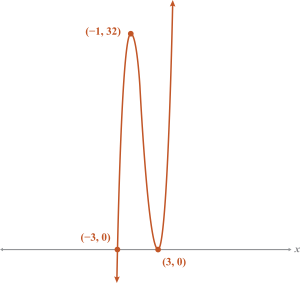 |
34 |
| 1D) | The function is increasing over the intervals |
35 |
| 2) | B | 31 |
| 3) | C | 34 |
| 4) | D | 34 |
| 5) | B | 36 |
| 6) | A | 32 |
| 7) | C | 31 |
| 8) | C | 35 |
| 9) | B | 32 |
| 10) | D | 33 |
| 11) | A | 31 |
| 12) | A | 34, 35 |
| 13) | D | 36 |
| 14) | D | 33 |
| 15) | B | 34 |
| 16) | B | 31 |
| 17) | B | 36 |
| 18) | C | 33 |
| 19) | A | 32 |
| 20) | B | 33, 35 |
| 21) | A | 32 |
| 22) | D | 31 |
| 23) | C | 35 |
| 24) | B | 35 |
| 25) | C | 36 |
Answer all parts of the open response problem.
- The product of g and f form the new function h(x). Find h(x). Show your work.
- Name the degree and end behavior for h(x).
a > 0, n = 3
The end behavior for a positive third degree polynomial is .
- Sketch the graph of h(x). Label the roots and turning points.
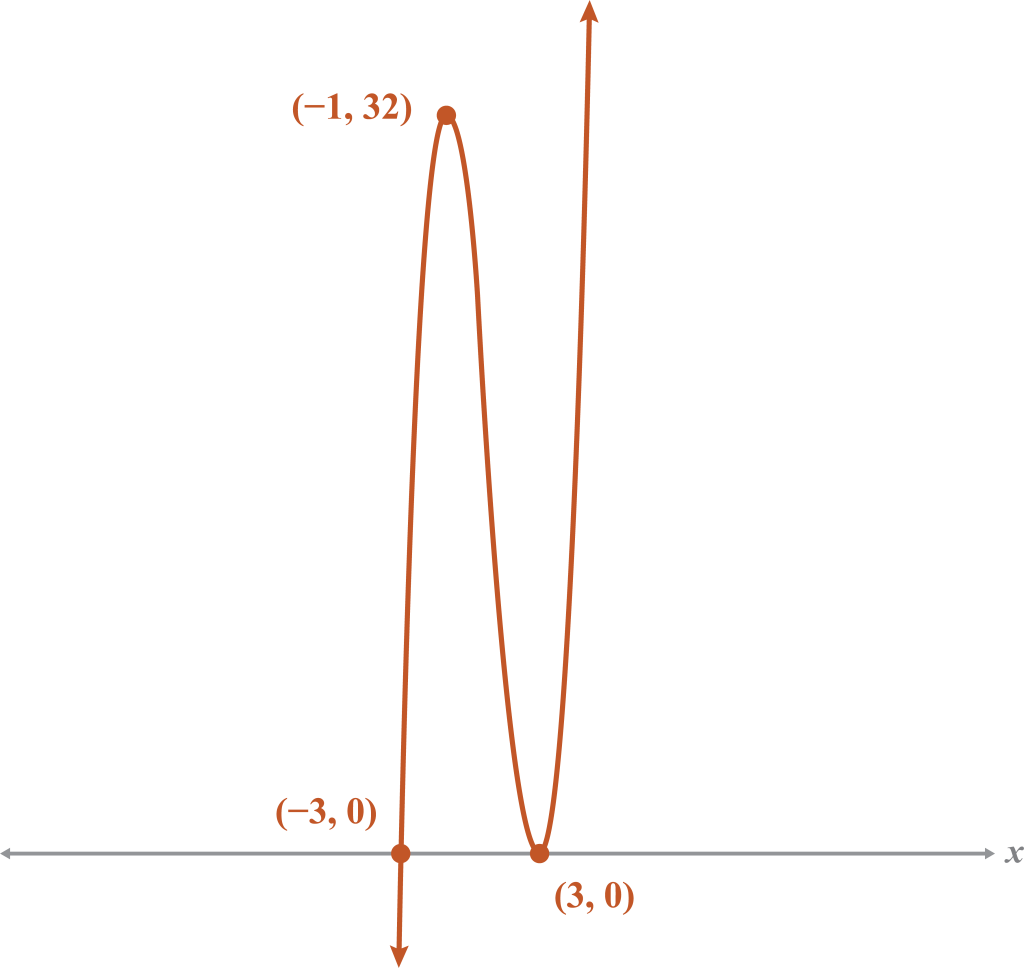
Note
Remember students should use technology to find the turning points.
- Name the interval(s) where h(x) is increasing.
The function is increasing over the intervals
Multiple Choice
B
- Name the excluded domain values for:
Note
A, C) These options only include one of the two domain restrictions.
- The value of the fraction in the denominator equals –1 only when
C
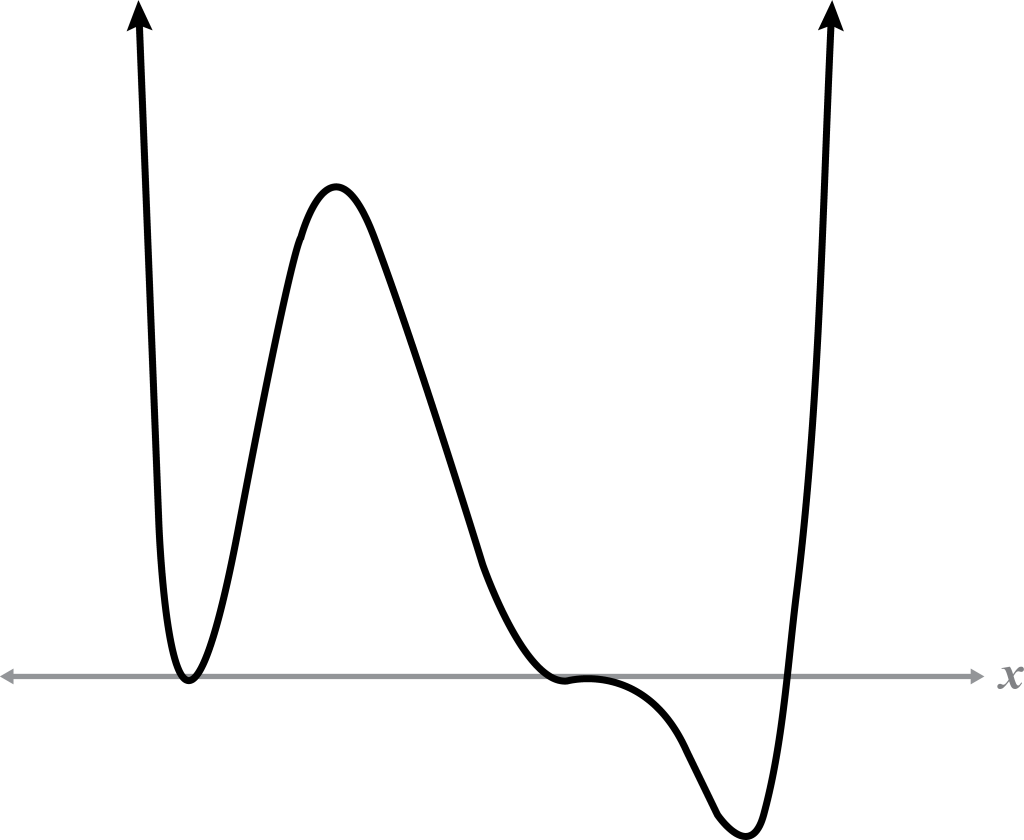
- Name the possible degree n and end behavior.
-
bounce = 2, snake = 3, cross-through = 1
n = 2 + 3 + 1 = 6
a > 0 from end behavior
Note
A, B) There are 3 roots, but the graph shows multiplicities greater than one with an even end behavior.
B, D) The end behavior is even, but these options are for an odd function.
D
- Determine all possible rational roots for
Note
A–C) These options do not include all possible rational roots.
B
- Select the equation.
y varies directly as x-squared, and inversely as the product of w and z-cubed.
Note
- The constant of variation k is missing.
- w belongs in the denominator.
- The terms w, x, and z are incorrectly placed in the equation.
A
- Determine the inverse of
-
inverse not shown
Note
- The value –6 should not be in the denominator.
- The term should be in the denominator.
C
- Determine the restrictions on the function:
Note
- This option is an incomplete list of the restrictions.
- The sign is incorrect for 5.
- The square root of 4 is ±2, not
C
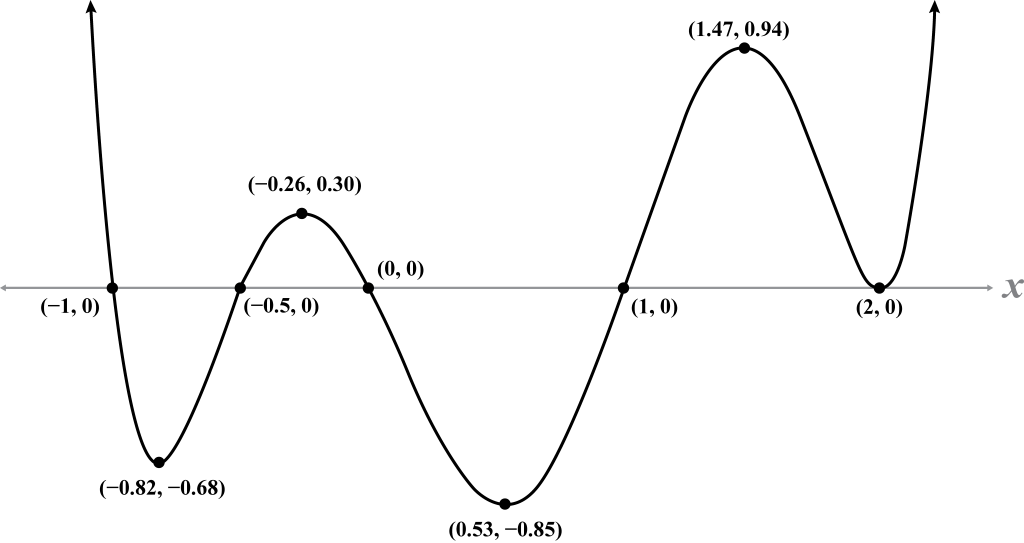
- Name the relative minimum over the interval [0, 3].
-
(–0.82, –0.68)
-
(1.47, 0.94)
-
(0.53, –0.85)
-
(2, 0)
The relative minimum is the lowest turning point across the given interval
Note
- This point is not in the interval.
- This point is a relative maximum point.
- This is not the lowest turning point over the interval.
B
- Evaluate
-
–1
-
0
-
2
-
3
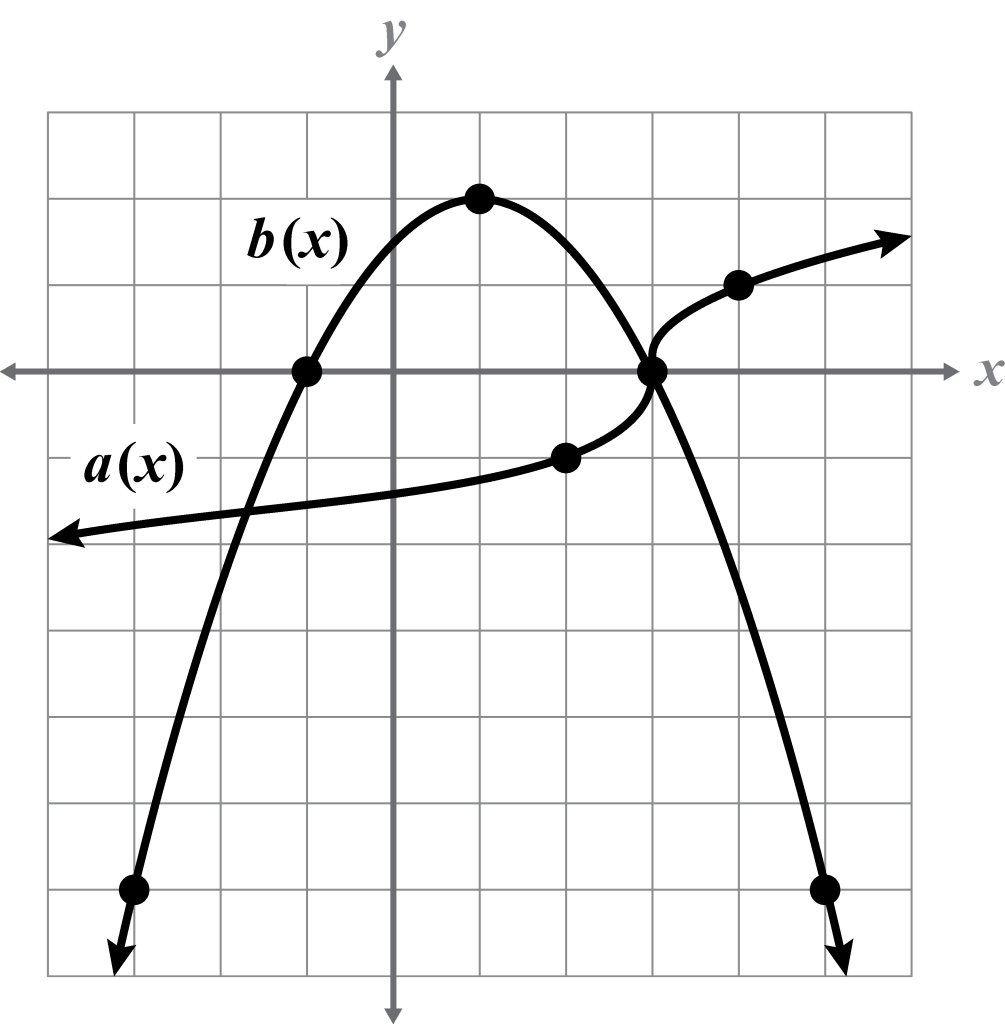
Note
- This option is
- This option is
- This option is the x-value of the intersection point.
D
- The graphs of polynomial functions are ___ smooth, continuous and ___ contain sharp turns or holes.
-
sometimes, never
-
always, always
-
never, sometimes
-
always, never
By definition, the graphs of a polynomial function are smooth and continuous.
Note
A–C) These options do not correctly define a polynomial function.
A
- Determine (g– h)(–2).
-
6
-
4
-
2
-
–6
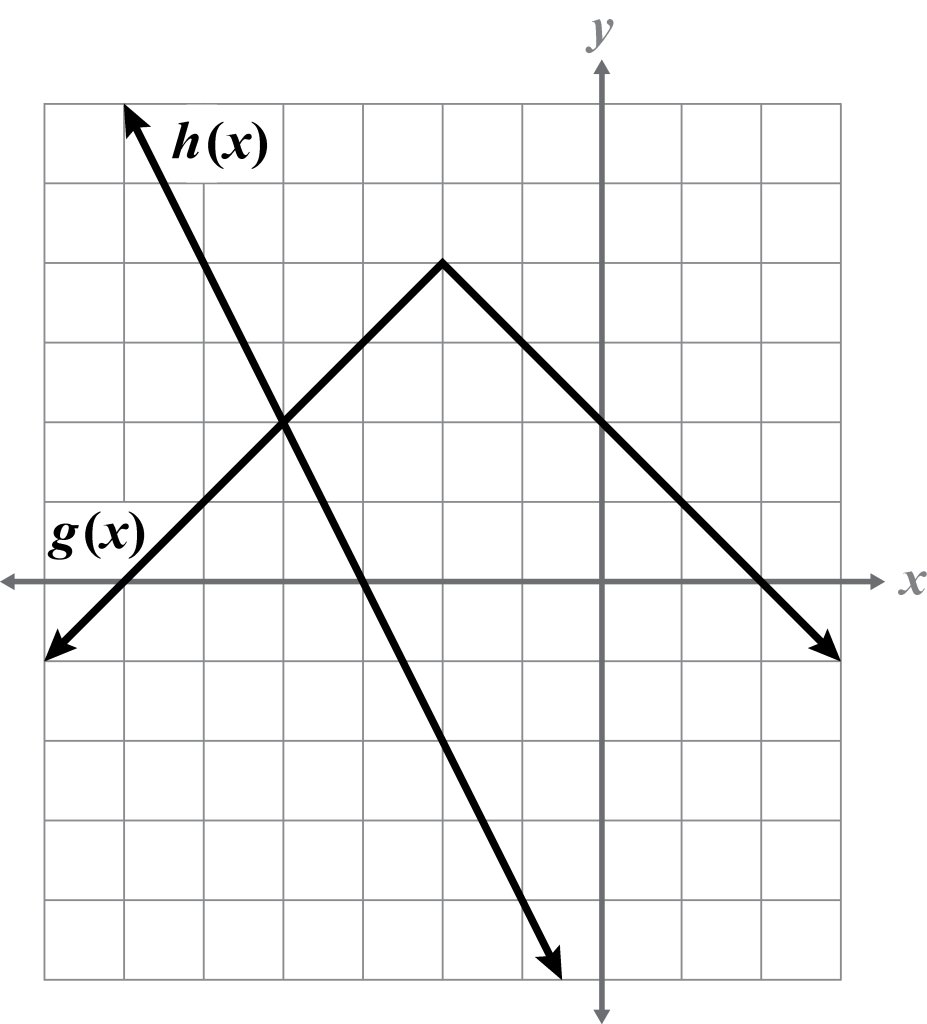
Note
- This option is the y-value of the point of intersection.
- This option is
- This option is
A
- Select the graph that contains a multiplicity of two and a multiplicity of three.
-
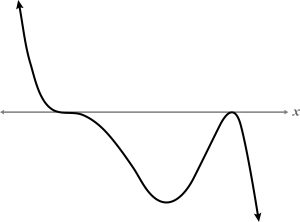
-
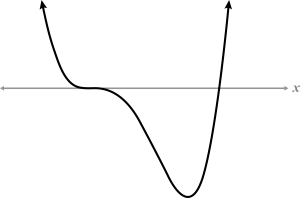
-
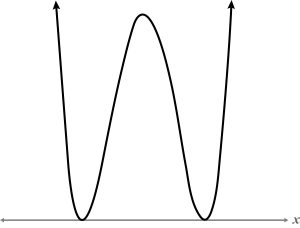
-
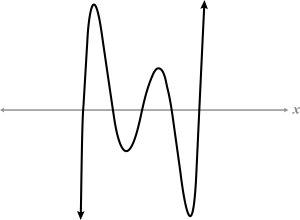
cross-through = multiplicity 1
bounce = multiplicity 2
snake = multiplicity 3
Note
- This graph has a triple root (multiplicity 3) and a single root (multiplicity 1).
- This graph has two double roots (multiplicity 2).
- This graph has five single roots (multiplicity 1).
D
- p varies jointly as the square of y, and the cube of x.
If and find p when and
Note
- This option is the constant of variation.
- This option is the solution when x- and y-values are switched.
- This option is the solution if no exponents are used.
D
- Select the graph that does not represent a polynomial function.
-
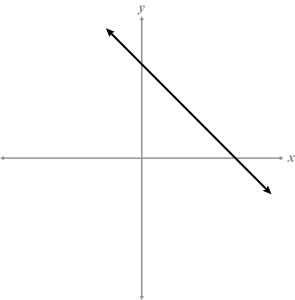
-
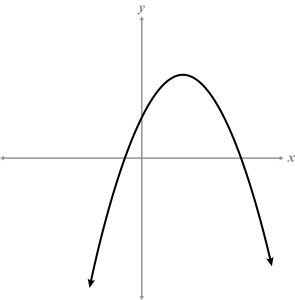
-
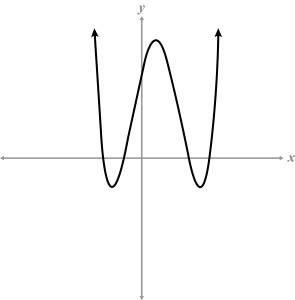
-
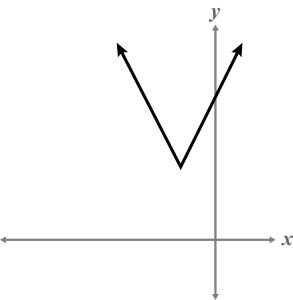
A polynomial function is a smooth, continuous graph. An absolute value graph is not a polynomial function.
Note
A–C) These options all represent polynomial functions.
B
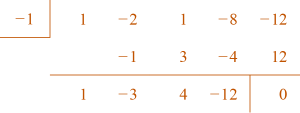
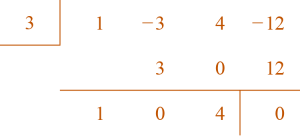
- Find the exact roots of
-
–3, 1
-
–1, 3
Note
- These values have the opposite signs of the roots.
- This option is missing a pair of imaginary roots.
- This option found the square root of 4 rather than –4.
B
- Find the quotient of g and f given:
Note
- This option is f divided by g.
- This option is fg.
- This option is g – f.
B
- Name the end behavior for the polynomial function.
Note
A, C) Represent functions when
- Represents a function when n = odd.
C
- The pressure P of gas in a container varies inversely as the volume V. Determine the constant of variation when the pressure is 32 pounds per square inch and the volume is 0.35 cubic feet.
-
91.428
-
32.35
-
11.2
-
0.001
Note
- This option is the quotient of P and V.
- This option is the sum of P and V.
- This option is the quotient of V and P.
A
- Decompose q(x) such that when
Note
B, C) The result is a constant function.
- The x-term is not squared.
B
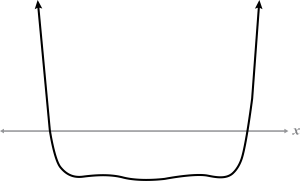
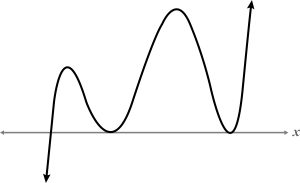
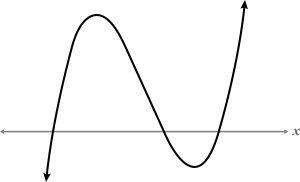
- Select the sketch of a graph that best represents a fifth degree polynomial function with all real roots.
-
-
-
-
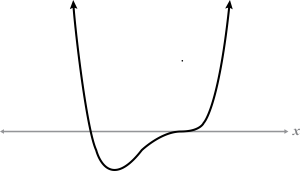
Graph A has 2 real roots.
Graph C has 3 real roots.
Graph D has 4 real roots.
Note
A, D) These options are even degree functions.
- This option is a third degree polynomial.
A
- An item costs x dollars to purchase. What order results in the best price when using a $20 off coupon and a 10% off coupon?
-
cannot be determined
Note
- The order of the coupons matters, and they are not equal.
- This option does not result in the lowest price.
D
- If and determine f(6).
-
–81
-
2
-
87
-
63
Note
- This option is the solution when
- This option is the value of a.
- This option occurs if the like terms are not combined correctly.
C
- For the polynomial function name the number of complex roots and the maximum possible number of turning points.
-
There are n number of complex roots and n turning points.
-
There are number of complex roots and n turning points.
-
There are n number of complex roots and turning points.
-
The number of complex roots and turning points cannot be determined.
The Fundamental Theorem of Algebra says that there are n complex roots and turning points.
Note
- This option does not have the correct number of turning points.
- This option does not have the correct number of complex roots.
B
- Name all increasing intervals for the given function.
-
Increasing intervals are where the x-values and y-values are both increasing from left to right across the graph.
-
Enter a Choice (Preferably 1-2 Lines Only)
Note
- This option has decreasing intervals.
- The intervals stop at the x-intercepts instead of a turning point.
- This option includes the x-intercepts, not the intervals.
C
- Determine the description that best matches the equation:
-
The volume of a sphere V varies jointly as the cube of the radius r.
-
The volume of a sphere V varies inversely as the cube of the radius r.
-
The volume of a sphere V varies directly as the cube of the radius r.
-
The volume of a sphere V varies jointly as the product of pi and the cube of the radius r.
Note
A, B, D) These options show inverse or joint problems, but this problem is a direct variation problem.