
Unit 3 Test (Lessons 23–30): Introductions to Conics Solutions
| # | Answer | Lesson Origin |
| 1A) | Equation G and equation K are hyperbolas because are non-zero, and have opposite signs. Equation H is a circle because and has non-zero values. Equation J is a parabola because |
24, 30 |
| 1B) |
Equation J is the parabola. A shift left occurs when or |
27 |
| 1C) |
Orange is part C solution
|
24, 28 |
| 1D) | 29 | |
| 2) | A | 28 |
| 3) | C | 25 |
| 4) | C | 23 |
| 5) | D | 29 |
| 6) | B | 28, 29 |
| 7) | C | 24 |
| 8) | C | 26 |
| 9) | A | 29 |
| 10) | D | 30 |
| 11) | B | 24 |
| 12) | B | 27 |
| 13) | A | 23 |
| 14) | D | 26 |
| 15) | C | 26, 28 |
| 16) | B | 24, 25 |
| 17) | C | 24, 25 |
| 18) | D | 27 |
| 19) | A | 30 |
| 20) | B | 26 |
| 21) | D | 30 |
| 22) | A | 23 |
| 23) | C | 25 |
| 24) | 23, 24 | |
| 25) |
A and C are non-zero |
29, 30 |
Answer all parts of the open response problem.
- Use the equations of conic sections to answer parts A–D.
- Name the type of conic each equation represents. Explain your reasoning.
Sample: Equation G and equation K are hyperbolas because are non-zero, and have opposite signs. Equation H is a circle because and has non-zero values. Equation J is a parabola because
- Write the equation of a parabola in standard form, then transform it left 15 spaces.
Equation J is the parabola. A shift left occurs when or
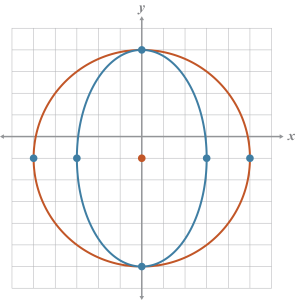
- Graph the equation of the circle.
Orange is part C solution
Blue is optional sketching to complete part D.
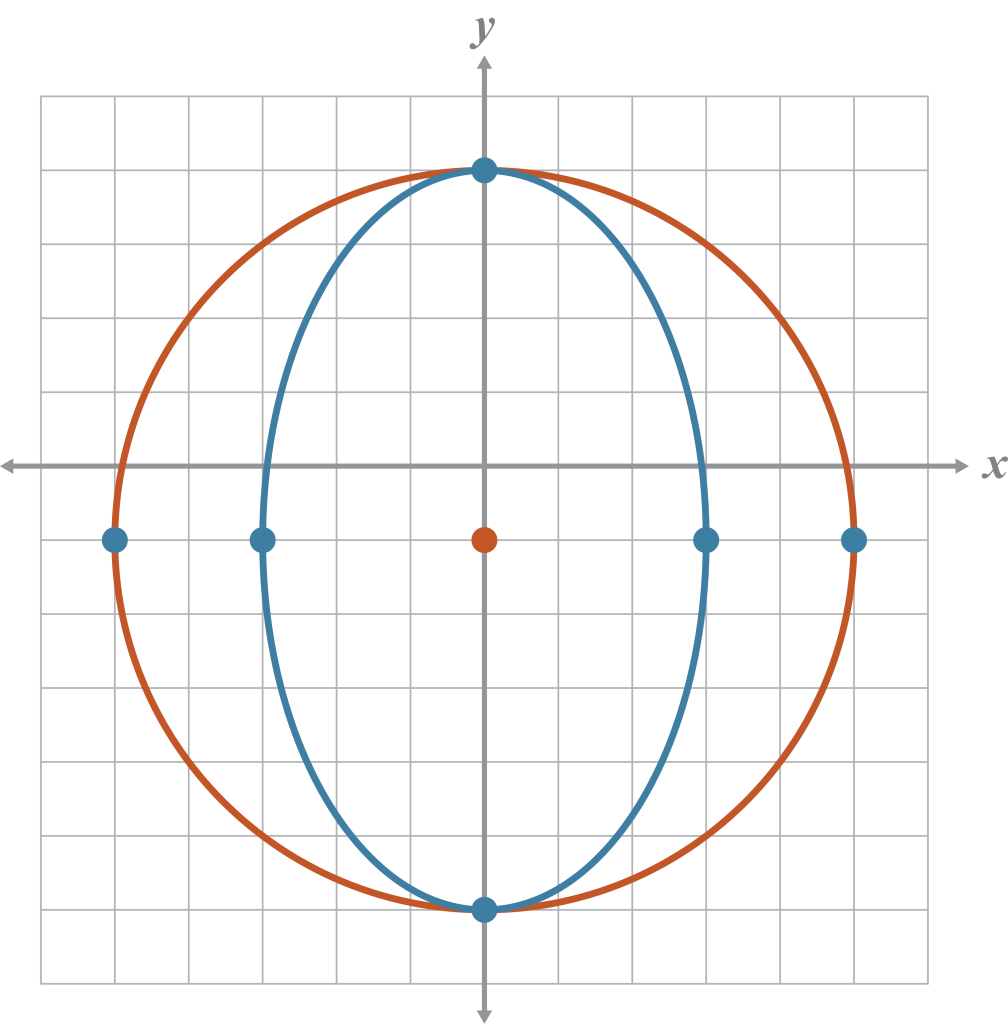
- Write the equation of an ellipse with the same center and vertical major axis as the circle and with a minor axis equal to 6 units.
Multiple Choice
A
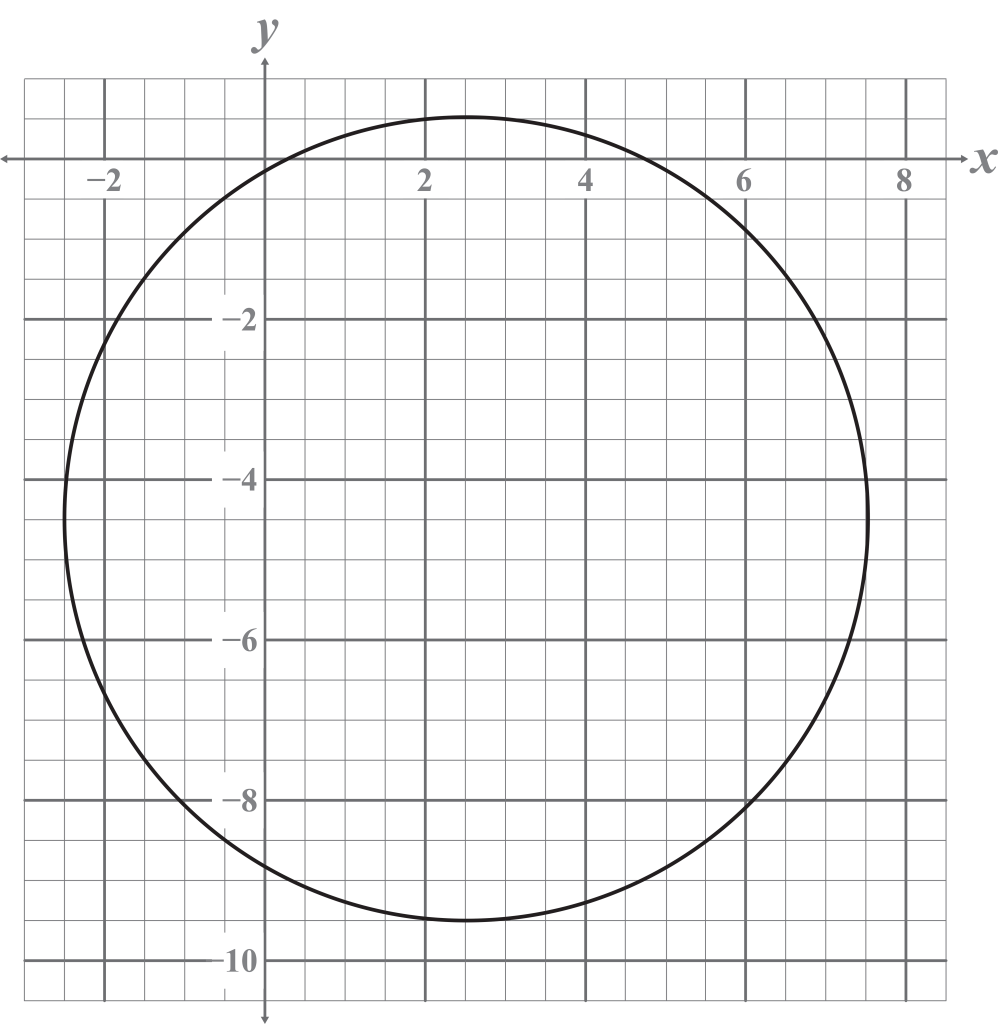
- Which equation represents the given conic section?
-
center radius = 5,
Note
- The signs of h and k are opposite the correct value.
- This option is a hyperbola because the terms are subtracted.
- The value of h and k are switched in the equation.
C
- An object launched into the air is modeled by the equation:. How many seconds, t, after launch does the object reach the ground?
-
–1
-
2
-
10
-
16
This equation can be solved by factoring, using the Quadratic Formula, or completing the square.
Note
- Time cannot be negative.
- This option is the result when 2 and 5 are used as factors of 10 instead of 1 and 10.
- This option is the result if the GCF is not factored out.
C
- Solve under the set of complex numbers.
-
no solution
Note
- This option is only one of two possible solutions.
- With this option, the square root of a negative number will be imaginary.
- Because complex numbers are being used, a solution is possible.
D
- Select the equation that translates the center of an ellipse at the origin into the third quadrant.
-
center translated to the third quadrant
Note
- This option is a hyperbola because the terms are subtracted.
- This option is an ellipse with a center in the first quadrant.
- This option is an ellipse with a center in the fourth quadrant.
B
- Select the statement that is true.
-
An ellipse is a special circle where
-
A circle is a special ellipse where
-
A circle is a special ellipse where
-
There is no relationship between a circle and an ellipse.
Note
The values of a and b are equal when the equation of a circle is written in the standard form of an ellipse.
C
- What value of b will form a perfect square trinomial ?
-
7
-
49
Note
- This option is half of c.
- This option does not double the middle term of the trinomial.
- This option is the correct value if you were asked for c.
C
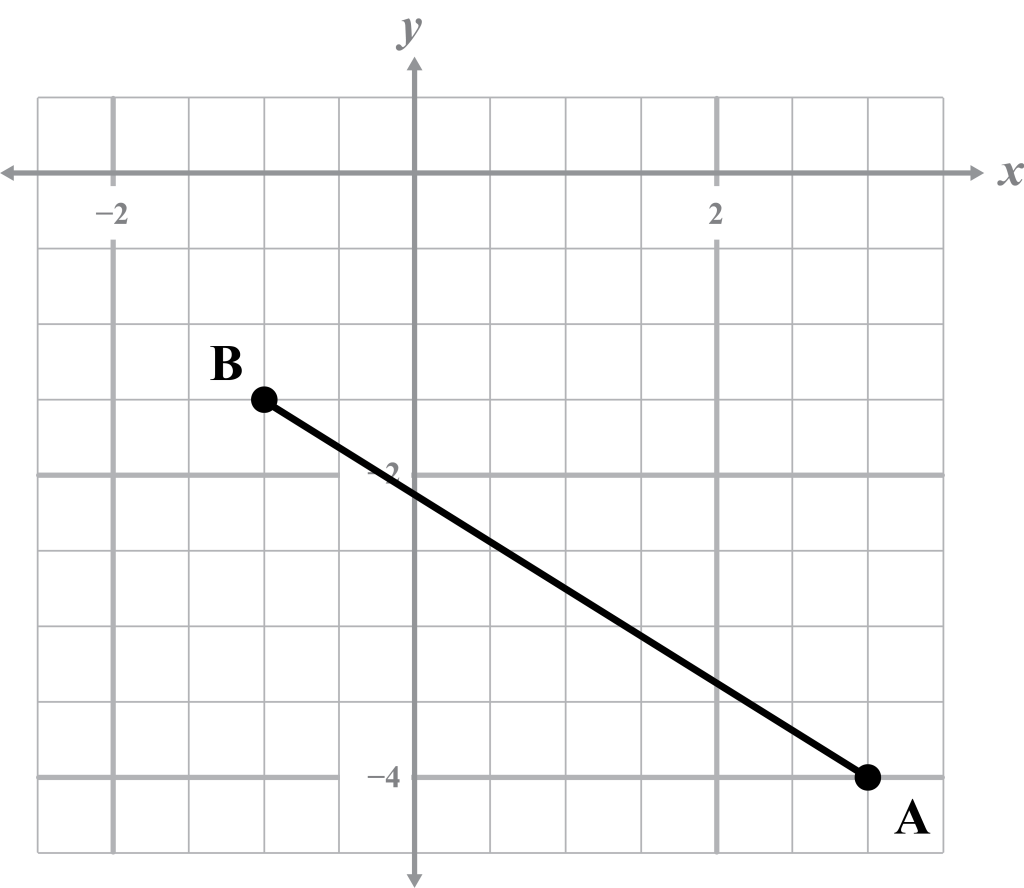
- Determine the distance between point A and the midpoint of segment AB.
-
5.57
-
4.72
-
2.36
-
1.18
Note
- This option is the approximate value before taking the square root.
- This option is the distance between A and B.
- This option is half the distance between the midpoint and point A.
A
- Select the equation that best represents the graph.
-
Center
Major axis horizontal,
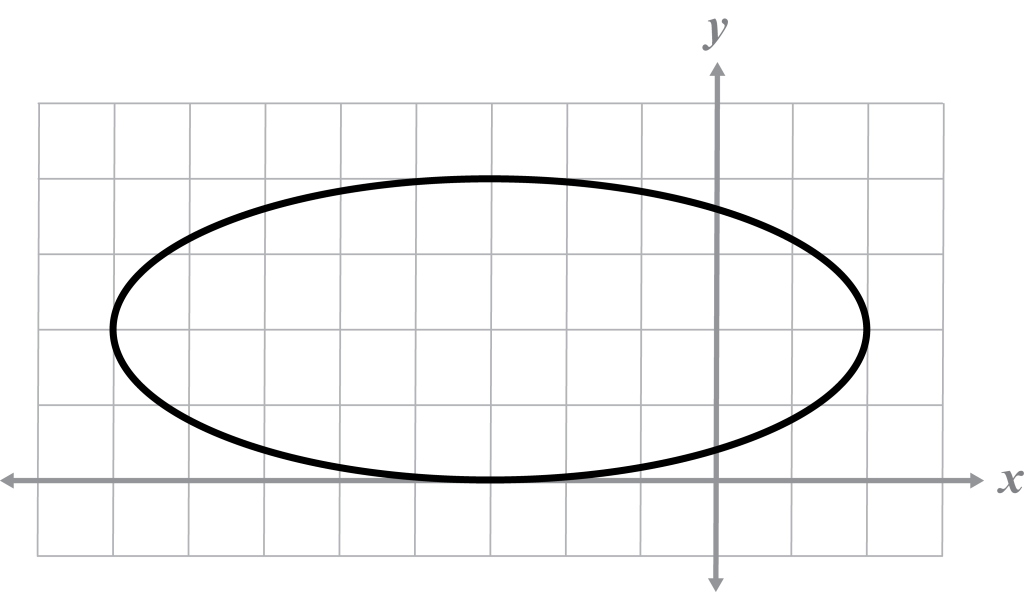
Note
- This option equation represents a hyperbola.
- This option represents an ellipse with a center in quadrant one.
- This option is a vertical ellipse.
D
- Solve by completing the square.
Note
- This option does not add 1 to both sides of the equation.
- This option represents only one of the two solutions.
- This option is missing i in the solution.
B
- Which equation represents a hyperbola?
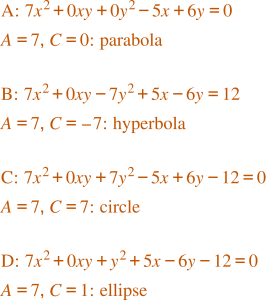
Note
- This option is a parabola because A is non-zero and
- This option is a circle because
- This option is an ellipse because A and C are non-zero values with the same sign.
B
- Select the graph that best represents the equation: .
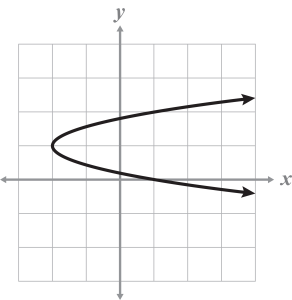
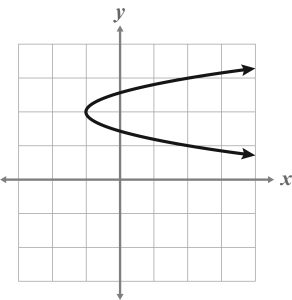
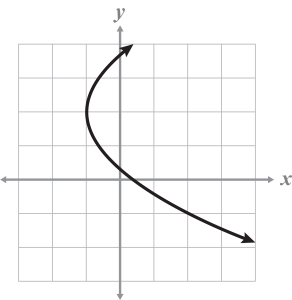
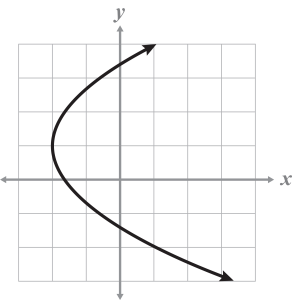
Note
A, D) These options have a vertex at
C, D) These options have rather than 3.
A
- Which equation represents a polynomial equation with integer coefficients given the roots ?
Note
- This option does not have integer coefficients and is not an equation.
- This option is the solution when is used as a factor.
- This option incorrectly combines the squared and linear terms.
D
- Determine the distance between the vertices of the two parabolas and to the nearest hundredth.
-
1.60
-
5.74
-
8.93
-
9.07
Note
- This option is the difference between the constant terms.
B–C) These values occur when the addition and subtraction symbols are incorrectly placed.
C
- Write the equation of a circle with endpoints on the diameter at and
Note
- This option has the opposite values for h and k.
- The values of h and k are switched in the equation.
- This option uses the length of the diameter rather than the radius.
B
- Order the steps to correctly show the derivation of the Quadratic Formula from the equation
-
I, II, III, IV
-
II, I, IV, III
-
III, IV, I, II
-
IV, I, II, III
C
- What type of roots will result from the equation
-
one real, rational root
-
two real, rational roots
-
two real, irrational roots
-
two imaginary roots
Note
A, B) The answer cannot be rational when it includes the square root of a prime number.
- The square root of a negative does not occur, so the answer is not imaginary.
D
- Determine the graph of the parabola that opens left and is wider than the graph of
-
The parabola is wider than the parent graph.
When a is a negative value, the graph opens left.
Note
A, C) When the parabola is narrower.
A, B) When a is a positive value, the parabola opens right.
A
- Which statement describes the graph of the equation ?
-
a hyperbola with center and vertices and
-
a hyperbola with center and vertices and
-
an ellipse with center and a major axis length of 2
-
an ellipse with center and a major axis length of 4
Note
B, C) The signs of the value of the center are reversed.
C, D) The given equation represents a hyperbola.
B
- Determine the length of segment AB with the midpoint and point
-
11.42
-
12.08
-
6.04
-
0

Note
- This option is the value when only addition is used in the distance formula.
- This option is the distance from the midpoint to an endpoint 6.04.
- This option is the value when only subtraction is used in the distance formula.
D
- Determine the set of equations that represents the asymptotes of the hyperbola:
Note
A, B) These options move the asymptote up three, rather than down three spaces.
A, C) These options have the incorrect solution for the asymptotes.
A
- If is a solution for where b and c are real numbers, what is the value of c ?
-
17
-
16
-
–1
-
–8
Note
- This option is the value if is dropped from the problem.
- This option is the value of when simplified.
- This option is the value of b.
C
- Determine the quadratic equation with exactly one real solution.
Note
A, D) These options have two imaginary complex solutions.
- This option has two real solutions.
- Select all possible solutions under the set of complex numbers for the polynomial equation Remember to rationalize solutions.
-
1, 5
Note
The incorrect options do not result in the equation being equal to zero when solved.
- Select the rules to determine an ellipse in the general form
-
A and C are non-zero
-
A and C have opposite signs
-
A and C have the same signs
Note
“A = C ”: For an ellipse, A cannot equal C.
“A and C have opposite signs”: For an ellipse, A and C cannot have opposite signs.
If and are non-zero and have the same sign, the conic is an ellipse.