
Test 10 (Lessons 19-20): Functions and Their Inverses Solutions
- Find the inverse of the relation. Show this as a table and a mapping.
R = {(–3, 4), (0, 3), (4, 1), (5, –2)}
| x | y |
| –2 | 5 |
| 1 | 4 |
| 3 | 0 |
| 4 | –3 |
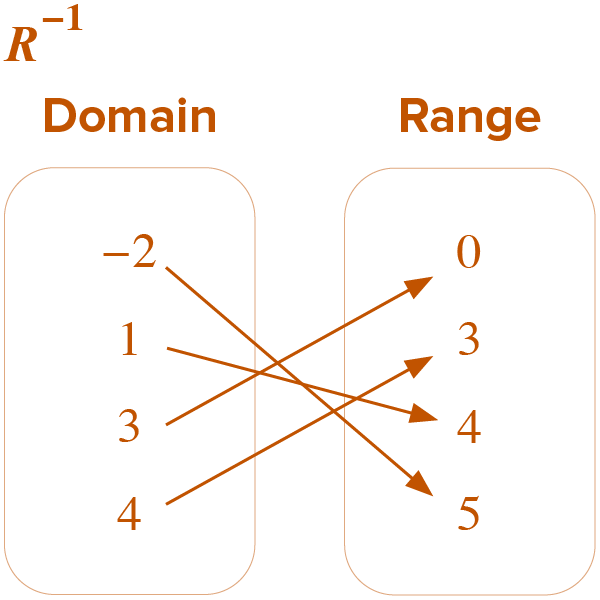
- Is the relation a function? Explain. Is the inverse of the relation a function? Explain.
Sample: The relation is a function because all of the domain values are unique. The inverse of the relation is also a function for the same reason. When the domain does not repeat, a function exists.
Find the inverse of the function.
Determine the inverse of the function algebraically. Then graph the function and its inverse on the coordinate plane.
- where
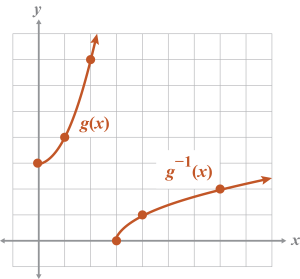
Determine the inverse of the function algebraically. Then graph the function and its inverse on the coordinate plane.
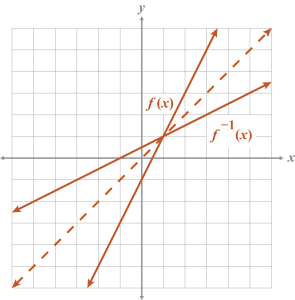
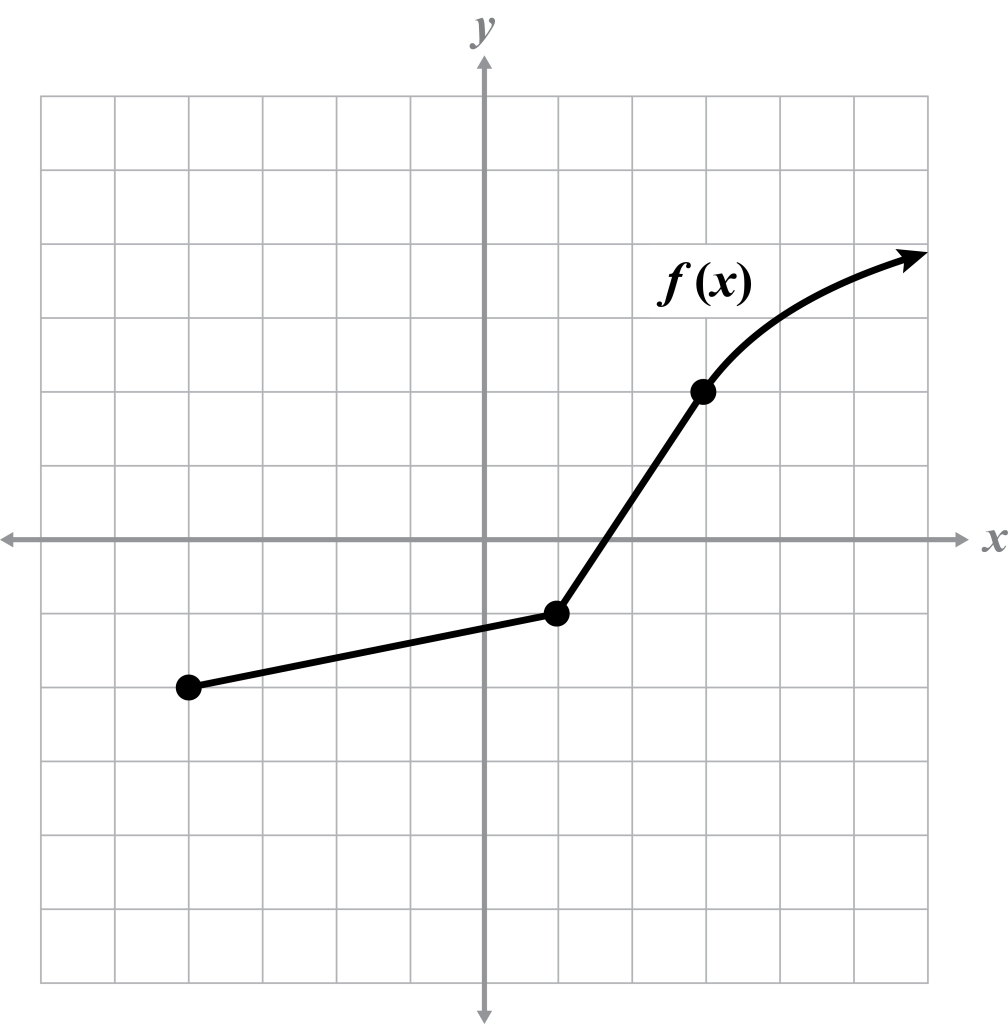
- Name the domain and range for the given function and its inverse.
Note
You may draw the inverse, but it is not required.
- Explain whether or not the function is one-to-one and whether or not the inverse is also a function.
Sample: The function is one-to-one. It passes the HLT. The inverse is also a function because the given passes the HLT, which makes the inverse pass a VLT.
- Graph the inverse.
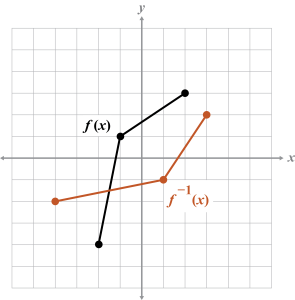
- Explain how you know that the inverse in problem 11 is also a function.
Sample: The graph is a function because it passes the vertical line test (VLT). The graph of f (x) also passes the horizontal line test (HLT) which makes also a function.