Compound Events Solutions
- A compound event in probability is made up of two or more simple events that happen together or in sequence.
Mutually Exclusive Events
- Mutually exclusive events cannot occur at the same time.
- If events have nothing in common, the sets will not intersect .
- For mutually exclusive events:
Note
This is always true because there are no overlapping elements.
- If A and B are mutually exclusive events, then the union , ⋃, of the events is:
or
Note
Notice the word “or” can be replaced by the union symbol ⋃.
Inclusive events
- Inclusive events occur when parts of a set overlap or intersect with another set.
- To prevent double-counting , subtract the intersection, ⋂, from the sum of A and B:
- Ask yourself, “What elements do A AND B have in common ?”

Example 3
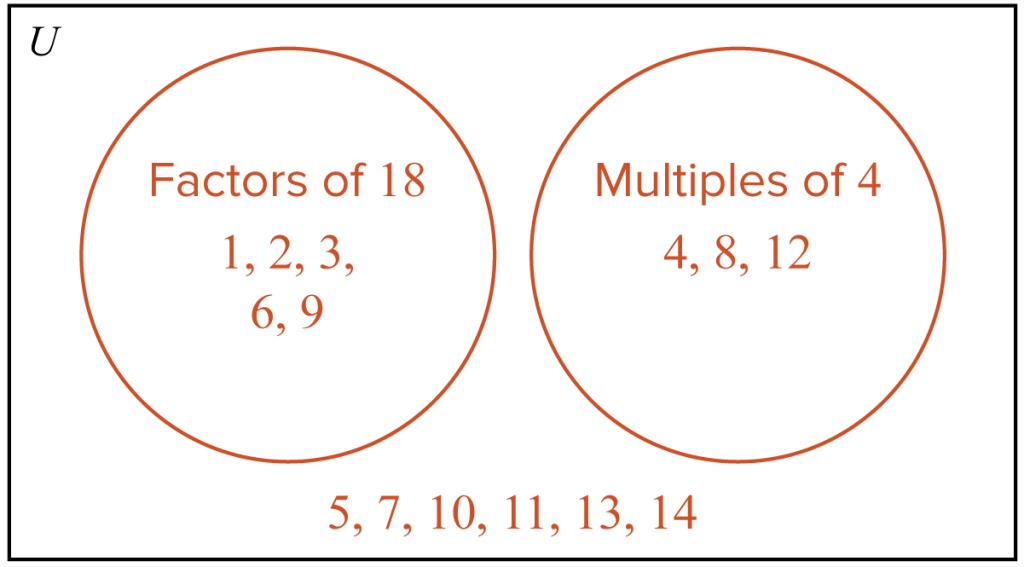
Sort the set, , into factors of 18 and multiples of 4. Then find the probabilities.
Note
Because there are no numbers that are both factors of 18 and multiples of 4, the events (or numbers) are mutually exclusive.
Remember, you need to count how many numbers, or elements, are in each section to find the probability. Do not use the numbers themselves.
Example 4
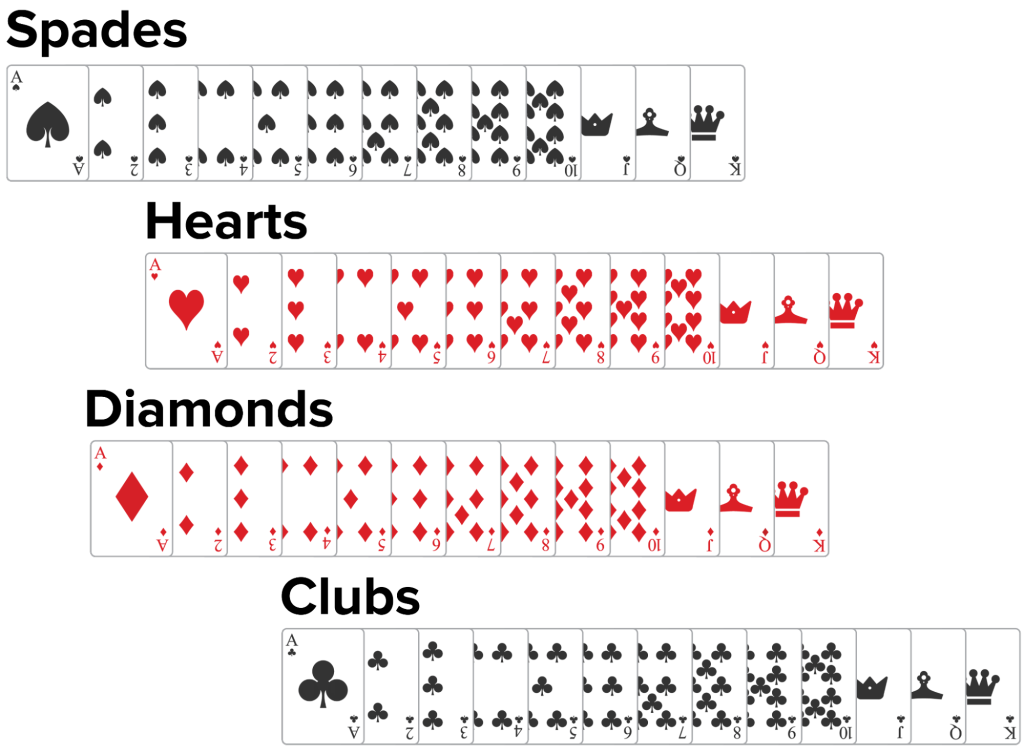
Determine probabilities of a standard deck of cards.
- A black ten or a red seven
Note
Problems A and E represent mutually exclusive events.