
Experimental Probability Solutions
Example 4
A probability experiment was conducted in which a coin was flipped to see how it landed, heads up or tails up. The data was recorded in a table.
- What is the experimental probability of landing tails up?
Total:
- What is the expected value for flipping a coin?
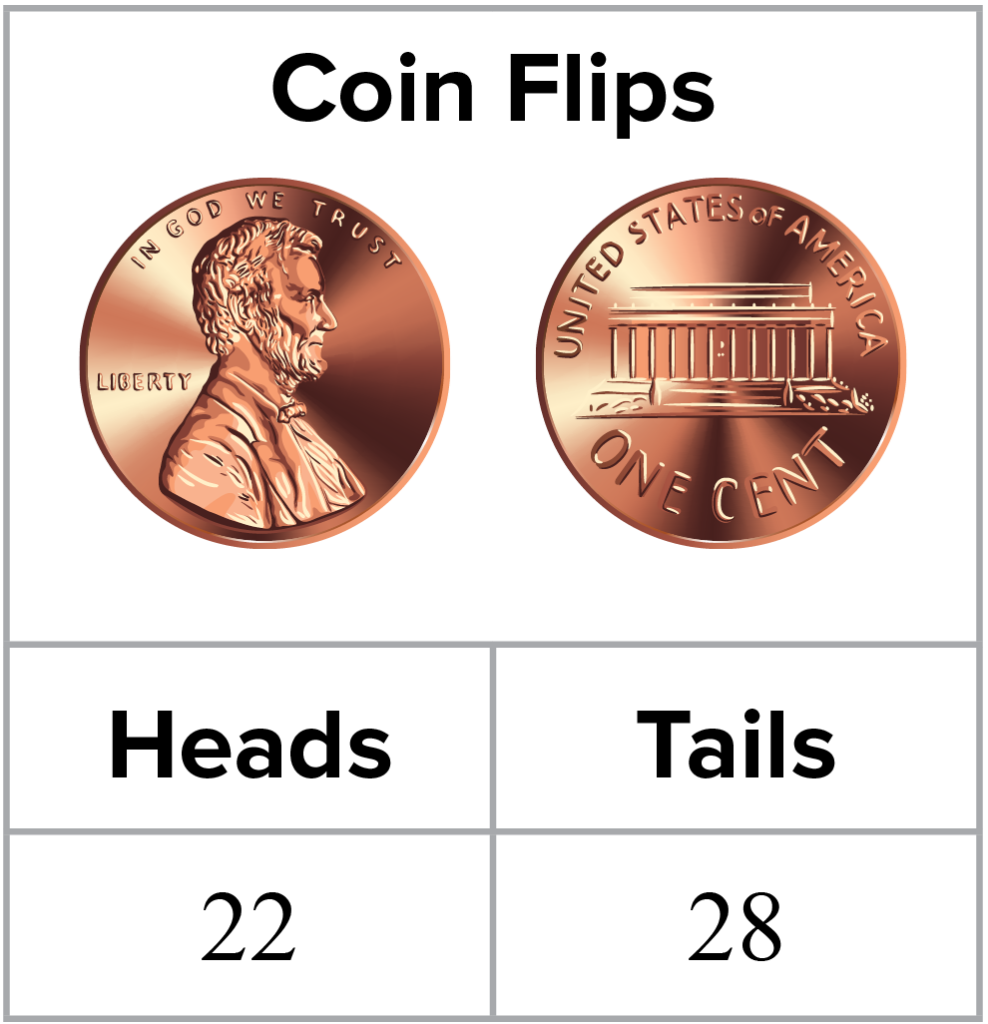
- Are the experimental and theoretical probabilities equal? Explain why or why not.
No . This experiment does not equal the theoretical probability because experiments have variations due to chance .
Note
It is unlikely that experimental and theoretical probability will be exactly equal, but the more trials completed, the closer they will get.
Example 5
A spinner contains wedges of equal size labeled with a letter. The tally chart shows the experiment’s results.
| Spin | Tally | |
| A | 40 | |
| B | 60 | |
| C | 32 | |
| D | 40 | |
| E | 48 | |
| F | 20 | |
| Total: | 240 |

- What is the theoretical probability of the arrow stopping on any wedge? Explain.
because the wedges are all the same size.
- From the tally chart, what spins are the most and least likely to occur?
Most likely: B
Most likely: F
- Based on the results, is the spinner fair? Explain.
Sample: The spinner is unfair because the events are not equally likely. Since there are six wedges on the spinner, a fair spinner would have results that simplify to about
Note
Probability can be used to determine whether fair decisions can be made. Analyzing events is important to deepen your understanding of probability.