Explore

Pascal’s Triangle Solutions

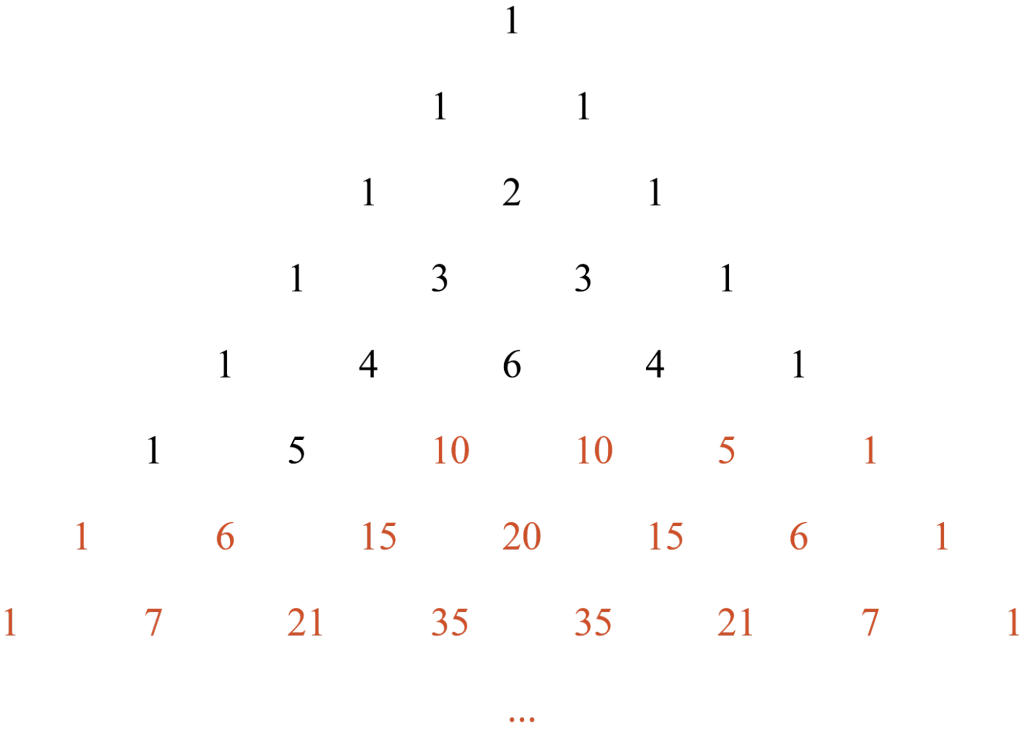
  •    Pascal’s Triangle    is a triangular arrangement of numbers in which each number is the sum of the two numbers directly above it.
  • Mathematicians have found many applications for Pascal’s Triangle, including:
    • Finding the number   of combinations for a problem   
    • Determining the coefficients    of nth row binomial expressions   
    • Finding the sum    of n-rows using 2n   
  • Pascal’s Triangle is constructed by    calculating the sum    of the two numbers in the row directly above it.

    • Each row starts and ends with    one   .

    • The top row of the triangle is “   row zero   .”
    • In each row that follows, the    second number    represents which row it is (row 1, row 2, etc.). 
Image3
Note

For example, row 2 (1 2 1) shows you there’s one way to choose zero items from a set of two, two ways to choose one item, and one way to choose both items.

  • To determine a combination, nCr, using Pascal’s Triangle:
    •    Go to the nth row   
    •    Count over to the (r + 1)th term     (the first term will always be the left-most “1” in the row)
    •    Record the answer   

For this lesson, a Pascal’s Triangle handout has been provided for you. You should be able to create additional rows on your own using the established pattern.

Example 1

Use Pascal’s Triangle to evaluate.

  1. nCr13, 7=1,716

Explain

  • The (r+1)th term in Pascal’s Triangle has the answer to the combination (7+1=8th term)
  • Find the 8th term in the 13th row
  1. nCr(15, 11)=1,365
Note

11+1=12th term

Find the 12th term in the 15th row

Example 2

Use Pascal’s Triangle to determine the sum of the row.  

  1. Row 6

26=1+6+15+20+15+6+1=64

  1. Row 17

217=131,072

Customer Service

Monday–Thursday 8:30am–6pm ET