
Mastery Check Solutions
Show What You Know
Complete the problem using f(x) and h(x).
- Write a new function, g(x), that is the inverse of f(x). Then, shift the graph up three units and right two units.
Note
Remember to identify a, h, and k to help describe transformations.
Q: What type of function is f(x)?
A: An exponential function
Q: What type of function occurs when you take the inverse of an exponential function?
A: A logarithmic function
- Describe the transformation from h(x) to f(x).
Logarithmic function, h(x):
Exponential function, f(x):
The inverse of h(x) is taken, then the graph is reflected over the x-axis and shifted up one unit.
Note
Q: What type of function is h(x)?
A: A logarithmic function
Q: What type of function occurs when you take the inverse of a logarithmic function?
A: An exponential function
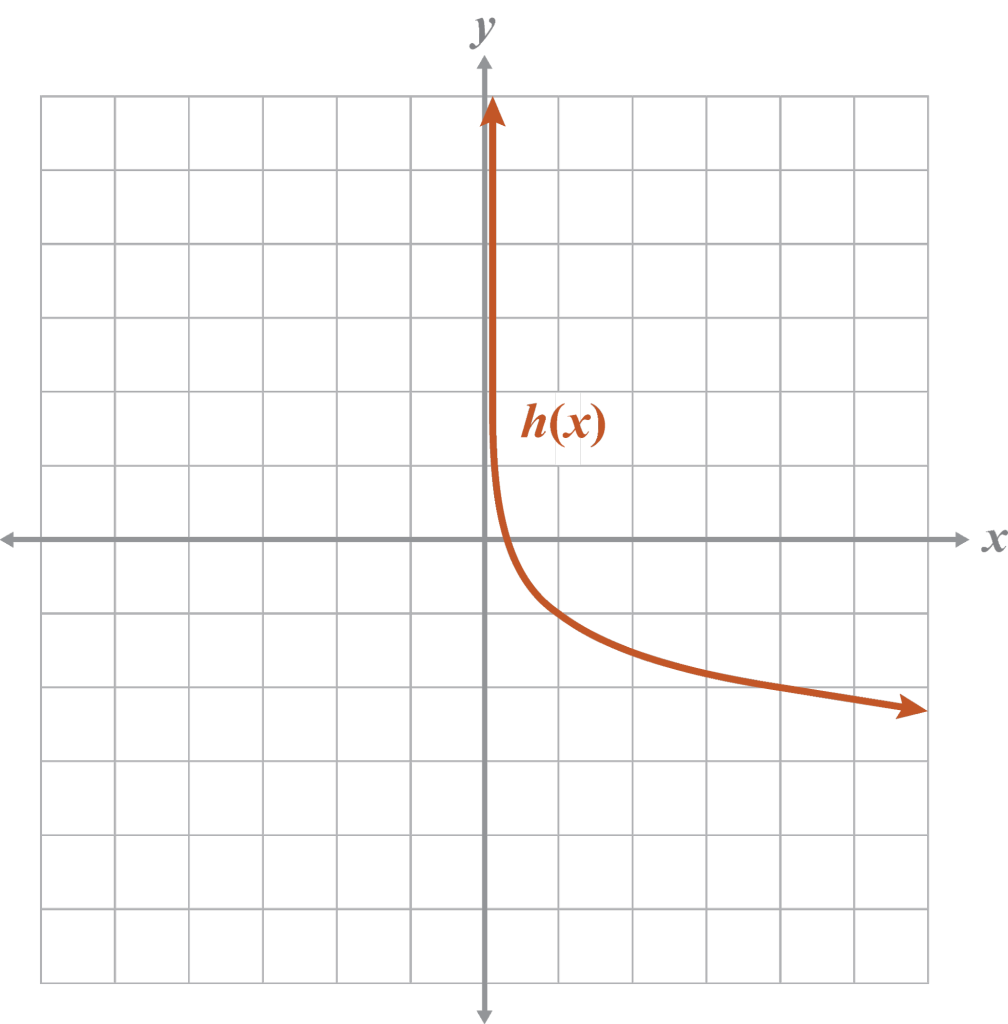
- Graph h(x).
h(x): a = –1, h = 0, k = –1
Asymptote: x = 0
Optional table:
| x | y |
| 0 | undefined |
| 1 | –1 |
| 2 | –1.5 |
| 4 | –2 |
| 8 | –2.5 |
Note
Use technology to determine the points on the graph.
Say What You Know
In your own words, talk about what you have learned using the objectives for this lesson and your work on this page.
Note
Restate the objectives of the lesson in your own words. If you are unable to restate the lesson objectives, go back and reread the objectives and then explain them.
- Write the inverse of an exponential and logarithmic function.
- Graph a logarithmic function.
- Transform a logarithmic function.
- Describe logarithmic functions in words and with an equation.