Explore

Graphing Exponential Functions Solutions

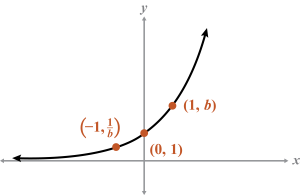
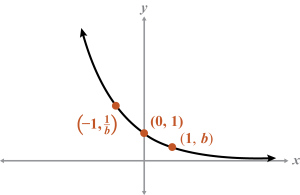
  • The exponential    parent function    is: y=bx, b>0, b1.
    • b>0: The base, b, cannot be    negative   .
    • b1: The base cannot equal one because one raised to any power is one, which results in a    a horizontal line   .
  • This equation has two forms:

    •    exponential growth  
    •   exponential decay    
  •  When the exponent, x, is    positive   , the    value of b    determines whether the function represents exponential growth or decay, without creating a graph.
  • And so, the value of b is also called the    growth or decay factor  .
  • Because there are an infinite number of    +   , there are infinite    parent graphs with base b   .

Pay attention to bx compared to bx. Without parentheses, the problem would read 1·bx, which would mean the base is not negative.

Recall that when an exponent is negative, take the reciprocal of the base.

Growth Function Decay Function
 b>1 y=bx, b>0, b1 0<b<1y=bx, b>0, b1

Asymptote: y = 0 (x-axis)

End behavior: As x+, f(x)+, and as x,  f(x)0.

Asymptote: y = 0 (x-axis)

End behavior: As x+, f(x)0, and as x, f(x)+.

Domain: x|x

Range: y|y, y>0

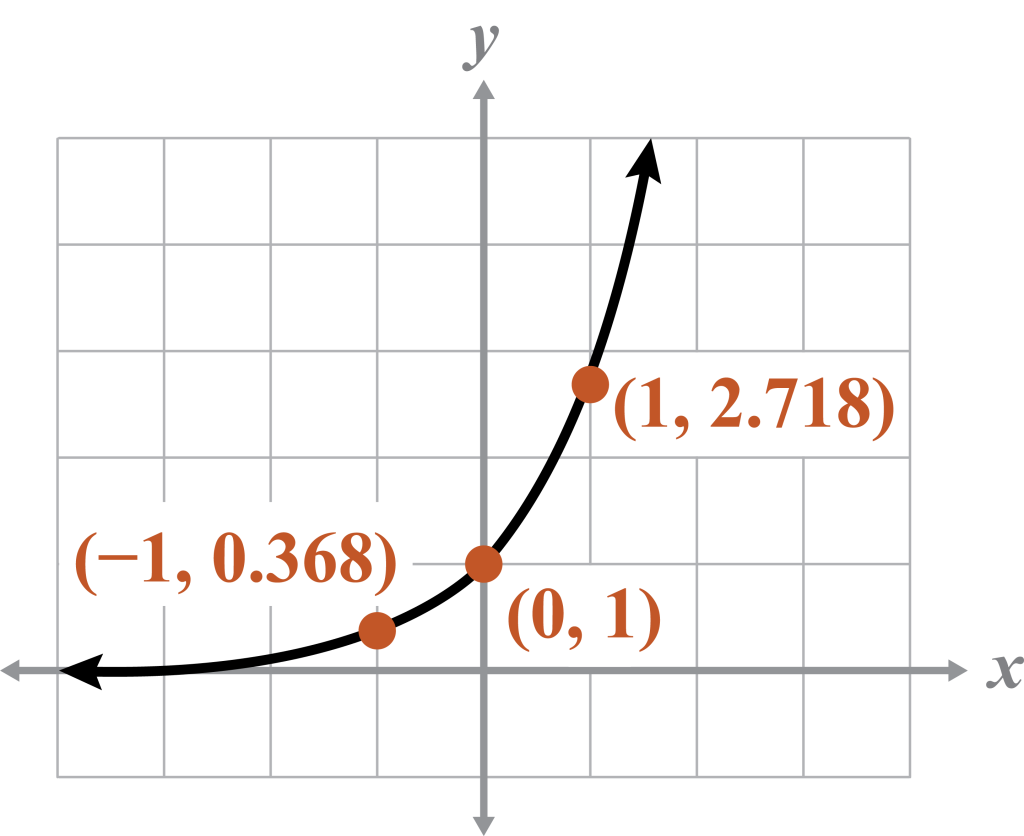
  • The    natural    exponential function, fx=ex, is a special exponential function.
    • In the function, e equals 2.718281…., e is an    irrational    but well-rounded number.
    • Because e is an irrational number, the approximation    2.718    will be used (rather than 2.718281…).

It is recommended that you use a calcÍulator when working with e

Note

e is defined as e=limn 1+1nn.

Example 1

Name the value of b and if it represents growth, decay, or neither.

 fx=0.2x 

b=0.2 

qx=4x

b=4 

gx=0.4x

b=10.4=2.5

 y=8x

b=8 

hx=10x

b=110

 y=1x

b=1 

kx=ex

b=e 

Note

Remember e is an irrational number.

Exponential Growth Exponential Decay Neither
qx=4xgx=0.4x kx=ex  f(x)=0.2x h(x)=10x   y=8x  y=1x
These functions represent exponential growth because b>1. These functions represent exponential decay because 0<b<1. These are not exponential functions because b=1 or b is a negative value.

Example 2

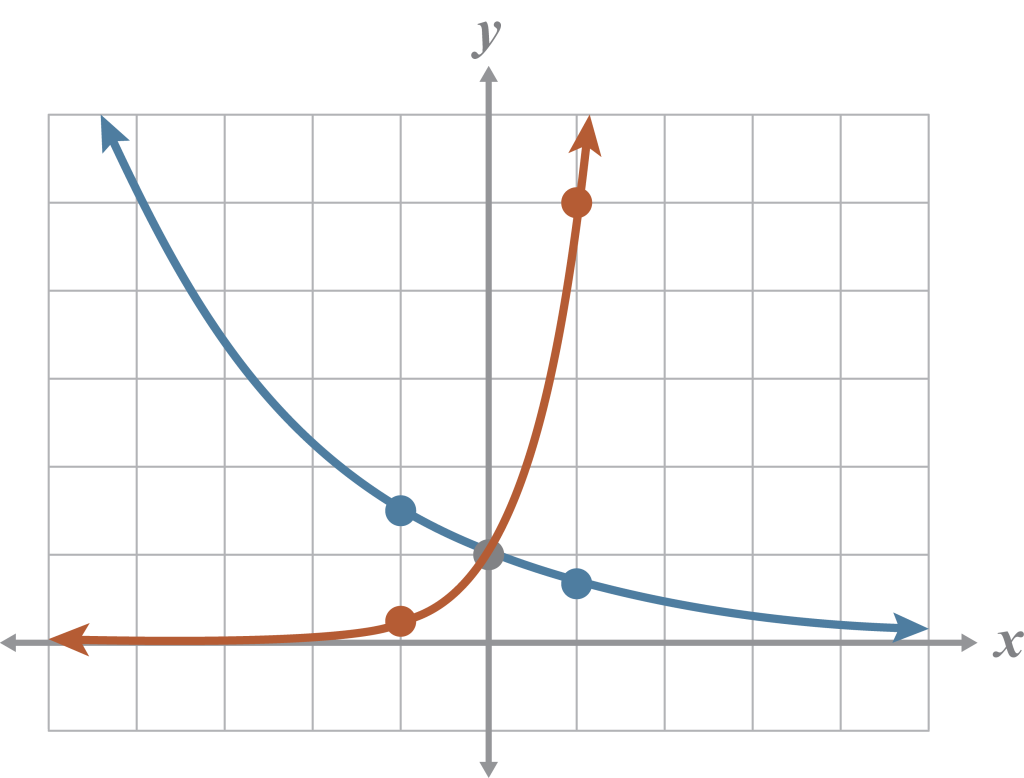
Graph both functions on the same coordinate plane. Name the end behavior and the domain and range.

 fx=5x 

b=5, growth 

gx=32x

b=23, decay 

Note

The negative power tells you to take the reciprocal of the base before determining if the graph will be a growth or decay function. Remember, both graphs have an asymptote at y=0.

x f(x) g(x)

Domain: x|x

Range: y|y, y>0

–1 15 32  
0 1 1  
1 5 23  

As x+,    f(x)+   , and as x,    f(x)0   .

As x+,    g(x)0   , and as x,    g(x)+   .

Customer Service

Monday–Thursday 8:30am–6pm ET