
Mastery Check Solutions
Show What You Know
Use the equation to answer each part.
Sample: Since , there are five roots. There can be five real roots, or three real and two non-real, complex roots, or one real and four non-real, complex roots.
Note
Optional Chart:
| degree | real | non-real, complex |
| 5 | 5 | 0 |
| 3 | 2 | |
| 1 | 4 |
- Explain how many turning points can occur for k(x). Why would a graph have fewer turning points?
Sample: There can be at most four turning points because there is one fewer turn than the value of n. A graph has fewer turning points when roots have multiplicities higher than one.
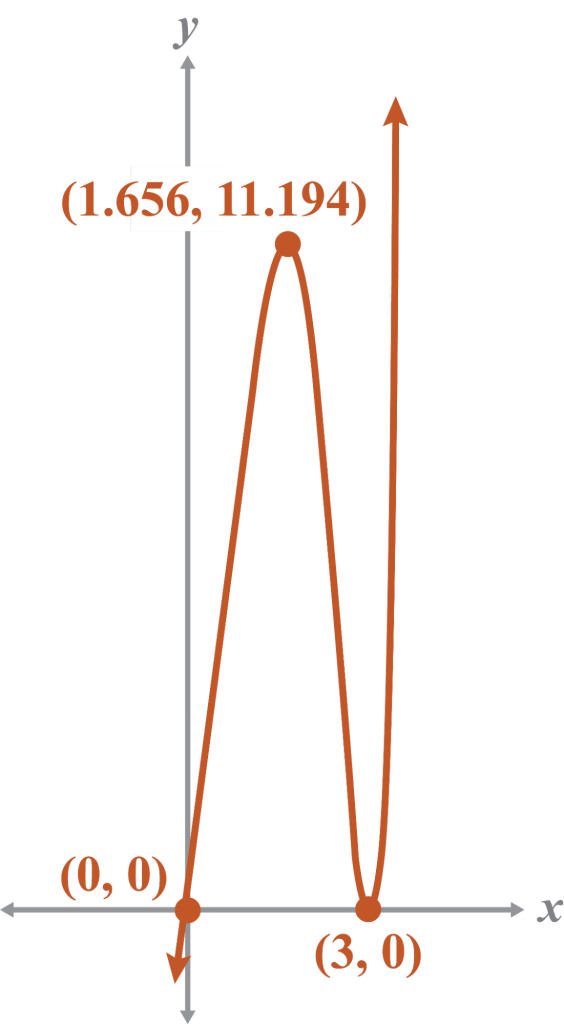
- Determine all roots for k(x). Describe the multiplicities as real or non-real, complex roots.
from the graph
, multiplicity 2 from the graph
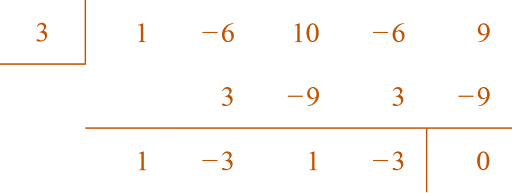
The function k(x) has three real roots when , 3, and two non-real, complex roots at ±i.
Note
You can also use repeated synthetic division to determine the non-real, complex roots.
Say What You Know
In your own words, talk about what you have learned using the objectives for this lesson and your work on this page.
Note
Restate the objectives of the lesson in your own words. If you are unable to restate the lesson objectives, go back and reread the objectives and then explain them.
Determine the number of roots for a given polynomial function using the Fundamental Theorem of Algebra.
Locate and estimate the relative minimum and relative maximum of a function (including the use of technology).
Sketch a graph given turning points and real zeros (distinct and multiple roots).
Name the increasing and decreasing intervals across a function.