
Explore
Multiplicity Solutions
Sketches, unlike exact graphs, do not need to include every detail.
Sketches in this lesson do not include the y-axis.
| Multiplicity |
Description/Implication |
Shorthand | Sketch |
| 1 | cross-through | C | 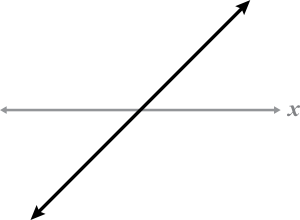 |
| 2 |
bounce (also called double root ) Note Any higher even multiplicities will make the point of intersection with the x-axis flatter.
|
B |  |
| 3 |
snake Note Any higher odd multiplicities will make the point of intersection with the x-axis flatter.
|
S | 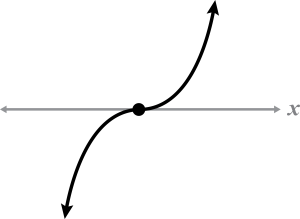 |
The descriptions/implications provided in the table are not technical math vocabulary; rather, they provide a way to describe multiplicity in simple language.
To state the possible multiplicities and the degree given a graph:
Example 1
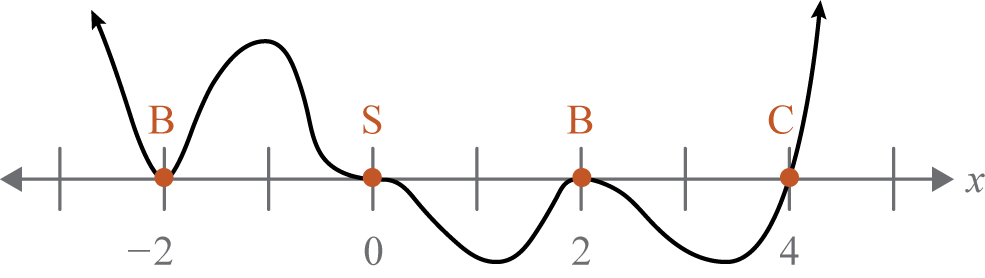
Write the polynomial as a product of factors using the graph.
Note
Start by determining the possible degree and multiplicities.
a > 0
n = even degree
C = cross-through
B = bounce
S = snake
Estimated degree:
Note
Remember, when finding the roots, you set the x-values equal to zero, which means that your equation can either be set equal to zero or f(x).
Example 2
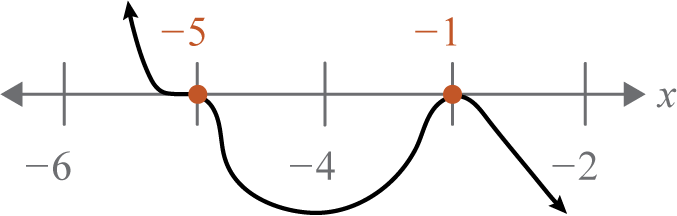
Write the polynomial as a product of factors using the graph. Explain.
a < 0
n = odd degree
Estimated degree:
n = 3 + 2 = 5
Explain
Note
Ask yourself: Based on multiplicity, what is the minimum degree this could be?