
Practice 1 Solutions
For problems 1–3, use the graph and equations.
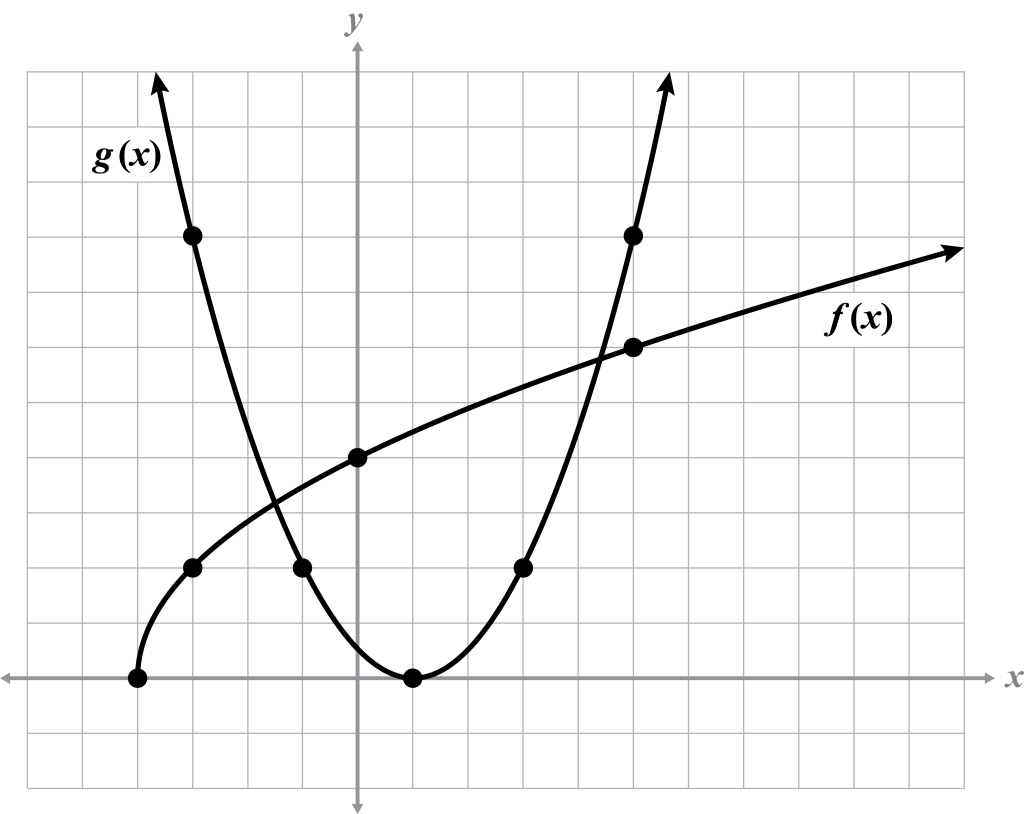
Note
The values were determined by reading the graph.
Note
Read f(–4) from the graph, and then check g(0) with the equation.
Note
g(–3) can be determined from the graph. f(8) needs to be determined algebraically because the function continues past what is viewable (extrapolation).
- State the domain and range of .
For problems 5–9, use the following functions to determine the given composite function. List all domain restrictions for the composite function.
Note
The denominator needs to be factored to determine all of the values excluded from the domain.
Determine the composite function.
Note
You don’t need to clear the square root from the denominator in the second step because when you divide in the next step, it flips to the numerator.
- Determine f and g such that and Select all that apply.
Note
The first and fourth options have f(x) and g(x) reversed.
- Determine j and k such that and Select all that apply.
Note
The second option has the constants reversed.
The third option has j(x) and k(x) reversed.
- Determine a and g such that and Select all that apply.
Note
The first option does not square and includes –1 under the radical.
- The regular price of a new gaming system is x dollars. A store allows customers to apply a $200 off coupon as well as a 15% off coupon. Determine which coupon should be applied first to get the lowest price.
allows for the greatest discount. 15% off coupon should be applied first, then the $200 off coupon.
Note
Use a specific dollar amount for the gaming system if you are struggling to determine the best discount.
For problems 17–20, determine if f(x) and g(x) are inverses.
f(x) and g(x) are inverses
f(x) and g(x) are not inverses
f(x) and g(x) are inverses
f(x) and g(x) are inverses