Explore
Composition of Functions Solutions
- A composition of functions occurs when one function is substituted into another function.
- A composition differs from a combination of functions because the commutative property does not hold true for composition of functions.
- The composition of the function f with g is noted as
- For all occurrences of x in f(x), substitute the expression equal to g(x) and simplify.
-
- “The function f composed with g.”
- The domain of the function f composed with g is the set of all x where:
- x is in the domain of g
- g(x) is in the domain of f
- If x is not in the domain of g(x), then it is not in the domain of .
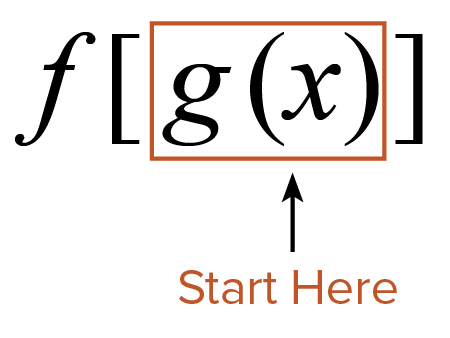
- The output for the inside function is the input for the exterior function. Therefore, you simplify from the inside out.
Note
In this level, the domain of the composition of functions will be the focus.
Either brackets or parentheses can be used to note a composition of functions. In this level, brackets are used to distinguish compositions from combinations of functions.
Example 1
Find and . State the domain and range.
Recall: A relation is a set of ordered pairs and can represent a discrete function.
Example 2
Find , and when and . Determine the domain of the composite function.
Plan
Determine the domain for the interior function
Simplify the composition of functions
Determine the domain for the composition of functions
Note
Remember the domain for the composition of functions includes restrictions for the interior function as well as the composition.