Explore
Hyperbolas Solutions
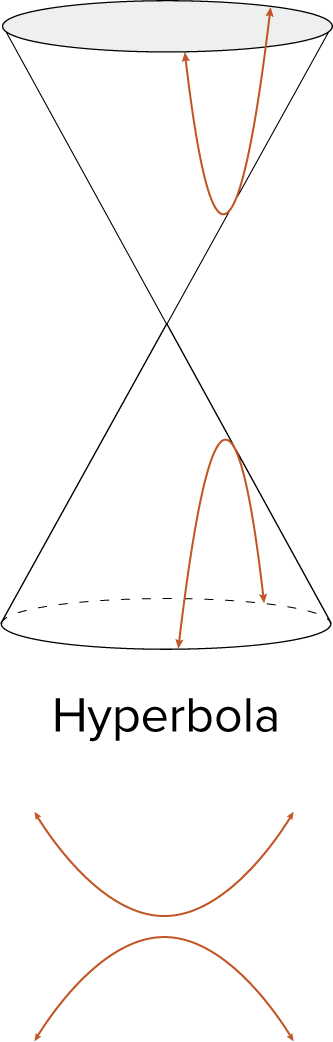
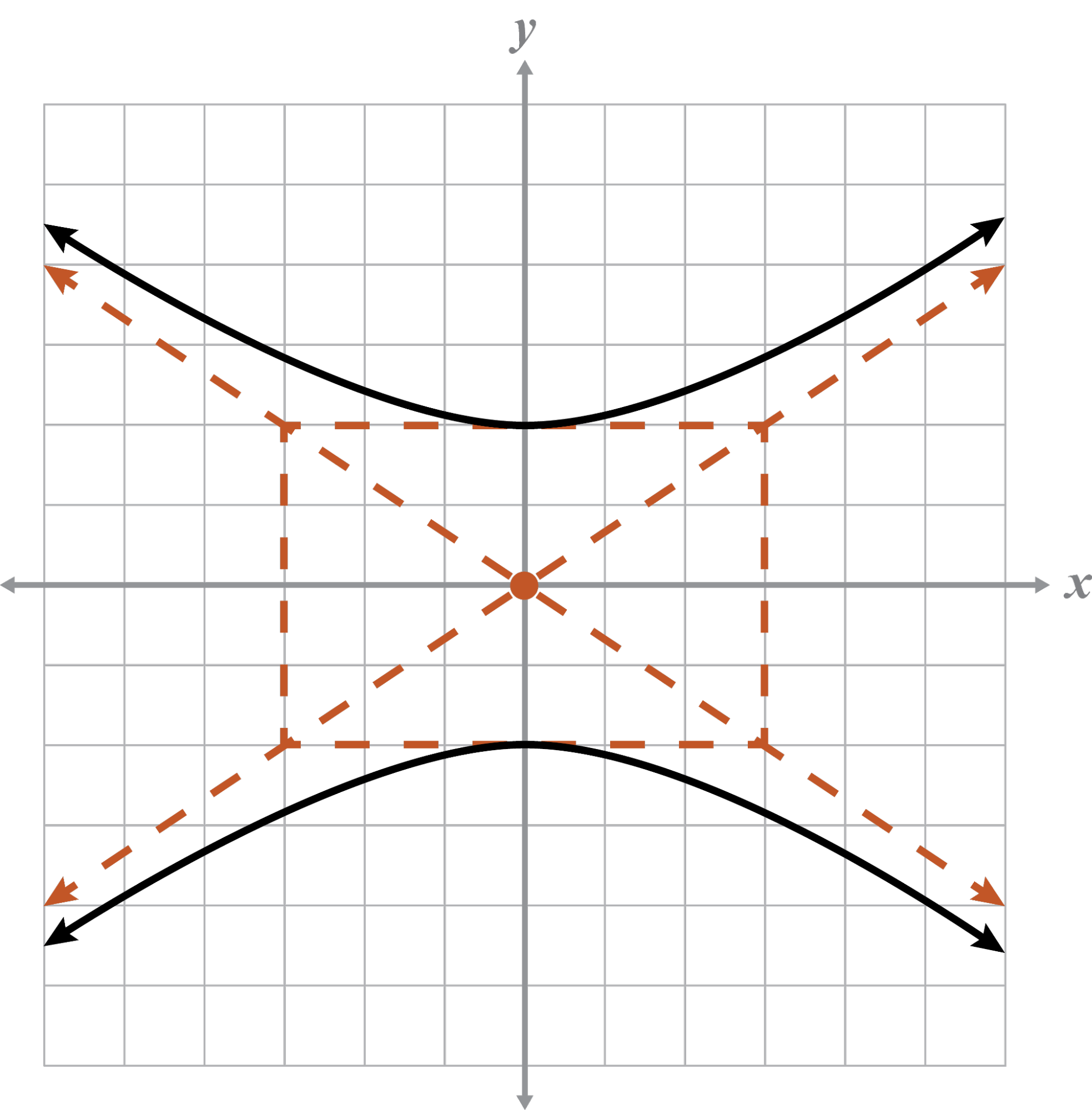
- A hyperbola is a conic section that is an open curve with two symmetric u-shaped branches set between asymptotes.
- A hyperbola is called a deep verticle slice when referring to conic sections.
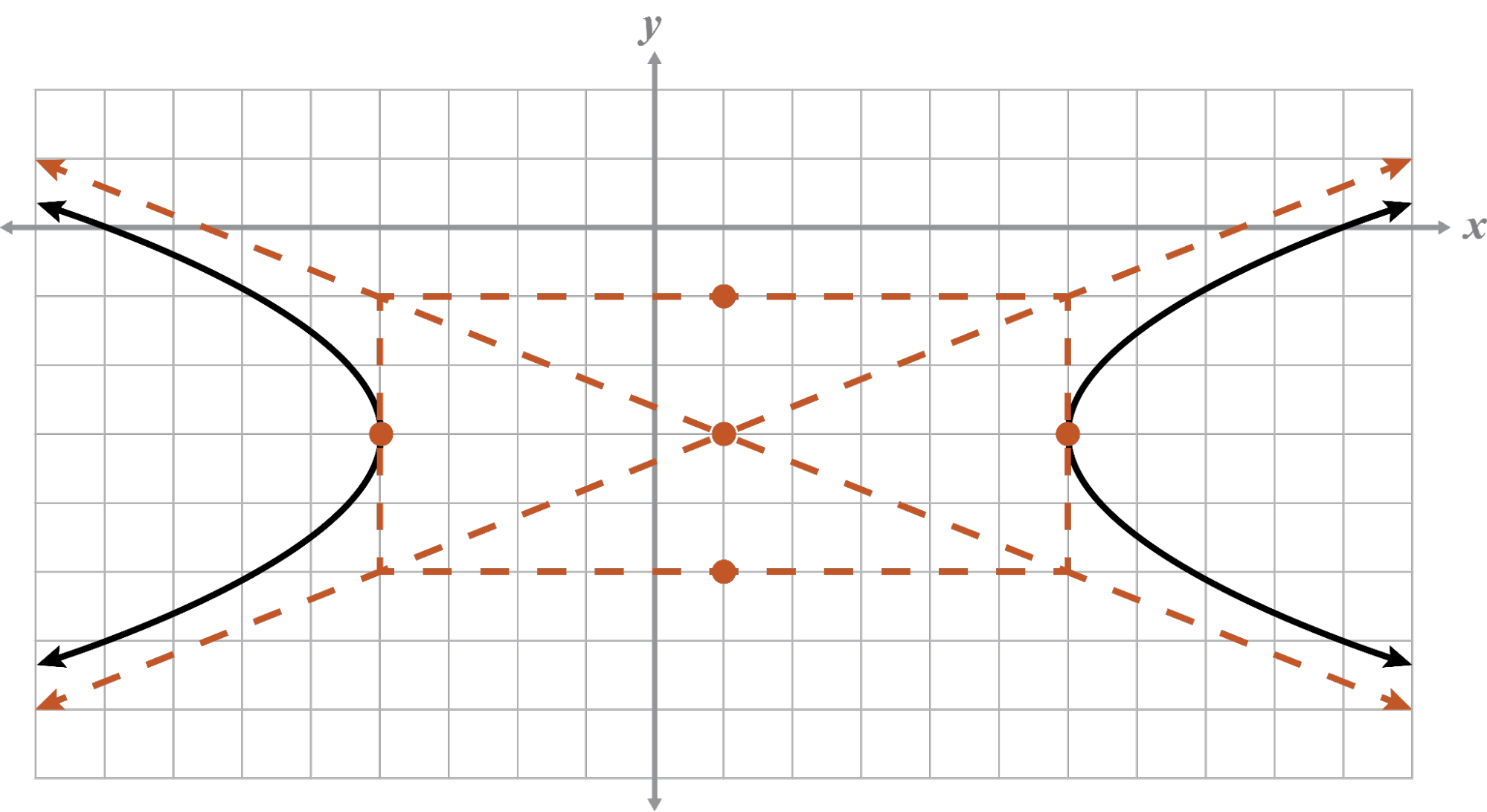
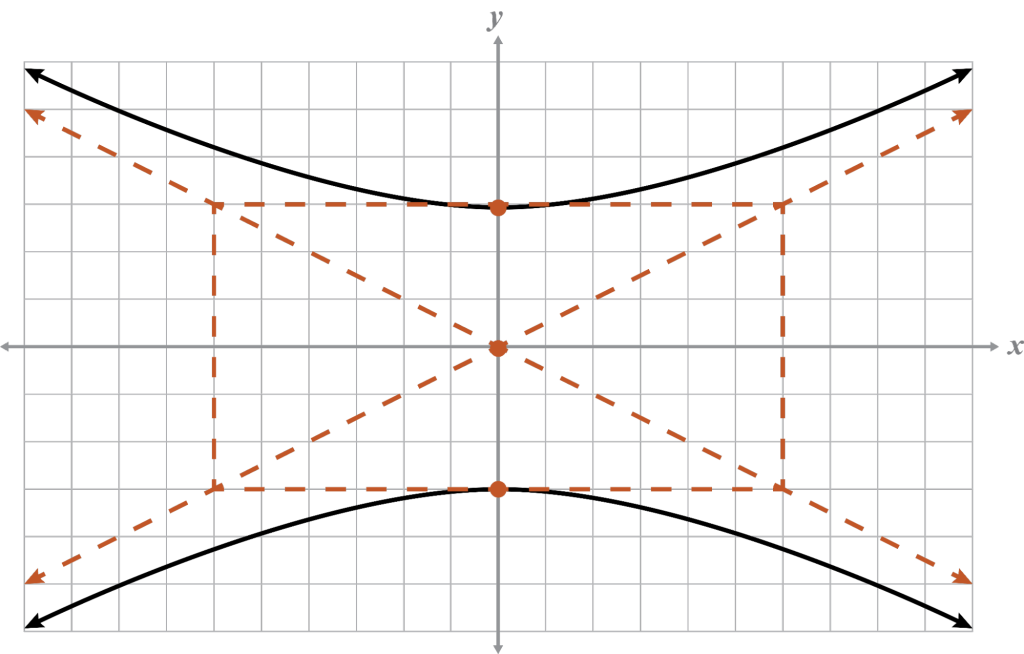
- The equation of a hyperbola has two general forms to represent either a horizontal or vertical graph.
- The hyperbola is broken into two parts, or branches, that fit between two slant asymptotes that meet at the center, .
Note
Recall from earlier lessons that an asymptote is a line that a graph approaches as it moves toward infinity. An asymptote is an invisible guideline that sets the boundaries of the graph. This means that it is not always drawn.
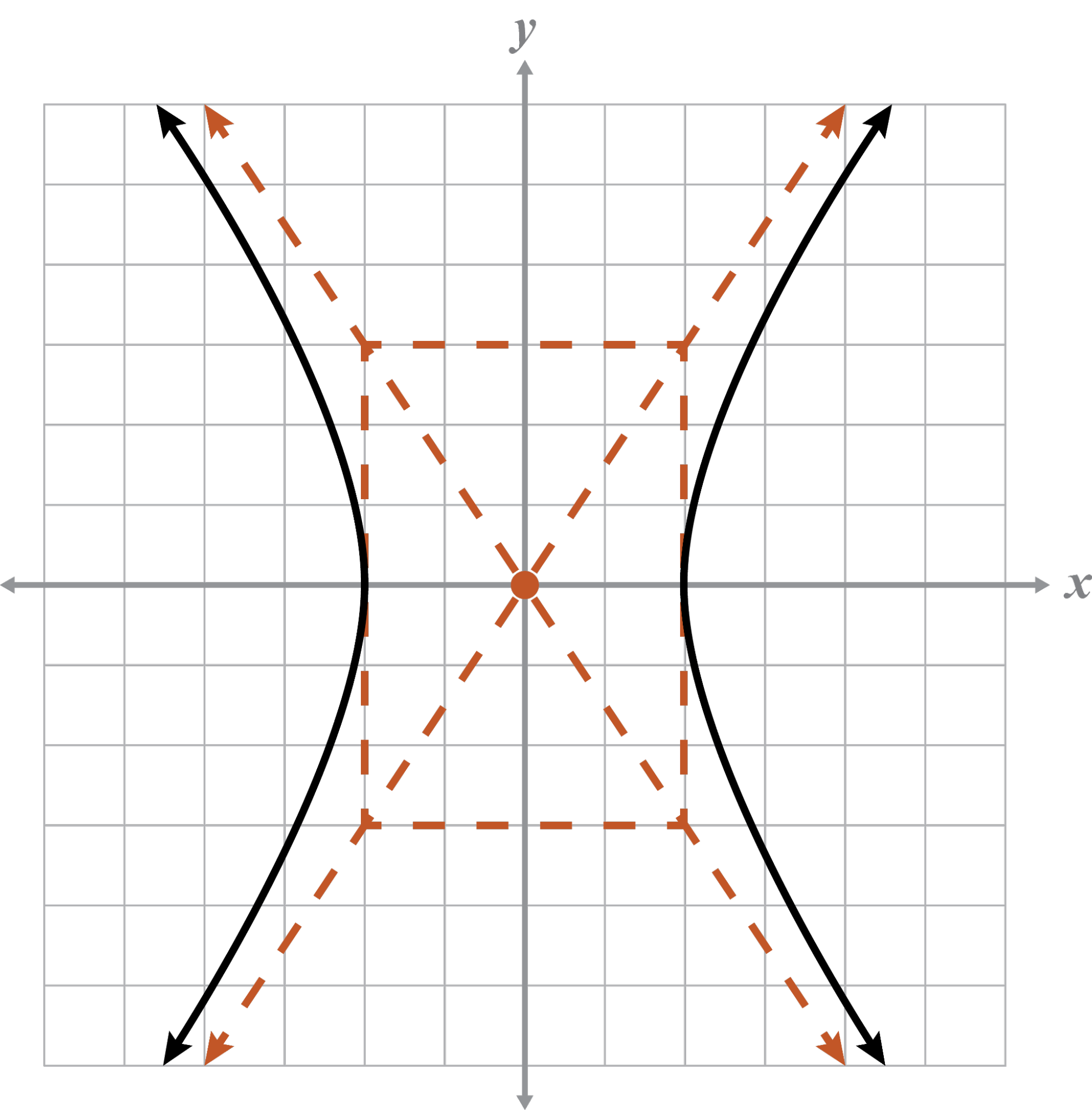
- The asymptotes of hyperbolas will be written in point-slope form where .
| |
Horizontal |
Vertical |
| General Form |
|
|
| Asymptotes |
 |
 |
| Branches |
left and right |
above and below |
| Transverse Axes |
horizontal |
vertical |
- The branches of the hyperbola intersect the transverse axis at the vertices .
- The vertices and co-vertices form a rectangle that can be used to graph the slant asymptotes diagonally across the rectangle and through the center, .
- The direction that the branches open is determined by the form of the equation.
- Note the direction on your paper with a quick sketch so that you can confirm your final graph matches it.
Example 1
Mark the center, asymptotes, and the vertices and co-vertices on the graph for the equation:
Plan
Determine the center, a, b
Mark the vertices and co–vertices
Mark the asymptotes
Write the equation of the asymptotes
Center
Example 2
Mark the center, asymptotes, and the vertices and co-vertices on the graph for the equation:
Center
Note
When the center is , it is not necessary to write the equation in point-slope form.