
Targeted Review Solutions
- Determine any missing roots, then write a possible polynomial equation.
- Determine the missing value that will make the expression a perfect trinomial square.
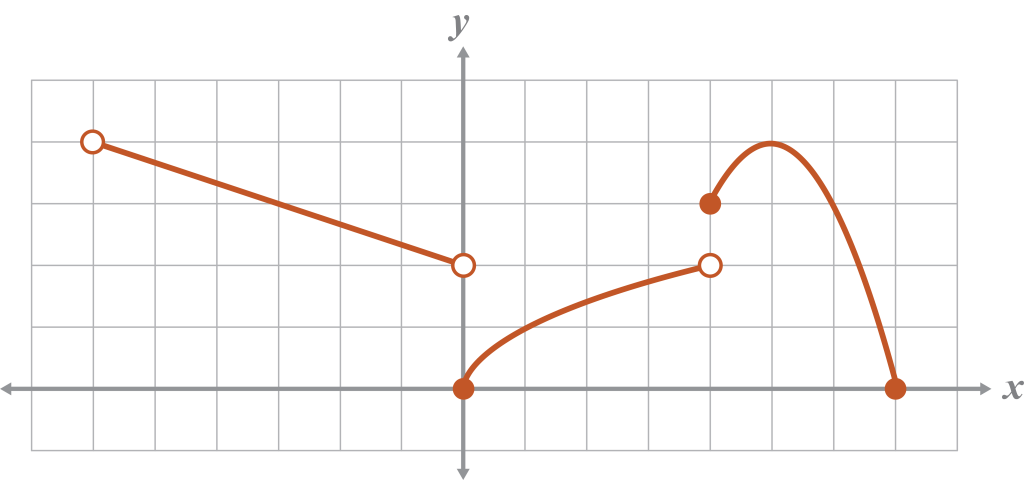
- Graph. (piecewise function)
- Graph:
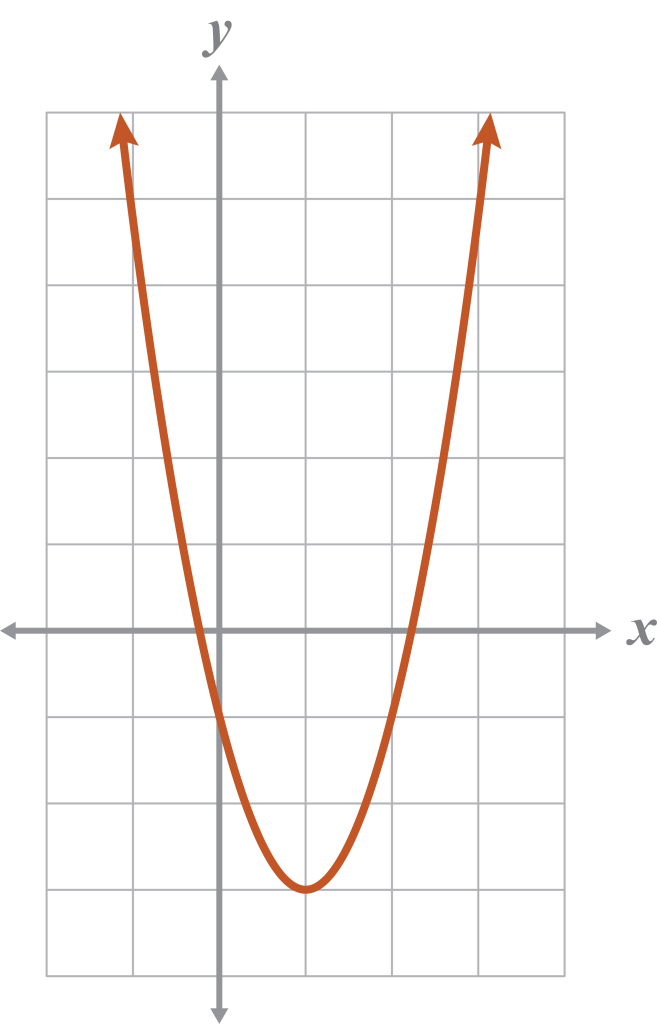
- Solve by completing the square.
Match both the equation in vertex form and the domain and range to the function name below.
- B, D Quadratic
- A, F Cubic
- C, E Rational
Multiple Choice
C
- Determine the perimeter of an isosceles right triangle with a hypotenuse that measures
-
4 meters
-
cannot be determined
Note
- A side of a triangle cannot be negative. This option is also not the perimeter.
- This option is the length of each leg. This value is needed to calculate the perimeter, but is not the perimeter.
- Because the triangle is an isosceles right triangle, it is possible to solve for the measure of both missing legs.
D
- Solve:
Note
- This answer is incomplete.
- This answer tries to combine the values.
- This answer drops the square root symbol with the number 2.
D
- The work provided for solving a quadratic equation contains an error.
Select the correct roots.
Note
- This answer occurs if the right side of the equation is equal to –18, in step 3.
- This answer does not fix the error and solves the problem with the error in step 6.
- This answer occurs when –1 is dropped from the left side of the equation in step 6.
- Classify the expression:
-
rational
-
irrational
-
real
-
imaginary
-
complex
Note
The square root of six is irrational; therefore, the expression cannot be rational. The imaginary number is not in the expression; therefore, it cannot be classified as an imaginary number.
| Problem | 1 | 2 | 3 | 4 | 5 | 6 | 7 | 8 | 9 | 10 | 11 | 12 |
| Origin | L23 | L24 | L21 | L18 | L24 | L17 | L17 | L17 | – | L23 | L24 | L15 |
L = Lesson in this level, A1 = Algebra 1: Principles of Secondary Mathematics