The Discriminant Solutions

  • When the quadratic equation is written in standard form, ax2+bx+c=0, the values of a, b, and c are used in the    discriminant   .
  • The discriminant is    b24ac   , which is the expression in the quadratic formula that is under the square root symbol.
  • 
The discriminant is used to determine the    quantity    and    type of roots    a quadratic equation will have.

  • The discriminant:
 
    •    does not    tell you the exact values for the roots.
determines whether you will have 0, 1, or 2     real    roots.
    • 
can help determine:

    • if the    graph    of a quadratic equation intersects the    x-axis    as you expect.

    OR

  • 
what    type    of answer to expect when using the quadratic formula.


Discriminant Value

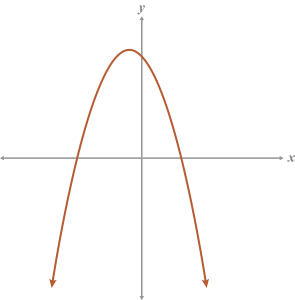
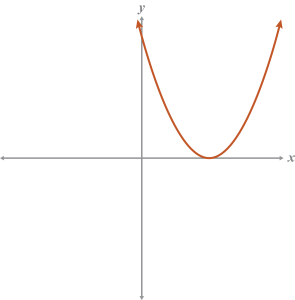
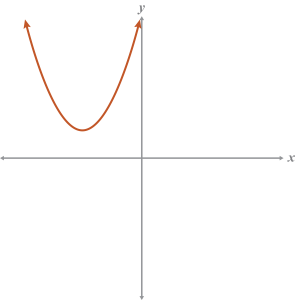
Roots Graph

b24ac>0

If b24ac>0 is a perfect square

If b24ac>0 is not a perfect square

2 real roots, or two x-intercepts

2 rational roots


2 irrational roots
b24ac=0

1 real root, or one x-intercept

Also referred to as double root because the equation in factored form will be

b24ac<0

0 real roots, or zero x-intercepts


2 complex roots
  • Remember    all numbers    are part of the complex number system. However, when describing the type of roots using the discriminant, complex refers to values in the form a±bi, where b0. 

  • If the discriminant is a    perfect square   , then the roots of the equation can be found using your preferred method of solving a quadratic equation.

Example 3

Determine the type of roots to the quadratic equation using the discriminant. Explain what the discriminant tells you about the roots.

3x2+8x4=x21

Plan

Write equation in standard form

Identify a, b, and c

Write the discriminant formula

Substitute values into the formula

Simplify

Implement

2x2+8x3=0a=2, b=8, c=3

b24ac8242364+2488

Explain

Because the discriminant is    greater than zero   , but not a perfect square, there are    2 irrational real    roots.

Example 4

Determine the type of roots to the quadratic equation using the discriminant. Explain.

x2+8=5x

Implement

x25x+8=0a=1, b=5, c=8b24ac5241825327

Explain

Because the discriminant is    less than zero   , there are    0 real    roots; however, there are    2 complex    roots.

Note

If you use mental math or can see that the value will be greater than or less than zero, it is not necessary to calculate the exact value of the discriminant.

Customer Service

Monday–Thursday 8:30am–6pm ET