Explore
Solutions to Inequalities Solutions
- When given an inequality or system of inequalities, use substitution to check algebraically if an ordered pair is or is not a solution.
- If you have a graph of an inequality, estimate the location of the ordered pair on the graph.
- Remember, these items are excluded from inequality solutions:
- dashed curves
- open points
- asymptotes
- To write an inequality from a graph consider these items:
- the family to which it belongs (use your formula sheet)
- how it is transformed , or the values a, h, k
- the inequality symbol (solid or dashed curve and shading)
Example 1
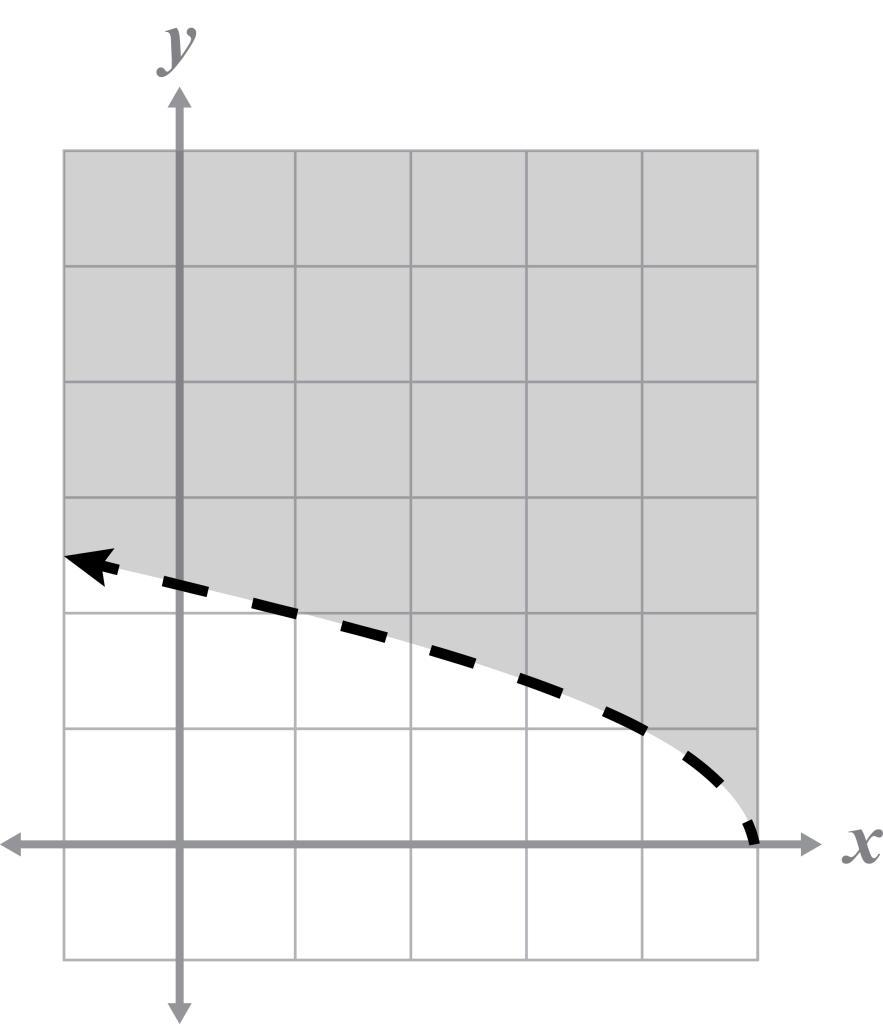
Write the inequality for the given graph.
Plan
Square root
Reflected over the y-axis: f(–x)
Translated 5 to the right
Shading above, dashed
Determine if are solutions to the inequality.
Point A is not a solution because it is not found within the shaded region .
Point B is a solution because it is found in the shaded region .
Point C is not a solution because it is not found within the shaded region .
Point D is not a solution because it is on the dashed line .
Example 2
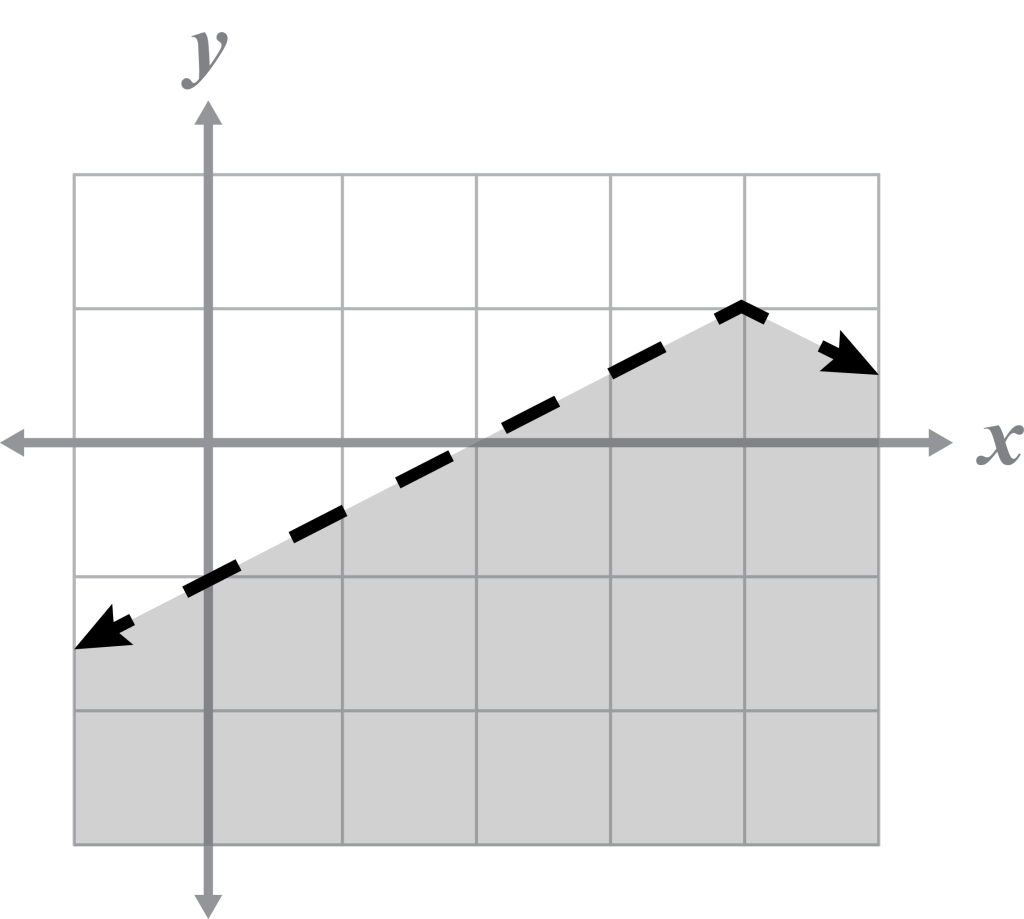
Write the inequality for the given graph.
Plan
Absolute value
Reflected over the x-axis
Translated right 4 and up 1
Shading below, dashed
Example 3
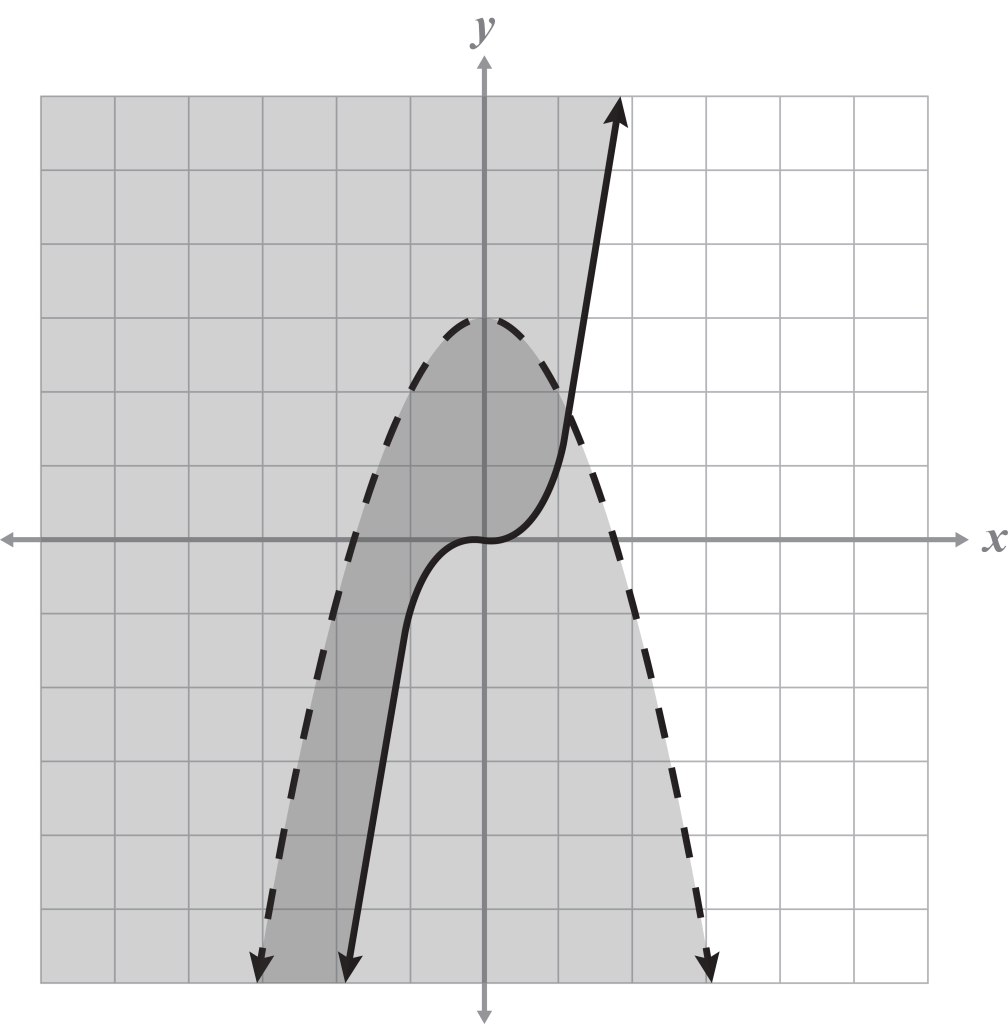
Write the system of inequalities for the given graph.