
Reciprocal Parent Functions Solutions
| Non-Polynomial Parent Functions | ||||
| Type | Absolute Value | Square Root | Cube Root | Reciprocal |
| Parent equation | ||||
| Degree | does not apply | –1 | ||
| Domain and Range | ||||
| Quadrants | Q1 and Q2 | Q1 | Q1 and Q3 | Q1 and Q3 |
| Because | y-coordinates will always be positive because | only are being graphed, so the x- and y-values will be zero | cube root of a number can be ±, so there are no restrictions for domain and range | 1 divided by a positive value will give a positive value ; 1 divided by a negative value will give a negative value |
| Other Characteristics | v-shaped, symmetric Axis of symmetry is the y-axis |
partial inverse of the quadratic function | inverse of the cubic parent function | has asymptotes denominator ≠ zero |
| Intersects graph | vertex at origin, changes directions at origin | defined start and end point at the origin | crosses the coordinate plane at the origin | continues across the coordinate plane in four directions with four end behavior statements (not two) |
Example 9
Graph the rational parent function. Name the domain and range set-builder notation. Then name the end behavior of the graph.
| x | y |
| –2 | –0.5 |
| –1 | –1 |
| 0 | undefined |
| 1 | 1 |
| 2 | 0.5 |
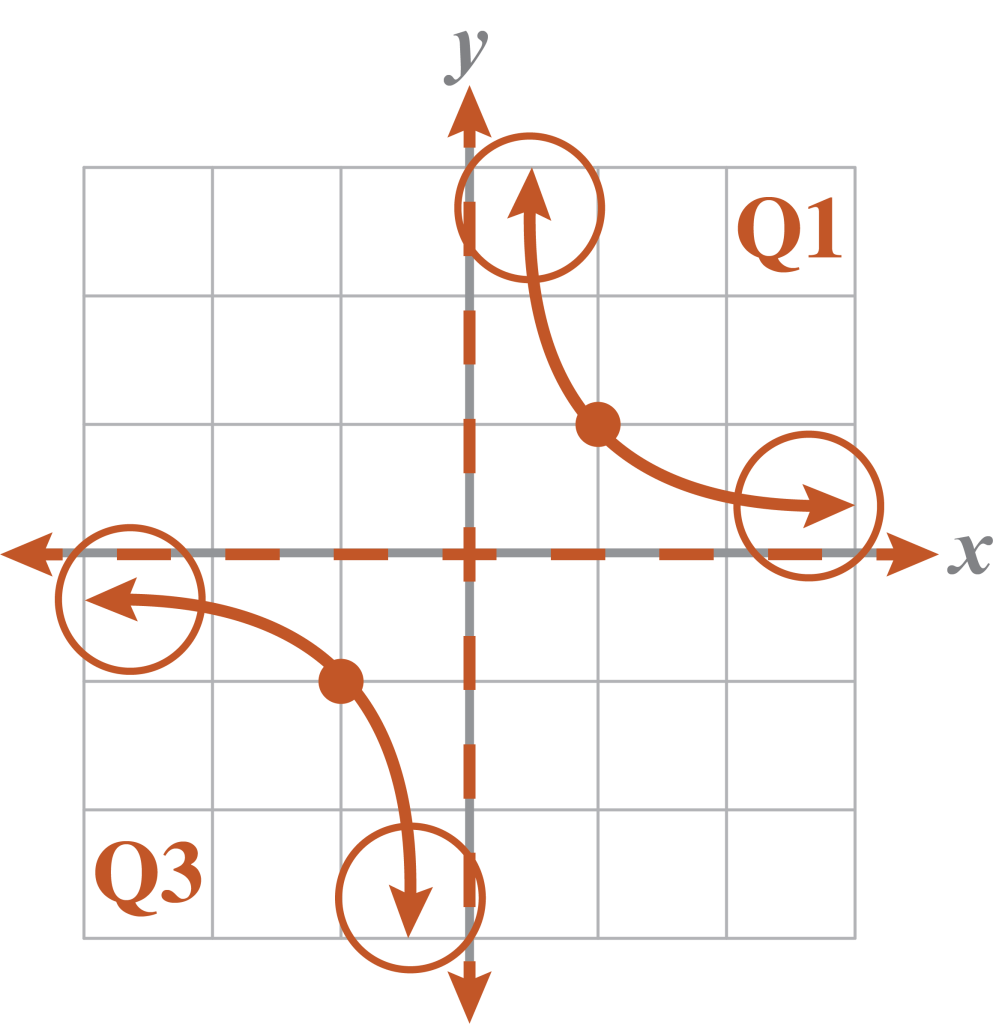
Set-builder notation
End behavior
Quadrant I
As and as
Quadrant III
As and as
The direction as x approaches zero is noted here because the rational parent function is in two quadrants.
Note
Find more details about graphing rational functions in Unit 1. Using interval notation for rational functions requires the use of union ∪ and intersection ⋂ symbols. This has not yet been introduced, therefore only set-builder notation is required at this time.