
Explore
Simplifying dth-degree Radical Expressions Solutions
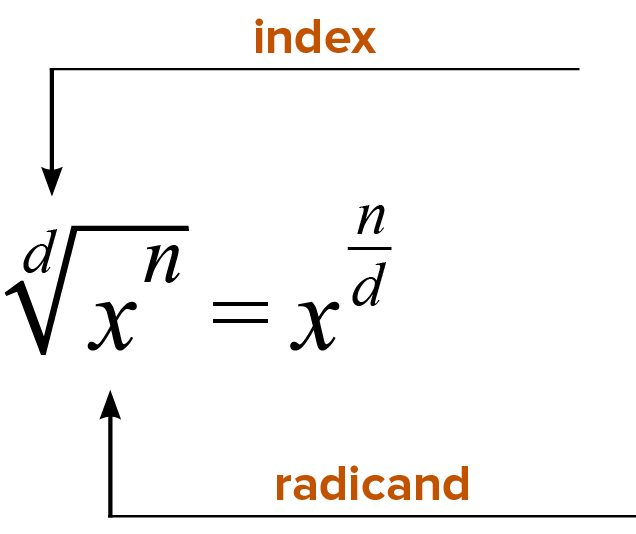
- Writing a radical expression with a base raised to a rational exponent allows you to use the exponent rules to simplify.
-
The rules for simplifying radicands are true for Real Numbers ℝ .
-
To simplify a radical expression, simplify out exact roots from the radicand using the index .
Note
Remember to use the Formula Sheet as a reference for exponent rules. This lesson extends from what began in Algebra 1 with exponent rules and simplifying radicals. (Algebra 1: Principles of Secondary Mathematics)
-
The index d determines the number of roots in a simplified expression.
-
The most common index is 2 , which is the square root.
-
The principal root is the non-negative square root of a non-negative real number.
-
| In this notation, 4 indicates the principal root. | |
| In this notation, –4 indicates the opposite of the principal root. | |
| In this notation, ±4 indicates the principal root and its opposite. |
For this level, if opposite (–) or principal and opposite (±) symbols are not shown, then the principal root is implied.
Note
You will learn how to work with negative radicands under the set of complex numbers in a later lesson.
| If |
Then |
| x < 0 | one negative root |
| x = 0 | one root, 0 |
| x > 0 | one positive root |
| If | Then |
| x < 0 |
no real root |
| x = 0 | one root, 0 |
| x > 0 | one positive root, one negative root: |
| If | Then |
| is an even exponent | no absolute value bars |
| is an odd exponent | absolute value bars included |
| Simplifying Examples Chart | ||
| odd index | even index | |
| radicand | ||
|
radicand |
||
| Variable radicand | ||
Note
Problems with a number and variable, as well as a radicand remainder, are in the following examples.
Example 1
Simplify. Write answers in simplified radical form.
Explain
- Power of a power rule
- Write exponents as mixed numbers
- Terms raised to an odd power need to be in absolute value bars when the index is an even number
Note
Because the index is even, the simplified terms raised to an odd power need absolute value bars.
Example 2
Simplify. Write answers in simplified radical form.
Note
Because the index is odd, absolute value bars are not needed because negative values are possible with odd roots under ℝ.
Example 3
Simplify. Write answers in simplified radical form.