Domain and Range of Reciprocal Functions Solutions
- When writing the domain and range for reciprocal functions, use set-builder notation.
- This math shorthand allows you to define the sets of numbers, rather than listing all of the values.
| Symbol |
Read as |
Meaning |
| { } |
set brackets, “the set of …” |
a group or set |
| | |
“such that” |
|
| ∈ |
“an element of” |
is part of a set |
| / |
“is not” (i.e. ≠: “is not equal to,” “is not an element of”) |
symbol to show negation |
| ℕ, 𝕎, ℤ, ℚ, 𝕀, ℝ |
Possible sets of numbers |
|
- Here are some examples using set-builder notation:
- “The set of all x’s such that x is an element of the Real number and cannot equal 2”
- “The set of all q’s such that q is an element of the Natural numbers, and between 2 and 8” This could also be written as {3, 4, 5, 6, 7}
Note
Set-builder notation is used here. Interval notation will also be used later in this level. See Algebra 1: Principles of Secondary Mathematics for more on interval notation.
- The domain is the set of x-values for a function.
- The range is the set of y-values for a function.
- For reciprocal functions, use the asymptotes to help determine restrictions for the domain and range.
- Graphs do not cross vertical asymptotes because this would make the denominator undefined .
- Vertical asymptotes are boundaries for the hyperbola .
- Horizontal asymptotes show the end behavior of a hyperbola as the graph moves toward infinity .
Note
End behavior will be discussed in more detail in later lessons and levels.
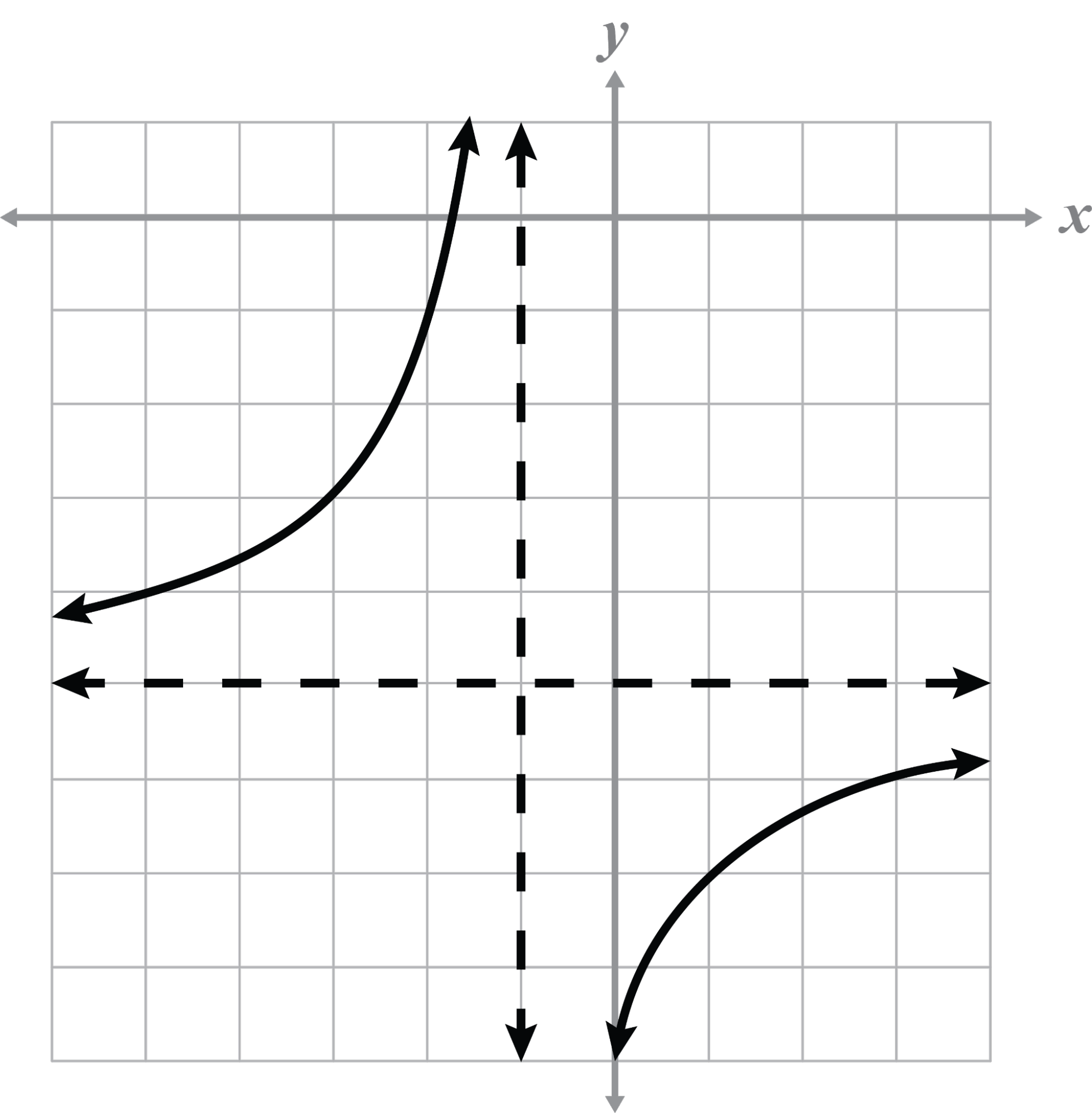
Example 4
Name the domain and range of the reciprocal function.
Plan
Identify a, h, k
Determine the domain and range in set-builder notation
Implement
Note
Recall that y and f (x) can be used interchangeably. Since the function is given as f (x), it is used for the range.
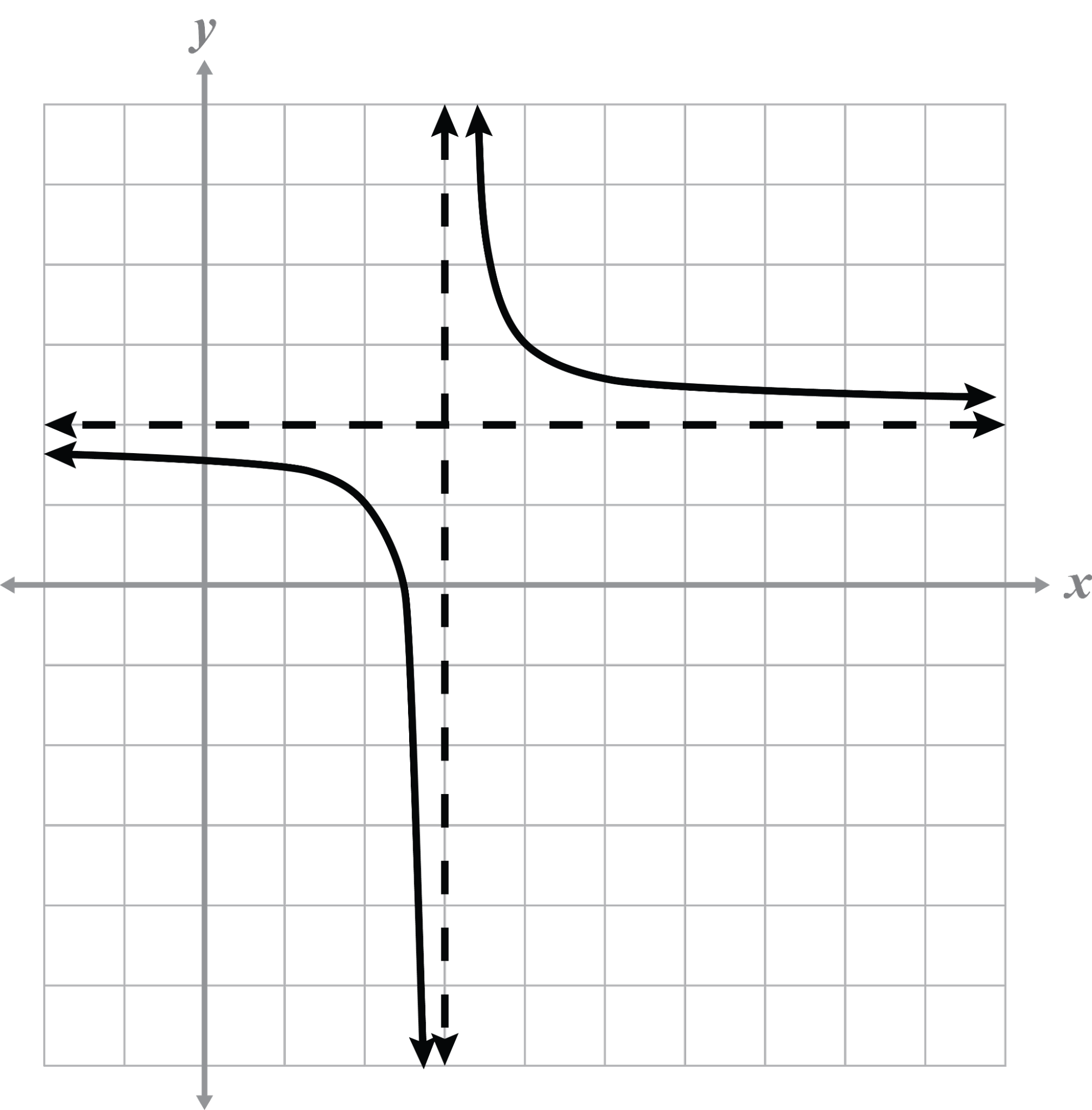
Example 5
Name the domain and range of the reciprocal function.