
Practice 1 Solutions
Name the value of b and if this represents growth, decay, or neither.
Note
Problems 1–4
Q: What is the value of b when a decay factor exists?
A: 0 < b < 1
Q: What is the value of b when a growth factor exists?
A: b > 1
, Decay
b = 9, Growth
, Decay
Note
Recall that when the denominator is larger than the numerator, the result is a fraction less than one.
, Growth
Describe the transformation from f(x) to g(x).
Note
Problems 5–8
You could also describe the similarities and differences of the given equations.
| f(x) | g(x) | |
| b | 4 | 4 |
| a | 1 | –1 |
| h | 0 | 0 |
| k | 0 | 0 |
g(x) is reflected across the x-axis from f(x).
| f(x) | g(x) | |
| b | 2 | |
| a | 1 | 1 |
| h | 0 | 0 |
| k | 0 | 0 |
f(x) is a decay function, and g(x) is a growth function.
| f(x) | g(x) | |
| b | 5 | 5 |
| a | 1 | 1 |
| h | 0 | 1 |
| k | 0 | 2 |
g(x) is translated one unit to the right and two units up from f(x).
| f(x) | g(x) | |
| b | 8 | 8 |
| a | 1 | 2 |
| h | –2 | –5 |
| k | 0 | 0 |
g(x) is vertically stretched and translated 3 units left from f(x).
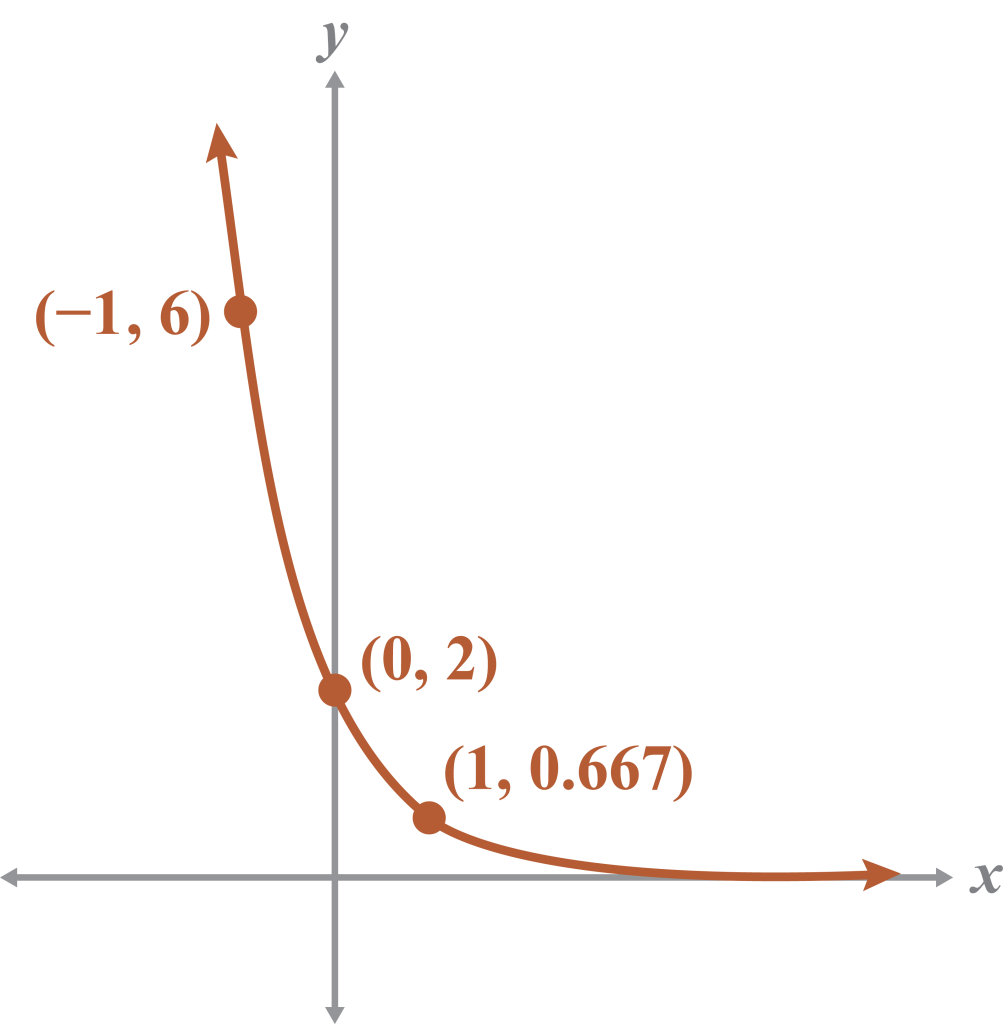
Sketch the graph using technology. Name the end behavior.
Note
Problems 9–12
Use graphing technology to verify the accuracy of your sketches.
Sample table:
| x | y |
| –1 | 6 |
| 0 | 2 |
| 1 |
Note
Q: What is f(x) approaching when x approaches positive infinity?
A: f(x) is approaching zero.
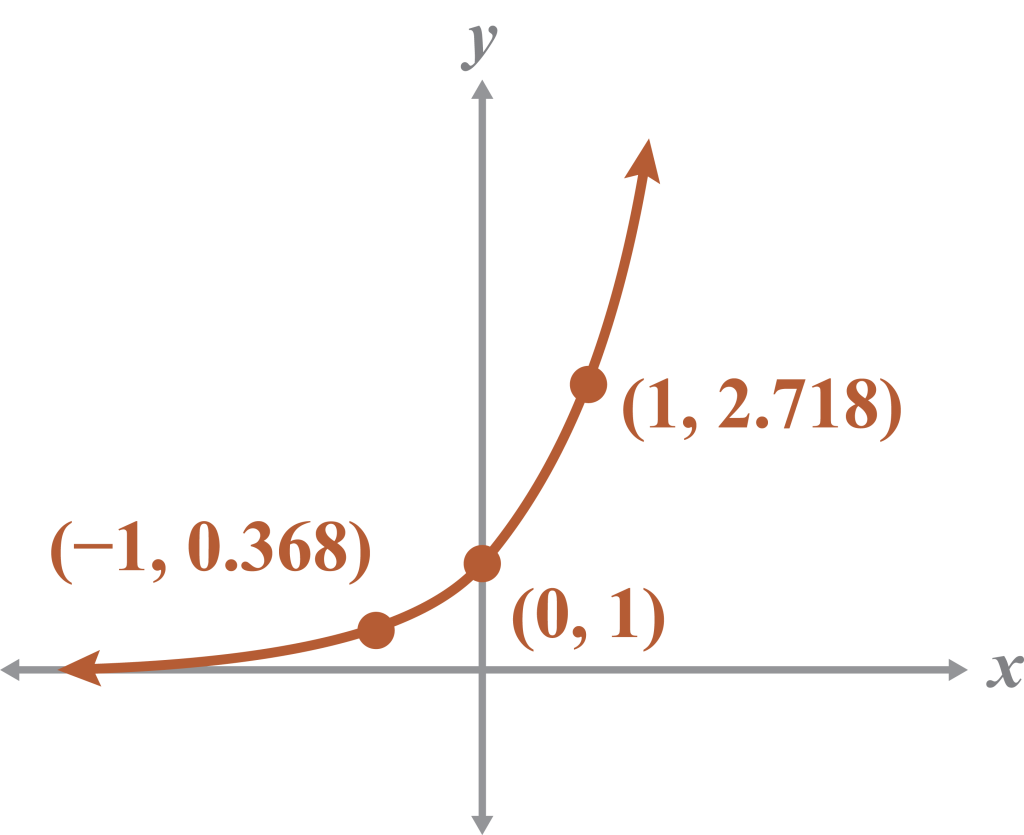
Sample table:
| x | y |
| –1 | |
| 0 | 1 |
| 1 | e |
Note
Q: What is g(x) approaching when x approaches positive infinity?
A: g(x) is approaching positive infinity.
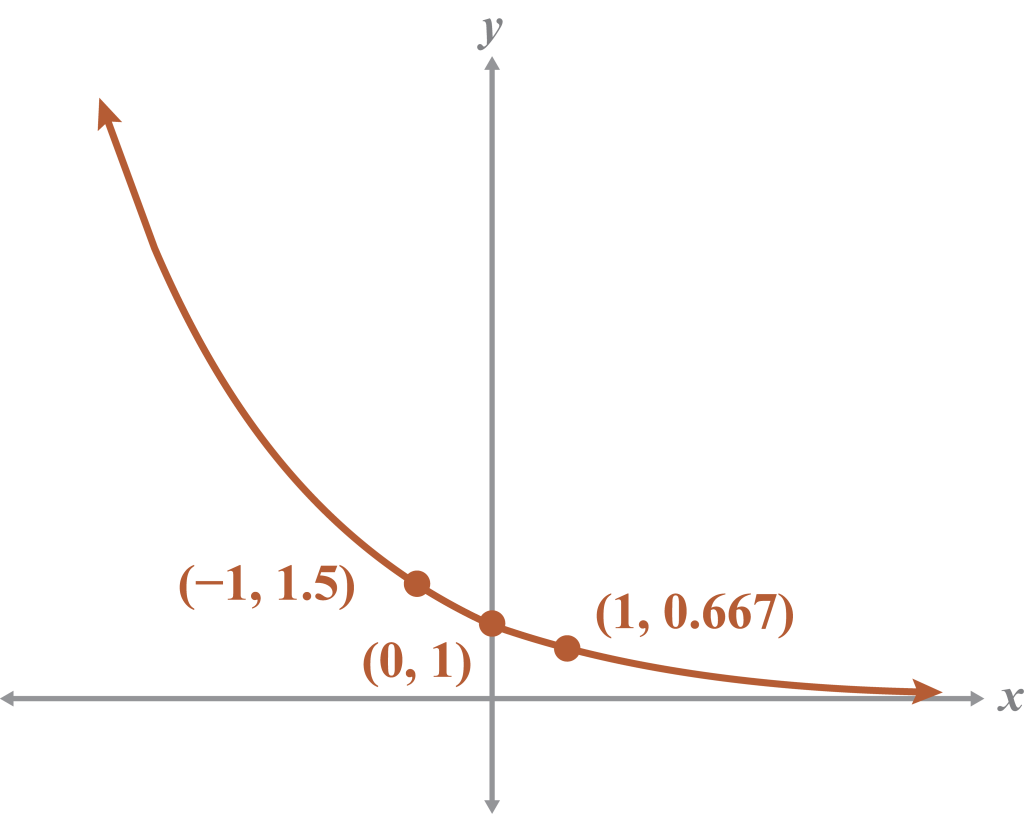
Sample table:
| x | y |
| –1 | 1.5 |
| 0 | 1 |
| 1 |
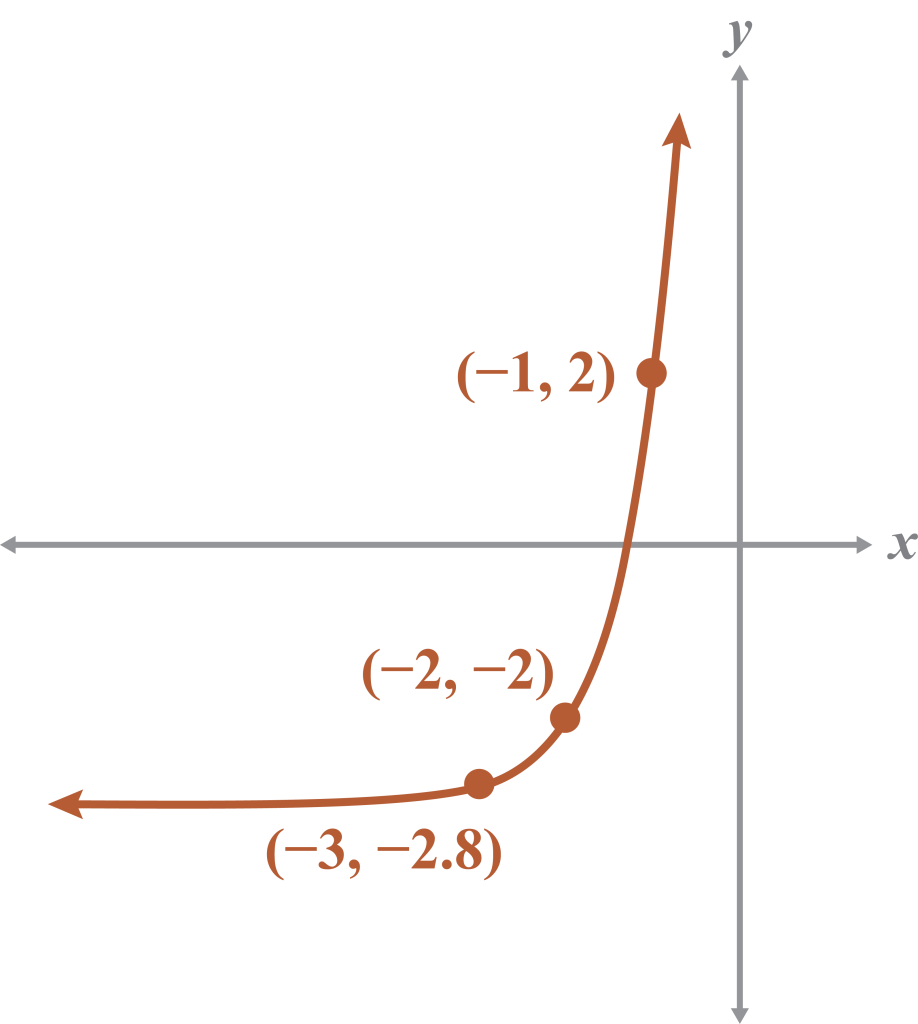
Sample table:
| x | y |
| –3 | –2.8 |
| –2 | –2 |
| –1 | 2 |
Describe the transformation. Determine if the function represents growth or decay. Name the domain and range.
This function is a decay function because the base is between 0 and 1 when the exponent is positive. It is vertically stretched and shifted up 4 units.
This function is a growth function. It is vertically stretched and reflected over the x-axis because a is –32. The function is also shifted left 3 and down 2 units.
This function is a growth function. It is vertically stretched.
This function is a growth function. It is vertically stretched and reflected over the x-axis because a is –10. The function is also shifted down 7 units.
Write the equation in the form using the given points.
- When planted from seed, the sprouting rate of radish seedlings appears exponential. At the end of week zero, two radish seedlings are visible. After two weeks, eighteen seedlings are visible. Write the exponential equation that models the growth of the seedlings. (x: time, y: seedlings)
Because the base of an exponential function cannot be negative
The equation to model the growth of seedlings is
Note
Remember to start by writing out the ordered pairs so you can write the equation.
Q: What is the ordered pair in words?
A: (time in weeks, seedlings)
- (0, –5) and
- (1, 4) and
- Two hours ago, twelve mold spores were counted under the microscope. One hour ago, six mold spores remained. Write an exponential equation to model the decline in the mold spores. (x: time, y: amount of mold spores)
The equation that models the declining mold spores is
Note
Because time is expressed as “two hours ago” and “one hour ago,” use negative numbers for those x-values.
Q: How many mold spores are present when the time is zero hours?
A: Three mold spores