
Explore: Conditional Probability Solutions
| Example Conditional Probability Phrases: |
|
|
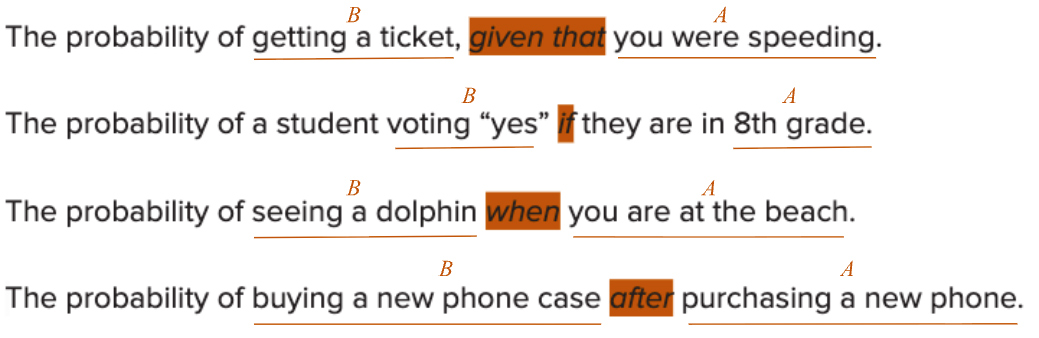
Example 3
A fruit bowl contains ten apples and eight nectarines. You decide to grab two pieces of fruit without looking. Determine the probability as a simplified fraction that:
- Both pieces of fruit are apples.
- You grab a nectarine after you already have an apple.
Note
Since you already know that you have an apple, you only need to find the probability of selecting a nectarine with one less piece of fruit.
Example 4
The employees of Buzz Coffee tracked orders on a busy morning. One of the employees created a Venn diagram to organize the orders and calculated some of the probabilities.
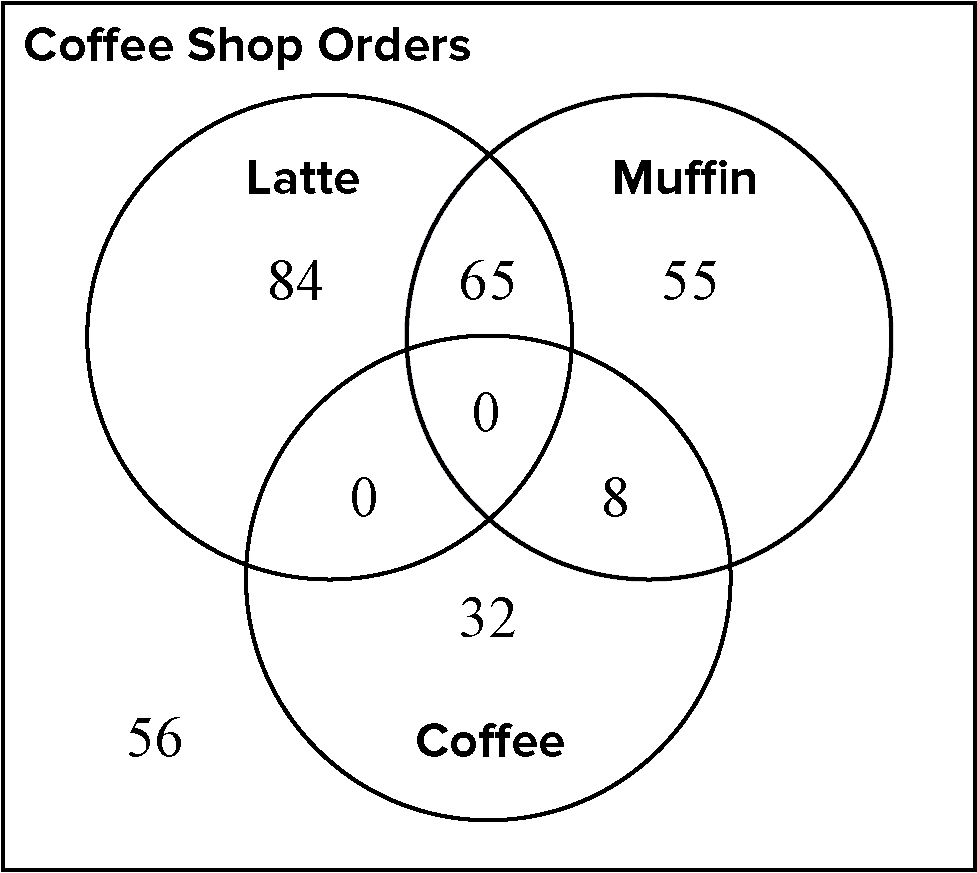
- Determine if the orders are independent events.
Independent:
Note
Latte and Muffin
Coffee and Muffin
The events are not independent because
Find the probability that:
- A customer ordered a muffin after they ordered a latte.
P(M | L)
- A customer ordered a latte when they ordered a muffin.
P(L | M)
- Why are the results of the probabilities in parts B and C different?
Sample: The results of parts B and C are different because the order in which the events occur matters. (From the notes: )
Example 5
On a given day, the probability that Adrian will wear sneakers is 60%. The probability that Adrian wears a baseball hat is 40%. The likelihood that she wears sneakers if she is already wearing a hat is 30%.
Determine the probability of Adrian wearing a hat and sneakers.
12% chance
Determine the probability of Adrian wearing a hat if she is already wearing sneakers.
20% chance