
Practice 2 Solutions
State whether the scenario describes an independent or dependent event.
- A teacher is assigning the order in which students will present their projects this month. Once a student presents, their turn is complete for that month.
Dependent
- Three experiments were conducted simultaneously: flipping a coin, rolling one die, and using a spinner.
Independent
- A baseball team calculated its batting average after calculating the individual batting averages of its top nine players.
Dependent
For problems 4–7, use the spinner and the eight-sided die with numbers 1 through 8 to find the probability.
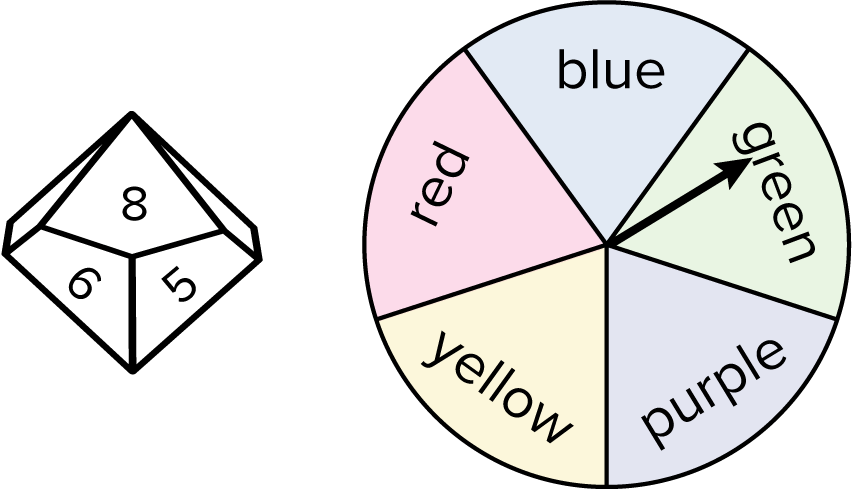
- Rolling an even number and landing on yellow
Note
Remember that in this problem the die has eight sides.
- Rolling a multiple of 3 and landing on a primary color
Note
Primary colors are red, blue, and yellow.
Multiples of 3 are 1 and 3.
- Rolling a 5 and not landing on purple
- Rolling any number except 7 and landing on purple or green
For problems 8–11, use the following scenario.
Cards are drawn from a standard deck with replacement. Determine the percent chance to the nearest hundredth of a percent.
- Heart, then a five
1.92%
0.59%
- Three face cards in a row
1.23%
0.05%
For problems 12–16, use the following scenario.
A recent survey found that 75% of people left a positive review of a product. If eight customers are randomly selected, determine to the nearest hundredth of a percent, the chance of:
- Exactly six people leaving a positive review
31.15%
- At least six people leaving a positive review
67.86%
Note
In this lesson, we found P(6), P(7), and P(8) individually. However, if you put the entire problem in the calculator with the formula, you will get an answer of 67.85%.
- Fewer than two people leaving a negative review
36.71%
- All eight people leaving a positive review
10.01%
- If ten people were randomly selected, determine, to the nearest hundredth of a percent, the chance of exactly five people leaving a positive review.
5.84%
Note
The number of trials changed.