
Explore
Independent Events Solutions
Note
Independent events can occur at the same time (simultaneously) or one after the other (consecutively).
Example 1
State whether the scenarios represent independent or dependent events.
- One card is selected from a deck, placed to the side, and another card is drawn.
Dependent
- A coin is flipped ten times in a row.
Independent
- Three marbles are drawn from a bag. After each draw, the marble is replaced.
Independent
Example 2
Determine the probability of rolling an eight-sided die and spinning the spinner arrow.
- Rolling 7, and the arrow stopping on red
- P(even and primary color)
even: {2, 4, 6, 8}, primary color: {red, blue, yellow}
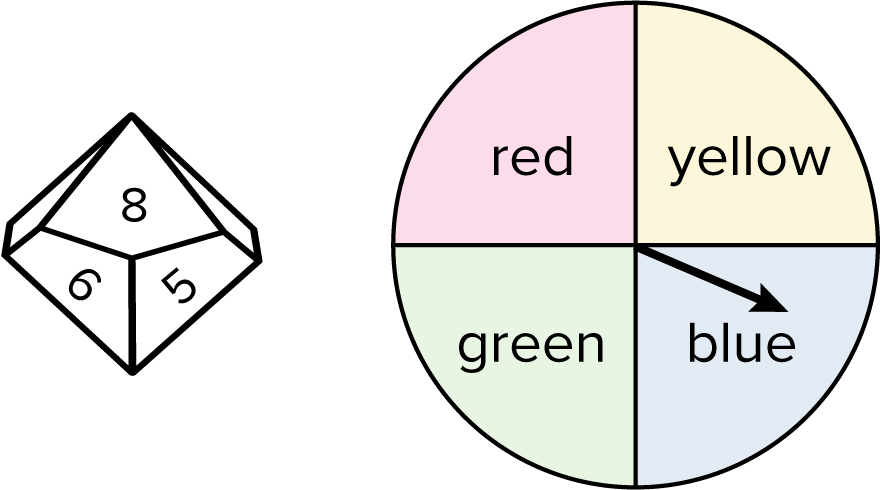
- Rolling anything but 2, and the arrow stopping on green
- P(multiple of 4 ⋂ red or blue)
Example 3
What is the percent chance of flipping a coin and getting tails 3 times in a row?