
Practice 1 Solutions
Note
The Pascal’s Triangle handout can be used as a reference during Practice.
- Write rows 0 through 6 of Pascal’s Triangle.
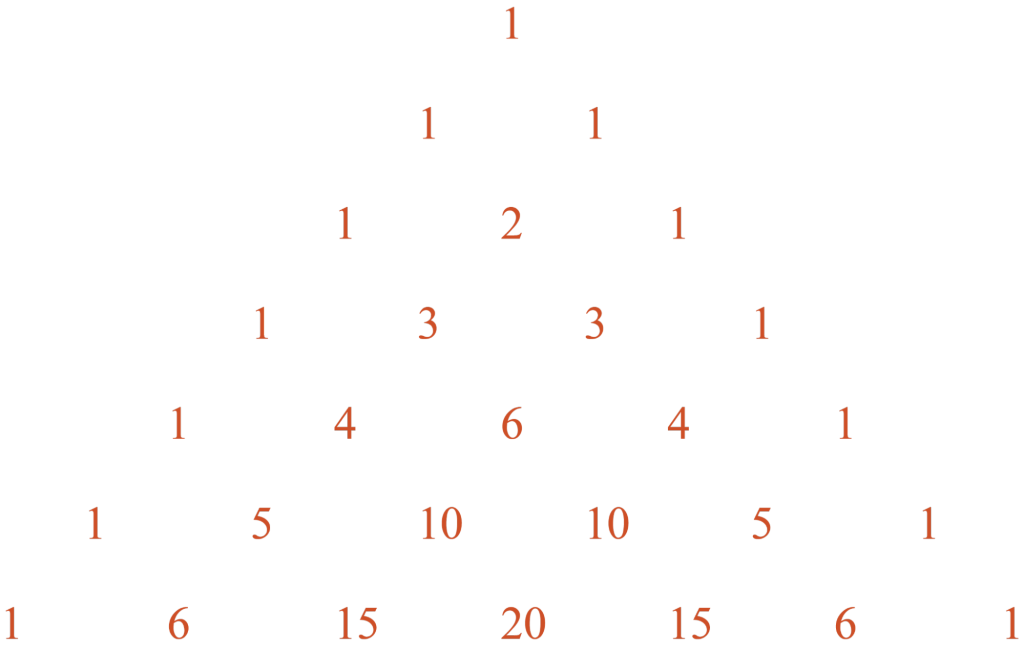
- Explain how to find the next row of Pascal’s Triangle.
Sample: Every row starts and ends with the number one. To find all the other numbers, you add every pair of numbers in the previous row to get the next number for the new row.
Determine the combination using Pascal’s Triangle.
792
9
- Determine the sum of row 8.
256
- Write the sum of the row as a base raised to a power. Do not evaluate.
Note
Q: Why would it be challenging to expand the expression even with Pascal’s Triangle?
A: The number will be extremely large. (A calculator makes more sense here.)
Expand the binomial with Pascal’s Triangle.
Note
Q: Why are the coefficients different than the numbers in the third row of Pascal’s Triangle?
A: Because a number other than one is in the original problem. In this case, all of the coefficients are multiplied by a power of two.
- Determine the third term of the binomial:
- Determine the sixth term of the binomial:
Note
Q: How do you determine the exponent for the a term?
A:
Expand the binomial.