Explore
Theoretical Probability Solutions
| Vocabulary | Example |
|
The sample space is a list of all possible outcomes. NoteThe total number of equally likely outcomes in the sample space
|
Sides of a number cube: {1, 2, 3, 4, 5, 6} Note6 (the cube has 6-sides)
|
|
An event is the favorable result or set of favorable results of a probability experiment. P(E) |
Rolling an even number on a number cube P(even) |
| An outcome is the result of a probability experiment. | Rolling a 2 on a number cube |
|
A complement to an event is all of the events that are not the event. or P(E’) |
The odd numbers are a complement to the evens on a number cube. P(not even) or P(odd) |
Note
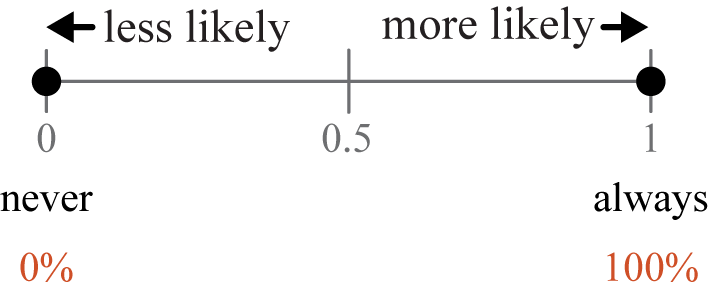
In mathematics, unless you are completing an experiment or activity, you are calculating the theoretical probability.
Example 1
A bag contains seven red, eight yellow, five blue, six white, and four purple marbles. Determine the probability.
Plan
Calculate the total number of outcomes
Determine P(favorable event)
Total:
- Red
- White
- Blue
- Yellow or Purple
Example 2
A security system requires a 5-digit code with no repeating numbers. If the digits 0 through 9 are allowed, what is the probability that a randomly generated code will contain the digits 1, 2, and 3 in that exact order, but the other two digits can be any other numbers (also in any order)?
Total number of codes:
Codes allowed:
Example 3
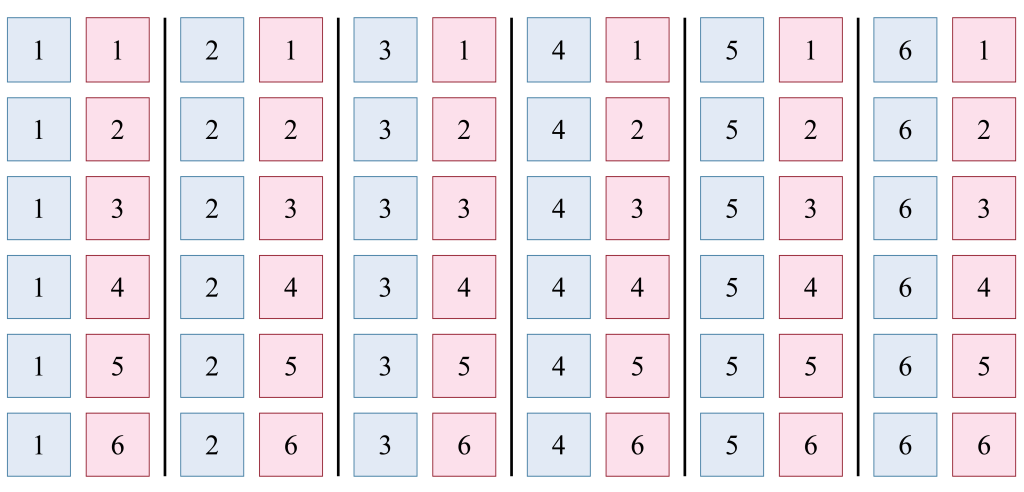
The diagram shows all possible pairs when two dice are rolled. Find the probability of each outcome to the nearest whole percent.
- P(sum of 10)
- P(both even)
- P(not doubles)