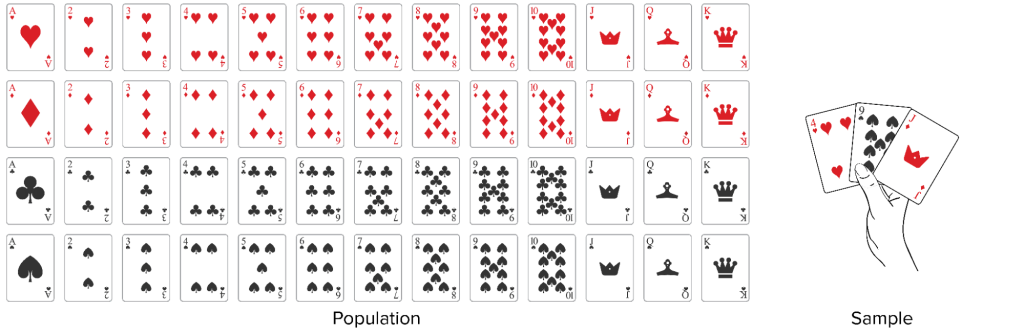
Prior to this lesson, you may have used some of the vocabulary words in a different context. Be sure to pay attention to how these words are defined for use in the study of statistics.
Descriptive Statistics
Descriptive statistics summarize a population through charts, graphs, and tables . (i.e., Measures of center can be used to describe the entire group.)
In descriptive statistics, you can only describe the information available to you .
Common phrases include:
calculate the measures of
how many
what is the average
Descriptive Statistics Vocabulary
A population is the entire group (every single person, thing, etc.) from which the data is gathered.
A census is a survey or study that collects data from every individual in the population.
A parameter is a characteristic or measure that describes the entire population. Parameters are determined from a census.
Note
Conducting a census is often unrealistic because the population can be extremely large, and getting the entire population to participate is impractical.
Data values (or elements, or individuals) are the people or things that make up the population. A collection of individual data values is called a data set .
Inferential Statistics
Inferential statistics generalize or infer from a sample what will likely happen within the population.
In inferential statistics, probability is used to determine the chance of occurrence (or make a reasonable guess) for the population based on the sample.
Common phrases include:
make a prediction
draw a conclusion
cause a change
describe the relationship between
Inferential Statistics Vocabulary
A sample is a subset (or part) of a population from which data is collected.
Most often, samples are analyzed to draw conclusions (make inferences) about the population because conducting a census is not practical.
A sample statistic , or statistic, is a calculation that is determined by using the data from the sample.
It is most often simply called a statistic because it is understood that an entire population is rarely used.
Statistical estimates about the population are made using proportions or percentages .
The population’s response is estimated using statistics that include a margin of error .
Example 1
Identify the population and sample from the scenario.
One student from every math class at Greenville High School
Population: all students taking math at GHS
Sample: one student from each math class
Five cards are drawn from a standard deck
Population: deck of cards Sample: 5 cards
Example 2
Determine if the question will result in descriptive or inferential statistics. Then name the population.