
Practice 1 Solutions
Use the information on decibel levels for problems 1–3.
The loudness of a sound L is measured in decibels (dB).
The formula for the loudness of a sound is:
Where:
-
- I: The intensity of the sound
- The reference intensity of the softest sound a human can hear:
- A normal conversation has a loudness of about 60 dB. What is the intensity level?
- A rock concert has a loudness of about 120 dB. How many times more intense is sound at a rock concert than in a normal conversation?
Alternate solve:
The sound at a rock concert is 1 million times more intense than a normal conversation.
- The sound of a vacuum cleaner has a registered intensity of . What is the decibel level?
The vacuum cleaner has a level of 75 dB.
Use the information on the continuous compounding formula for problems 4–5.
P: Initial amount
r: Rate
t: Time
y: Final amount
- The intensity of a certain earthquake’s seismic waves diminishes continuously at a rate of 9% per kilometer as they travel through the Earth’s crust. If the initial intensity of the waves is measured at 7.5 on the Richter scale, at what distance will the earthquake wave intensity reach 4.0 on the Richter scale? Round to the nearest hundredth.
The earthquake intensity is equal to 4.0 on the Richter scale at a distance of 6.98 kilometers.
- Kristin invested $6000 in a savings account with a 6% annual interest rate, compounded continuously. How much money will she have in the account after 10 years?
In 10 years, Kristin will have $10,932.71 in her account.
Use the information on the compound interest formula for problems 6–7.
P: Initial amount
r: Annual interest rate
n: Compounding number
t: Time in years
A: Final amount with interest
Note
In Algebra 1: Principles of Secondary Mathematics, final amount with interest is represented by y.
- Kristin invested $6000 in a savings account that offers a 6% annual interest rate, compounded annually. How much money will she have in the account after 10 years?
When compounded yearly, in 10 years, Kristin will have $10,745.09 in her account.
Note
Compare the amount of money Kristin would have if the bank compounded monthly.
- Natalee invests $5000 in a savings account with a 6.5% interest rate that is compounded twice a year. How many years will it take for her to have $15,000 in her account?
In 17.17 years, Natalee will have $15,000 in her account.
Note
Q: How many years and months is 17.17 years?
A: It is approximately 17 years and 2 months.
Use the information on the half-life formula for problems 8–9.
Initial quantity
t: Time in years
h: Half-life
A(t): Quantity remaining at time t
- A scientist discovers a new radioactive element, Element X. After observing a 100 gram sample for 10 days, they find that only 25 grams remain. What is the half-life of Element X?
The half-life of Element X is 5 days.
- A biologist is studying a bacterial culture with a very short half-life of 30 minutes. If they start with a sample of 1 million bacteria, how many bacteria will be left after two hours?
In two hours, only 62,500 bacteria will be left.
Note
Q: How will 30 minutes be represented as t in the formula? Explain.
A: Since 30 minutes is 0.5 hours, The variable t must have the same units as the half-life.
Use the information below for problems 10–12.
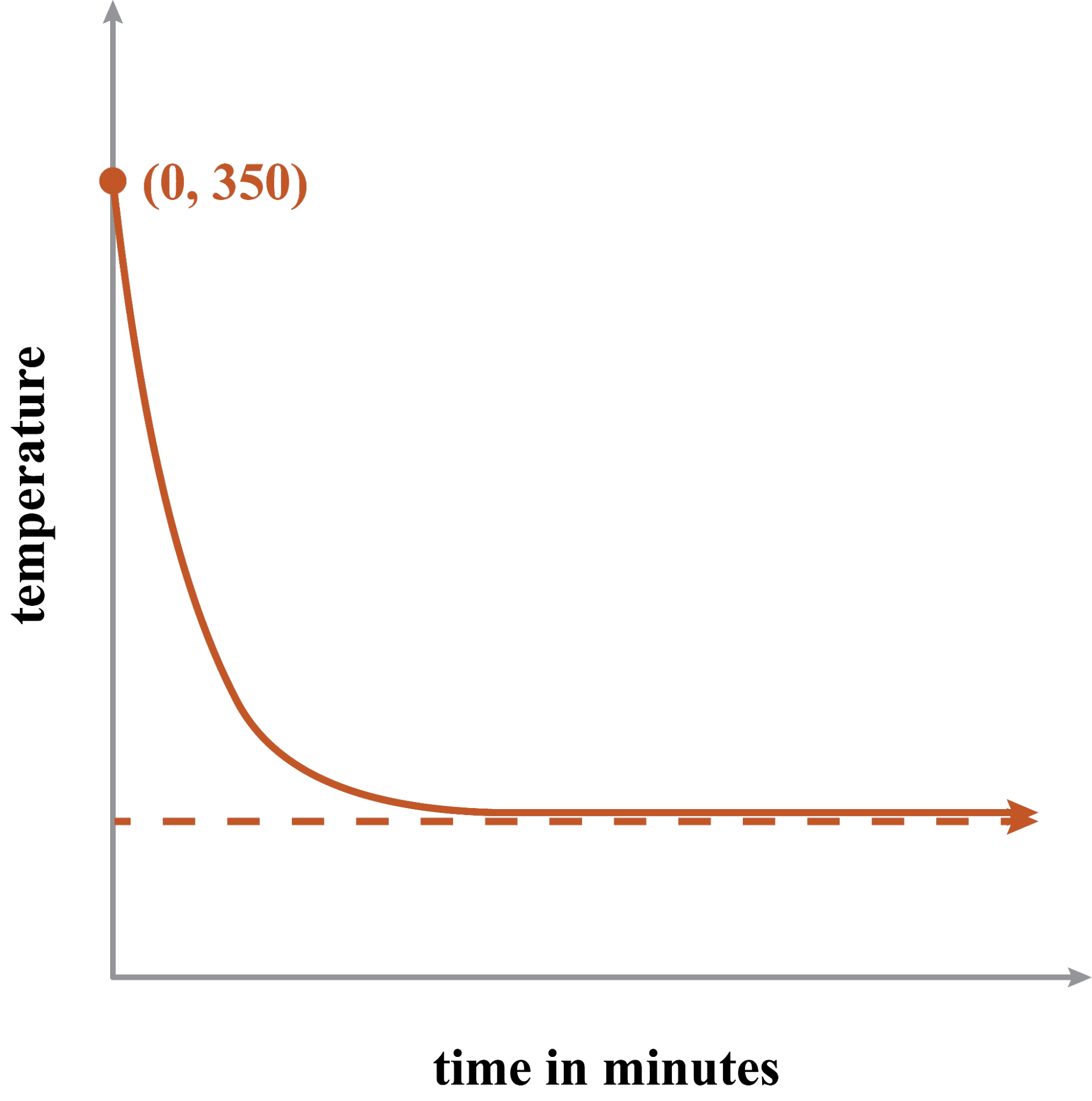
A baker takes a fresh apple pie out of a 350°F oven and places it on a cooling rack in the kitchen, where the room temperature is a constant 72°F. After 15 minutes, the pie has cooled to 250°F.
T(t): Temperature of the object at time t
Ambient temperature
Initial temperature of the object
k: Cooling constant
- Determine the cooling constant, k. Round to the nearest hundredth.
- If the baker took the pie out of the oven at 6:00 p.m., when will it reach a temperature of ? Round to the nearest whole minute.
The pie will reach at 7:17 pm.
- Sketch the graph. Include labels.
Note
Q: Why is there a horizontal asymptote at?
A: Because the temperature of the room is a constant 72 degrees, the pie cannot be cooler than room temperature.