
Targeted Review Solutions
- Solve:
- Solve:
- Write the polynomial equation with integer coefficients given the roots:
- Calculate the discriminant for the equation. Explain what this tells you about the roots.
Sample: A discriminant of –3 means the equation has zero real roots. Another way of saying it is that the equation has two complex roots.
Problems 5–7 work together.
- Graph.
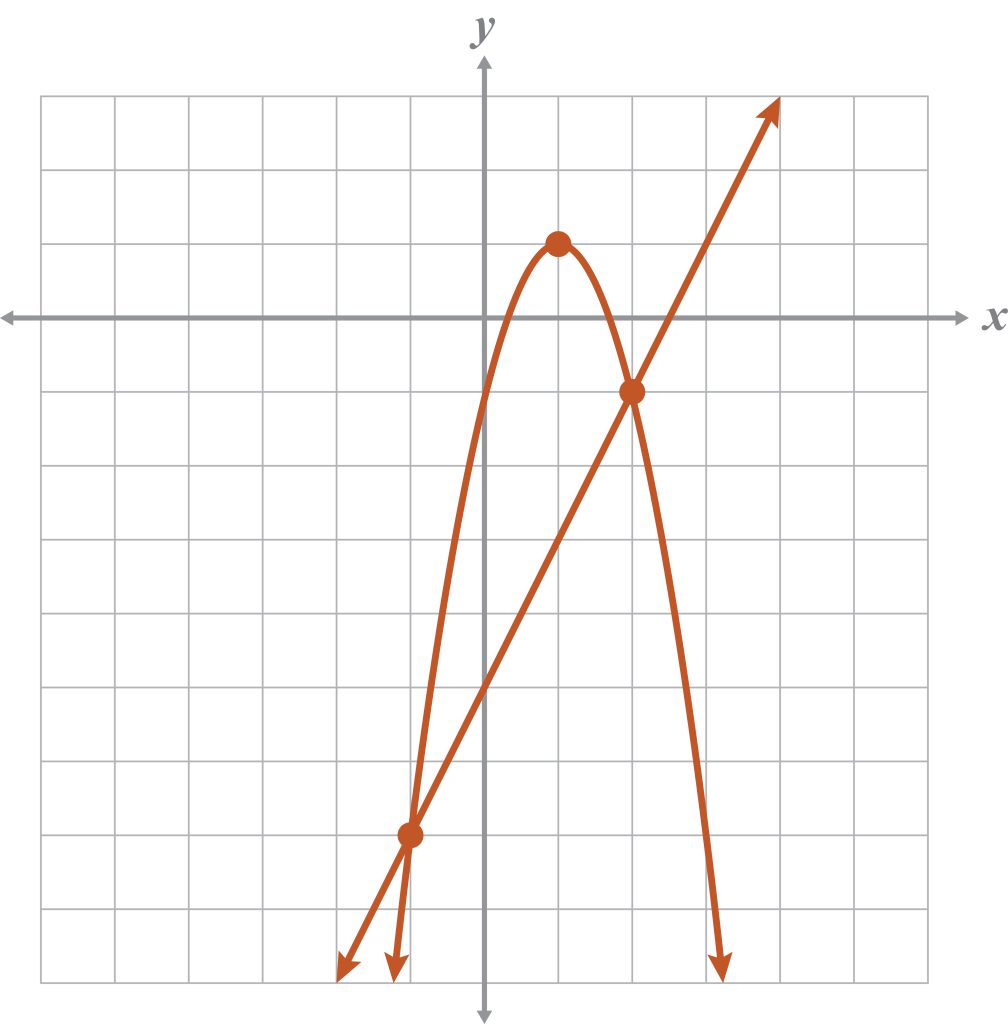
- Using your graph from problem 5, calculate the midpoint of the line segment inside the parabola using the points of intersection. Use the intersection points to calculate the midpoint of the line segment inside the parabola.
- Using your work for problems 5 and 6, calculate the distance between the vertex and midpoint of the line segment. Write the answer in radical form.
- Solve using the quadratic formula.
Multiple Choice
B
- Determine the value of b to form a perfect square trinomial:
Note
- This value is the opposite of the solution.
- This value is the square root of (ac) but does not multiply it by 2.
- This value would occur if solving for c rather than b.
C
- Right triangle ABC is graphed on the coordinate plane. Determine the length of the hypotenuse, AC, when , and .
-
5
Note
- This solution is the distance of segment AB.
- This solution is the distance of segment BC.
- This error occurs if subtraction is not used in the distance formula.
B
- Determine the polynomial equation given the roots: 3i, 5i.
Note
- This answer does not include the roots –3i and –5i.
- This answer does not include the root –5i.
- This answer is the product of the difference of squares rather than the sum of squares.
C
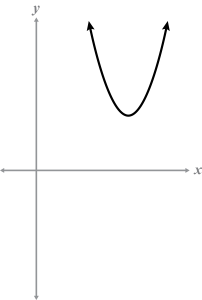
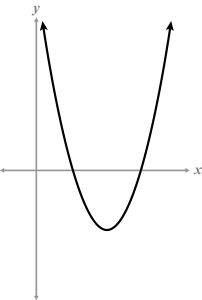
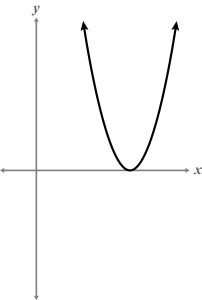
- Select the graph that represents a discriminant value of zero.
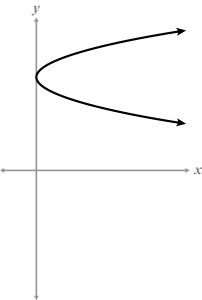
Note
A, B, D) A discriminant with a value of zero intersects the x-axis at one point.
| Problem | 1 | 2 | 3 | 4 | 5 | 6 | 7 | 8 | 9 | 10 | 11 | 12 |
| Origin | L23 | L23 | L23 | L25 | L18 | L26 | L26 | L25 | L24 | L26 | L23 | L25 |
L = Lesson in this level, A1 = Algebra 1: Principles of Secondary Mathematics, FD = Foundational Knowledge