Explore
Classifying Real Numbers Solutions
- Every number that you have learned about so far is a real number . That includes square and cube roots, , as well as positive or negative numbers.
- Real numbers are all the numbers that can be plotted on a number line .
- To classify a real number is to identify the specific subsets to which it belongs.
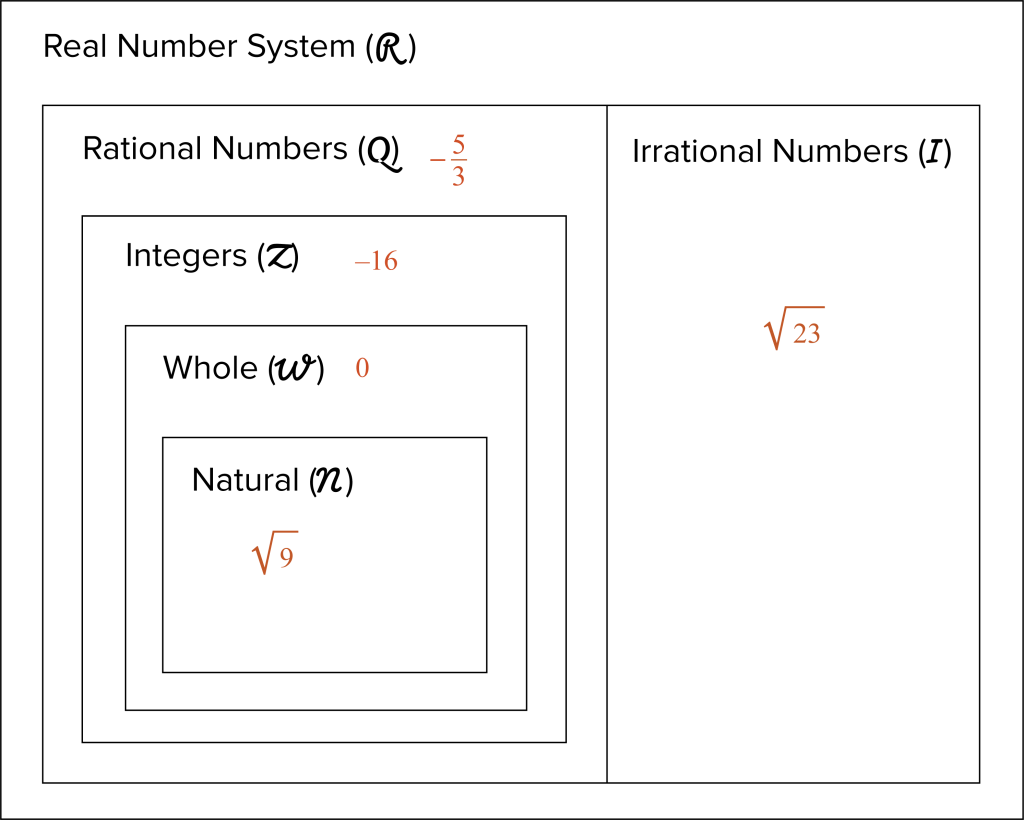
- Each number set in the Real Number System is represented by a capital script letter that you can see next to the name of the set.
- Real numbers (R) have two main subsets: rational (Q) and irrational (I) numbers.
- Within the set of rational numbers, there are integers (Z) , whole numbers (W) , and natural numbers (N) .
-
Natural numbers (N) are often thought of as “counting numbers” beginning at one. Written as a set:.
- Whole numbers (W) include all of the natural numbers and add the number 0. Written as a set: .
- Integers (Z) include all of the whole numbers and their opposites. Integers are positive and negative whole numbers. Written as a set: .
- Rational numbers (Q) can be expressed as a where a and b are integers and b cannot equal zero.
Note
‘b’ cannot equal zero, because dividing by zero is undefined.
- Integers (Z) , whole numbers (W) and natural numbers (N) can be written as ratios when put over the number one .
- Rational numbers (Q) can be written as fractions or decimals .
- However, when rational numbers are written as decimals they will either terminate or repeat .
- Irrational numbers cannot be written as a ratio of two integers. This means it cannot be written exactly as a fraction or a decimal.
- Irrational numbers when written as a decimal are non-terminating and non-repeating .
Each subset of the real number system can be represented in this diagram.

Example 1
Determine if the number is rational or irrational. Explain.
Rational. It is the ratio of two integers –7 and 18.
Irrational. It is non-repeating and non-terminating in decimal form.
Rational. 35% can be written as a terminating decimal and as a ratio of two integers.
Example 2
Determine if the rational number is an integer, whole number, or natural number. It is possible to have more than one answer.
Note
Q: Why are all natural and whole numbers integers?
A: The set of integers contains all whole numbers and their negatives.
Example 3
Place the numbers for A–E in the most specific set in the diagram.
Note
Q: Why is the a natural number?
A: Because