Test 13 (Lessons 25–26): The Quadratic Formula, Distance Formula, and Midpoint Formula Solutions
- Solve using the Quadratic Formula. Show all work.
- Calculate the distance between the y-intercept and the positive root using the equation from problem 1.
Fill in the blanks.
- The midpoint formula calculates the point that is equidistant from either endpoint.
- When the discriminant is in the form the roots will be complex .
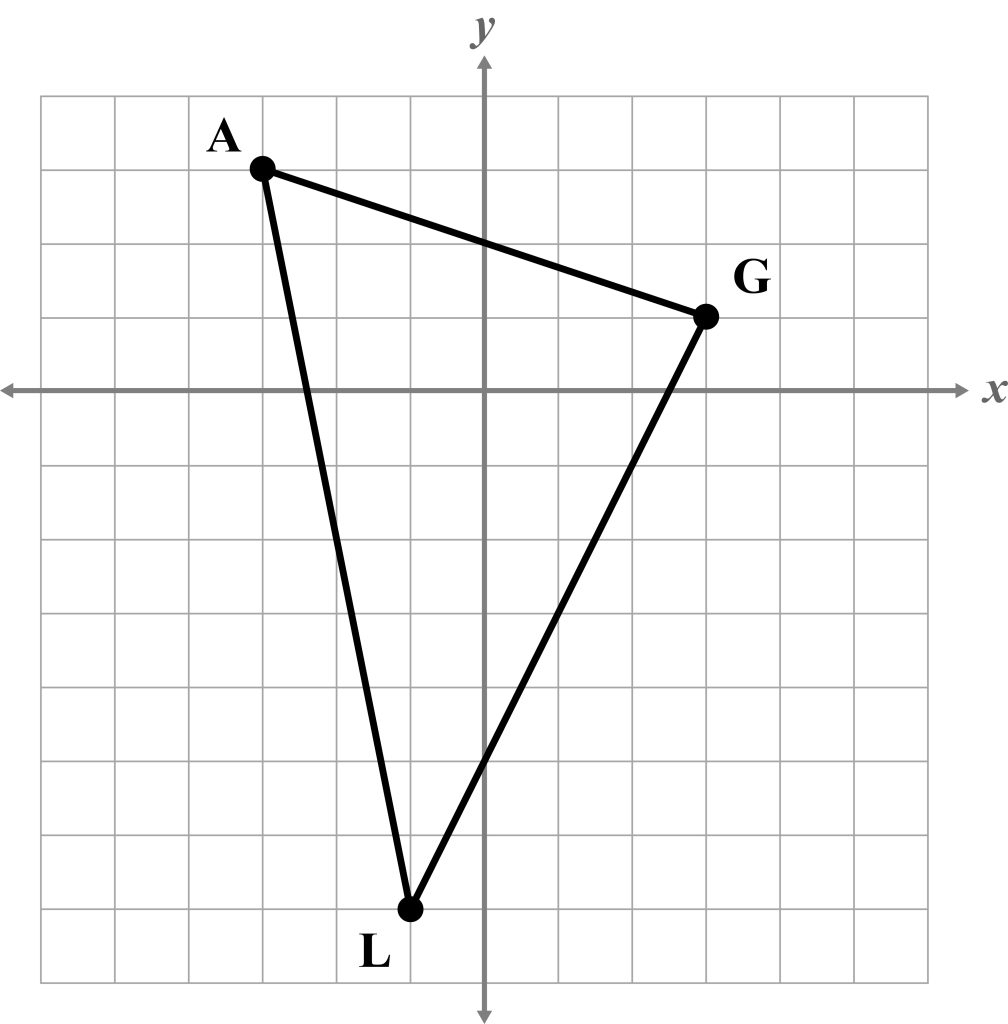
Use the graph to answer problems 5–6.
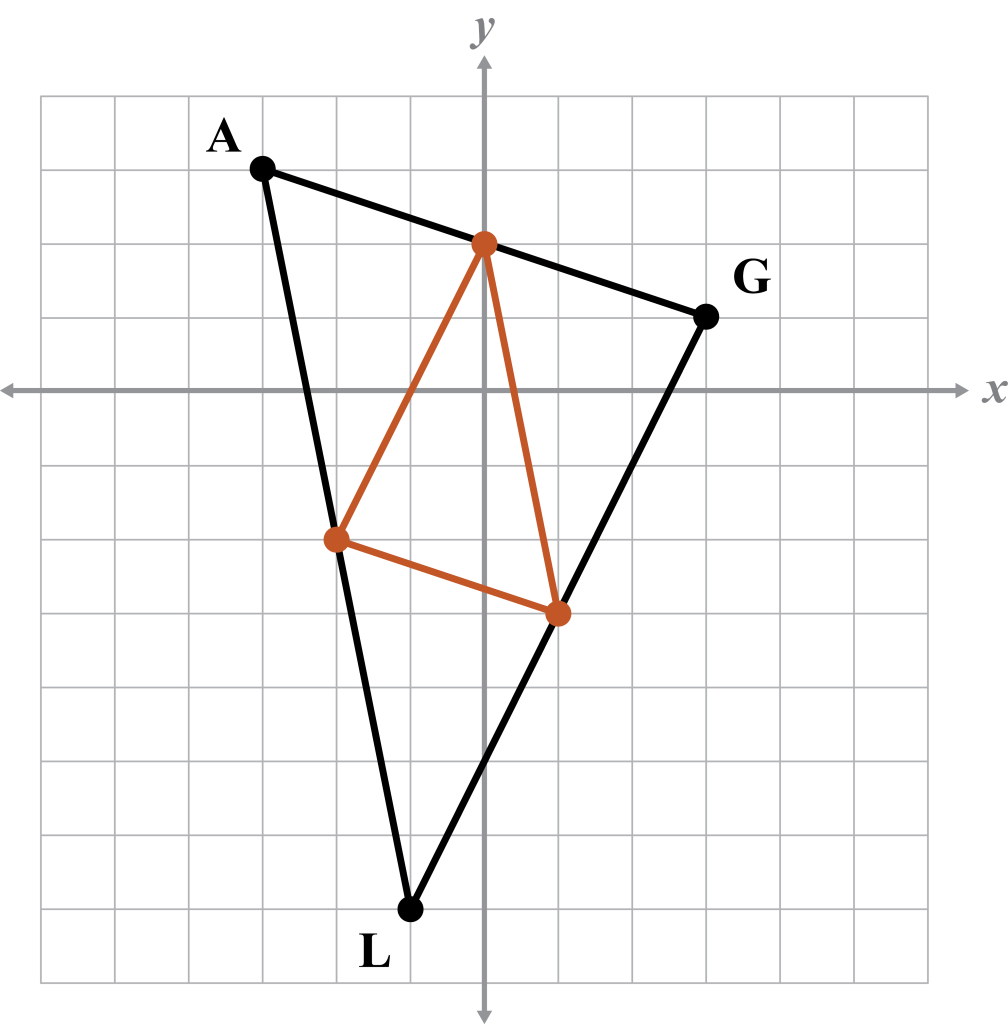
- Determine the midpoint of each side of triangle AGL.
- Connect all of the midpoints to form a new triangle. Find the perimeter of the new triangle.
The perimeter of the new triangle is 12.73 units.
Fill in the blanks.
- The distance formula can be used to calculate the units between two ordered pairs.
- The quadratic formula can be used to determine the roots (or solutions, x-intercepts) of a quadratic equation.
- A slow-pitch softball pitcher releases the ball 2.25 feet above the ground with an initial velocity of 50 ft/s. If the batter hits the ball 2 feet above the ground, how long did it take for the ball to reach the batter? Recall and
The batter will hit the ball 3.13 seconds after it is pitched.
- Determine the type of roots using the discriminant. Explain.
Sample: The quadratic equation will have two real, irrational roots because the discriminant is greater than zero and not a perfect square.