
Practice 1 Solutions
Simplify. Rationalize the denominator. Assume all variables are positive.
Note
You may rationalize the denominator by multiplying by . It is more efficient to simplify the radical first.
Note
Q: What is the conjugate of the denominator?
A:
If you wrote the terms in a different order, it is still correct. However, it is standard to write terms in descending order by degree.
Note
Q: If all coefficients are even, what should be simplified (factored) out of all terms?
A: A factor of at minimum 2.
Note
You need to multiply the problem by the radical that will make the denominator simplify to a non-radical expression. Since the index is 4, the radicand needs to be an expression that will result in when multiplied by the given denominator.
Note
Q: Why does the sign of –3 not change when working with conjugates?
A: Because only the symbol between the terms changes.
Note
Distribute the denominator –1 across all terms to simplify completely.
- The area of a rectangle is square inches, and the length is inches. Determine the simplified width.
Note
Remember to rationalize the denominator.
- The bases of a trapezoid are meters and meters. If the area of the trapezoid is 35 square meters, determine the height of the trapezoid.
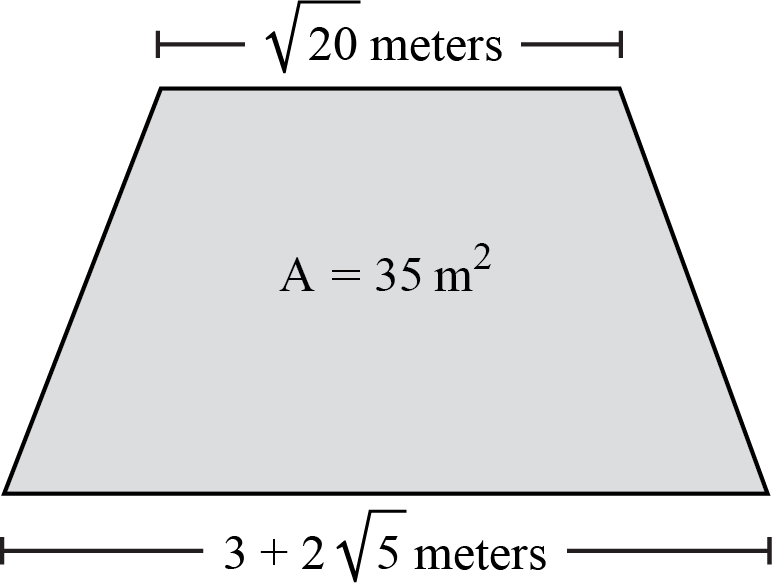
Use the given figure to answer problems 11–12.
The Neills are fencing in a rectangular pasture for their goats and need to know the area that will have grass for the goats to eat.
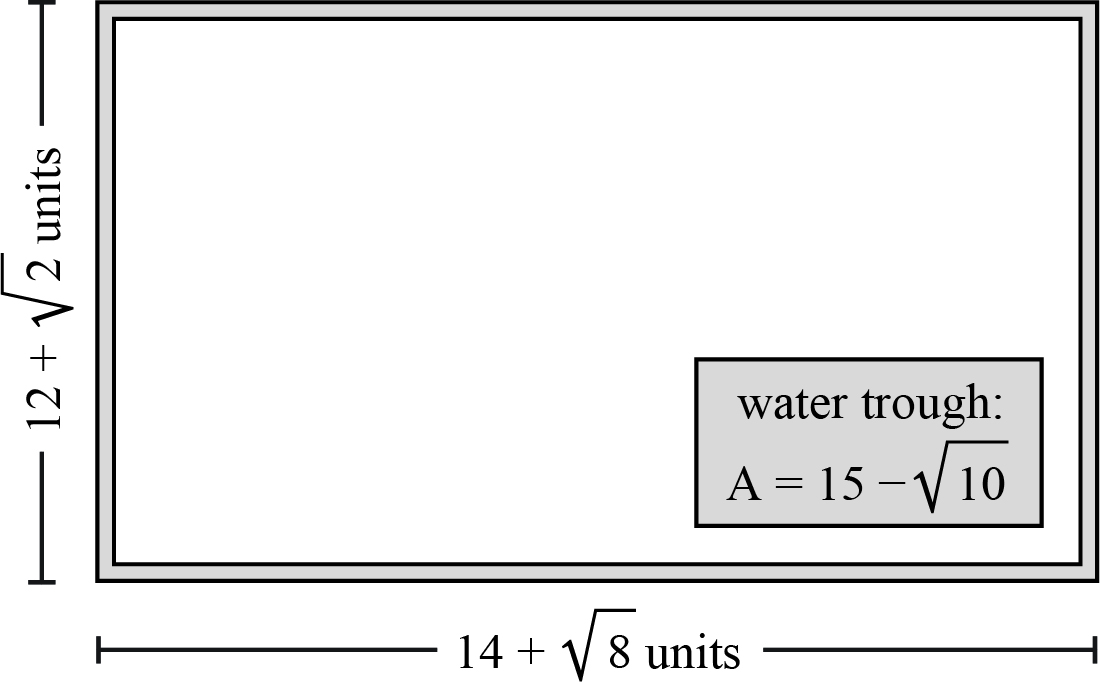
- If a water trough with an area of square units is added to the enclosure, what is the total area of pasture the goats will be able to use?
- Knowing that the goats would soon eat all of the available grass in the fenced in area, the Neills decided to extend both the length and width by units. What is the new total area of pasture the goats will be able to use?
(Hint: The water trough is still in the fenced area.)
Total area for the goats = Total area – Area of the water trough