
Solving Systems of Equations with Three Variables Solutions
Remember that it is okay to make mistakes and to learn from them!
Example 2
Find the solution that will satisfy all three variables.
Plan
Eliminate a variable from any two equations
Eliminate the same variable using a different pair of equations
From the two-variable equations, eliminate another variable
Use substitution to solve for the remaining variables
Check answer in three original equations
Eliminate z from P and Q
Eliminate z from Q and R
Eliminate y from the two new equations
Implement
Explain
- Substitute the x-value into an equation and solve for y.
- Use any equation to solve for z.
- Substitute all 3 values into each equation. Use a calculator to check that both sides are equal.
Exactly one solution
The planes intersect in a single point.

Example 3
Find the solution that will satisfy all three variables.
Since (–3P + Q) and (–4P + R) result in the same equation, there are infinite solutions.
This is also the same equation. This is the same plane.
Infinitely many solutions
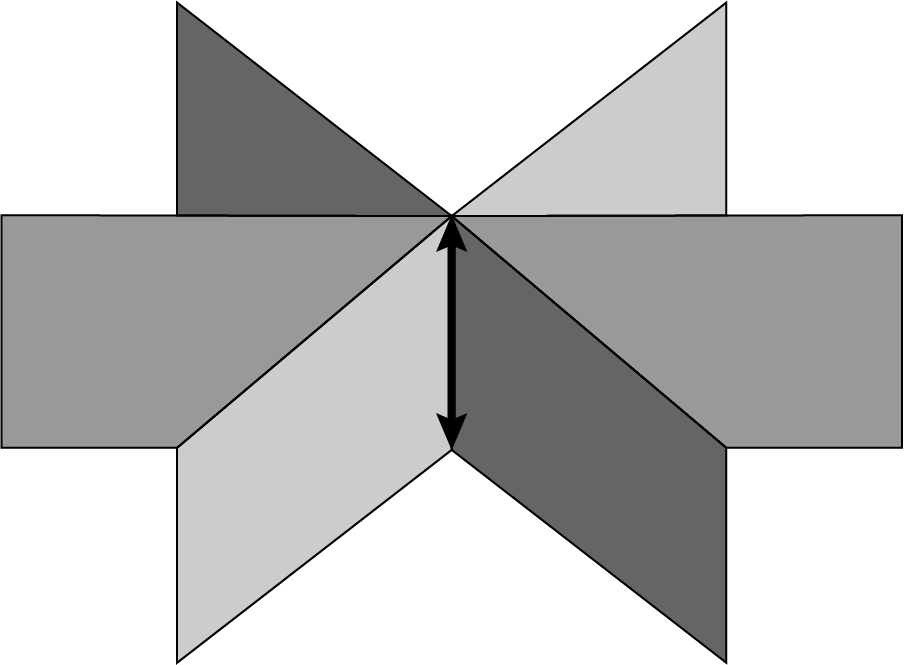
The planes intersect in a line or are the same plane.
Note
Any combination of equations P, Q, R will result in 0 = 0.
Suppose Equation R is replaced with S: a – 3b + c = –9. How will this change the solution?
Using equation S, the system has no solution.

Note
Similar to a system of equations with two variables, if a system of equations with three variables has a solution such as 0 = 3 (or (0 = –2), or any other solution that cannot be true), there is no need to continue solving, as there is no solution for the system.
However, when solving systems of equations with three variables and one of the solutions is 0 = 0, it is important to continue solving the system. It is possible for 0 = 0 to be the solution to two of the equations, but not all three. And so before you can say a system has infinite solutions, you must check all the equations.